

Table of Contents
- What is a CPF Nomination?
- Who Can Make a Nomination and Who You Can Nominate
- What a CPF Nomination Covers
- Types of CPF Nomination
- CPF Nomination and Your Will
- How Marriage and Divorce Affect Your CPF Nomination
- How to Carry Out a CPF Nomination?
- How to Check CPF Nomination Online and In Person
- What Happens If You Don’t Make a Nomination
- Talk to Ng Pui Khim About Your CPF Nomination and Will
- Frequently Asked Questions
Most people know CPF savings are meant for retirement, healthcare, and housing. Fewer realise that without a CPF nomination, you don’t get to decide who receives those savings when you’re gone.
A CPF nomination is a simple, free step that puts that decision back in your hands, yet CPF Board data shows tens of millions of dollars in un-nominated savings sit unclaimed every year.
This guide covers how CPF nomination works, how to check your CPF nomination, how it interacts with your will, and what changes when you get married or divorced.
What is a CPF Nomination?
A CPF nomination is an action that you can take, in order to specify who will receive your CPF savings (i.e. your “nominee(s)”), and how much each nominee should receive upon your demise.
If you do not make a CPF nomination, your CPF savings will be distributed by the Public Trustee’s Office (PTO) to legally entitled beneficiaries (usually family members and next-of-kin) under the Intestate Succession Act or the Inheritance Certificate (for Muslims).
The PTO will also charge a fee for the distribution of your un-nominated CPF savings.
Who Can Make a Nomination and Who You Can Nominate
Any CPF member aged 16 and above can make a nomination, provided they’re of sound mind at the time. You can nominate almost anyone, including someone who isn’t a Singapore Citizen or Permanent Resident, and there’s no cap on how many nominees you appoint, though online nominations are limited to eight; beyond that, you’ll need to visit a CPF Service Centre.
What happens to a nominee’s share depends on their circumstances at the time of your passing.
| Nominee’s situation | What happens |
|---|---|
| Below 18 years old | Held in trust by the Public Trustee’s Office until they turn 18 |
| Of unsound mind | Paid to a court-appointed deputy on their behalf |
| Bankrupt | Forwarded to the Official Assignee |
What a CPF Nomination Covers
A nomination applies to your Ordinary, Special, MediSave and Retirement Account savings, any unused CPF LIFE premiums, and discounted SingTel shares. It does not cover property bought with CPF savings, payouts from the Dependants’ Protection Scheme, or investments held under the CPF Investment Scheme, so these need separate planning through insurance nominations or your will.
Types of CPF Nomination
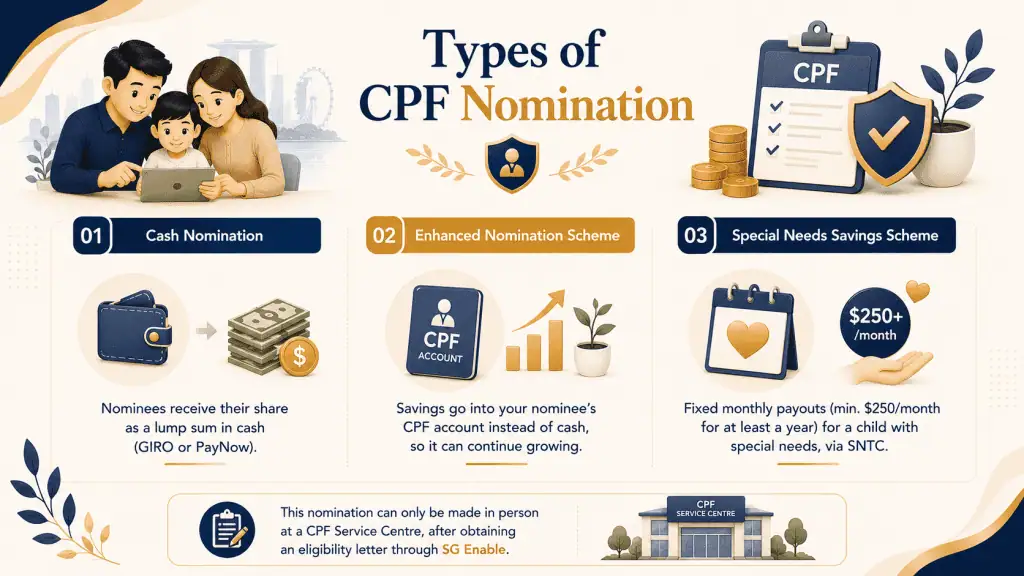
Most members default to a straightforward cash payout, but CPF Board offers two other schemes worth knowing about, especially if you’re planning for a child with special needs.
Cash Nomination
This is the standard option. Your nominees receive their share as a lump sum in cash, either by GIRO or PayNow, once the CPF Board processes your passing.
Enhanced Nomination Scheme
Under the Enhanced Nomination Scheme (ENS), your savings go into your nominee’s own CPF account instead of being paid out as cash. This lets the money continue growing within the CPF system rather than being withdrawn immediately.
Special Needs Savings Scheme
The Special Needs Savings Scheme (SNSS) lets parents of a child with special needs nominate them to receive fixed monthly payouts, rather than a single lump sum, administered together with the Special Needs Trust Company.
The minimum payout is $250 a month for at least a year, which can matter if the child isn’t in a position to manage a lump sum independently. This nomination can only be made in person at a CPF Service Centre, after obtaining an eligibility letter through SG Enable.
Also Read: What to Do When a Family Member Passes Away in Singapore
CPF Nomination and Your Will
A common misconception is that a will automatically covers CPF savings. It doesn’t. Since CPF monies sit outside your estate, naming a beneficiary for them in your will has no legal effect, your CPF nomination is the only instrument that controls where those savings go.
This is exactly why a CPF nomination and a will need to be planned together, particularly for blended families, business owners, or anyone with beneficiaries who have different needs, since gaps between the two can leave a spouse or child unintentionally excluded from one or the other.
How Marriage and Divorce Affect Your CPF Nomination
Getting married automatically revokes any CPF nomination you made beforehand, similar to how the Wills Act treats a will made before marriage. This is intentional. It gives you a chance to reconsider your nominees now that you have a new family nucleus, but it also means you could unknowingly have no nomination in place at all until you make a new one.
Divorce, on the other hand, does not revoke an existing nomination. If you divorce and never update it, an ex-spouse can still legally remain your nominee, which is why reviewing your nomination after any major life change, marriage, divorce, a new child, or the death of a nominee, is worth treating as a routine task rather than an afterthought.
How to Carry Out a CPF Nomination?
Online
| Items Needed | – Your SingPass with biometric verification for extra security. – Your nominees’ NRIC particulars (Name, NRIC No., Mailing address, Email address) – Two witnesses’ NRIC particulars (Name, NRIC No., Mailing address, Email and/or Singapore-registered Mobile Phone Number) Witnesses must be 21 years or older, have their own Singpass, and cannot be your nominees. |
| Action | Log in to my CPF Online Services using your Singpass to make an online nomination. – If you’re appointing more than 15 nominees, you’ll need to visit a CPF Service Centre instead. – If you’d like help completing the online form, officers at any ServiceSG Centre can assist you. |
| What’s Next | – Your 2 witnesses will be notified via SMS and/or email that they have to witness your nomination. – Both witnesses must log in to my CPF online services with their individual Sing Pass within 7 days to confirm your intent to nominate. – Once witnessing is complete, the CPF Board processes your nomination within 4 working days. – The CPF Board will notify you via SMS and/or email on the status of your nomination. |
In-Person at CPF Service Centres
| Items Needed | – Your IC/passport – Your nominees’ NRIC particulars (Name, NRIC No., Mailing address, Email address) |
| Action | – Book an appointment at least one working day before visiting a CPF service centre in-person because the counter services on premises are available by appointment only. – Complete your CPF Nomination in the presence of the Customer Service Executives (CSEs) stationed on premises. – They can act as your witnesses and clarify any questions you may have. – You do not have to bring along 2 witnesses. |
How to Check CPF Nomination Online and In Person
You can view your CPF nomination details yourself, either online with Singpass or in person at a CPF Service Centre. It is worth doing after any major life event such as marriage, divorce, or the birth of a child, since marriage revokes an existing nomination while divorce does not.
Check CPF Nomination Online Using my CPF Online Services
| Action | – Login with your SingPass. – Click on My Requests > Nomination Details > View My Nomination Details. |
| Things to Note | – If you are not able to view your nomination details, you can submit an online request via My Requests. – After your request has been processed, you will receive an email to inform you that you can view your nomination details online. – Requests will be processed within 4 working days. |
Check CPF Nomination at CPF Service Centres
| Action | – Please book an appointment at least one working day before visiting in-person because the counter services on premises are available by appointment only. – You should also bring your identity card/passport to any CPF Service Centres for identification purposes. |
| Things to Note | – Checking of nomination details is available from Monday to Friday only. – Because your nomination details are confidential, the CPF Board cannot reveal them through other channels such as phone, email, and third parties. – Nominations made more than 30 years ago cannot be viewed online. CPF Board recommends making a new nomination in that case so your nominees’ details are current. |
How to Check CPF Nomination Status
If you have just submitted an online nomination, you can check the status through your Singpass. CPF Board sends an email or SMS once your nomination is routed to your witnesses, and again once it has been processed, which generally takes four working days after both witnesses confirm. After that, you can view the full nomination details under My Requests as described above.
In a Nutshell:
CPF nominations moved fully digital in 2021, when the requirement to complete and sign a hard copy Form 6A(1) in front of two independent witnesses, then hand it in at a CPF service centre or post it, was removed. If you still prefer to sign a hard copy, this remains possible in person at a CPF Service Centre, where two CPF officers can act as your witnesses, though this is no longer necessary for most members.
What Happens If You Don’t Make a Nomination
Without a nomination, your CPF savings are transferred to the Public Trustee’s Office (PTO), which distributes them according to the Intestate Succession Act, or the Inheritance Certificate issued by the Syariah Court if you’re Muslim. Your family doesn’t get to choose who receives what; the law decides for them.
This process typically takes around six months from the time CPF Board notifies the PTO to when eligible beneficiaries are identified and paid, largely because the PTO needs supporting documents like birth and marriage certificates to verify each relationship.
The PTO also charges a tiered administrative fee, deducted directly from the CPF savings, with a minimum fee of $15. The fee decreases as the amount grows:
- 2.400% on the first $1,000
- 1.500% on the next $9,000
- 0.750% on the next $240,000
- 0.450% on the next $250,000
- 0.300% on anything above $500,000
The difference between having a nomination and not having one comes down to three things: who decides, how it’s handled, and how long it takes. With a nomination, you decide the recipients, CPF Board pays them directly at no cost, and it’s considerably faster since there’s no need to verify relationships.
Without one, the Intestate Succession Act or Inheritance Certificate decides on your family’s behalf, the Public Trustee’s Office handles distribution and deducts its fee, and the whole process typically stretches to around six months.
Also Read: How to Do a Name Change in Singapore Legally? Deed Poll Guide
Talk to Ng Pui Khim About Your CPF Nomination and Will
A CPF nomination is one of the easiest legal documents to overlook, precisely because it’s so quick to set up. But it rarely stands alone. Between your will, your CPF nomination, and your insurance policies, it’s easy for one to fall out of sync with the others, especially after a marriage, a divorce, a new child, or the passing of someone you’d nominated.
Getting your CPF nomination properly aligned with your will and the rest of your estate plan takes more than filling in a form once and forgetting about it.
Ng Pui Khim brings over 20 years of experience in wills and succession law, helping clients make sure their CPF nomination, will, and estate plan work together rather than against each other. Contact us to review your CPF nomination and will, or find out more about our will writing services, or call us at 6323 1261.
This article is jointly authored by Ng Pui Khim and Jonathan Fong and has been updated by the PKNG Editorial Team to reflect the latest CPF nomination rules
Frequently Asked Questions
How can I check my CPF nomination?
Log in to my CPF Online Services with your Singpass and go to My Requests > Nomination Details > View My Nomination Details. You can also visit a CPF Service Centre with your identity card or passport after booking an appointment. CPF Board cannot share nomination details over the phone or by email.
Does my will cover my CPF savings?
No. CPF savings don’t form part of your estate, so they can’t be distributed through a will. A CPF nomination is the only way to direct where they go.
What happens to my CPF nomination when I get married?
It’s automatically revoked. You’ll need to make a new nomination after the wedding if you want your CPF savings distributed according to your wishes.
Does divorce cancel my CPF nomination?
No. Unlike marriage, divorce doesn’t revoke an existing nomination, so an ex-spouse can remain your nominee unless you actively change it.
Can I nominate someone who isn’t a Singapore Citizen or PR?
Yes. You can nominate any person or eligible organisation, regardless of their citizenship or residency status.
What if I don’t make a CPF nomination?
Your savings go to the Public Trustee’s Office, which distributes them under the Intestate Succession Act or Inheritance Certificate, minus an administrative fee, and the process typically takes around six months.
Is it free to make or change a CPF nomination?
Yes. Making, updating, or replacing a CPF nomination costs nothing, and there’s no limit to how many times you can change it.
How do I know if I have made a CPF nomination?
View your nomination details through my CPF Online Services. If you cannot see any details, submit a request under My Requests, and CPF Board will process it within four working days.

The PKNG Editorial Team researches and maintains general Singapore legal information for iLawyer. Its work follows the site editorial policy and uses authoritative sources where available.
All rights reserved. Any information of a legal nature in this website is given in good faith and has been derived from resources believed to be reliable and accurate. The author of the information contained herein this website does not give any warranty or accept any responsibility arising in any way, including by reason of negligence for any errors or omissions herein. Readers should seek independent legal advice