

Table of Contents
- Custody vs Care and Control in Singapore
- Who decide a child’s upbringing & welfare?
- What Sole Care and Control Means
- Shared Care and Control in Singapore
- Care and Control and Taking the Child Overseas
- How the Court Decides Care and Control
- Common Mistakes Parents Make in Care and Control Applications
- Practical Questions to Think Through
- Applying for a Variation of a Care and Control Order
- What Happens If the Other Parent Breaches the Order
- Speak With a Divorce Lawyer About Care and Control
- Frequently Asked Questions
Navigating child arrangements during a divorce in Singapore can feel confusing, especially when “custody” and “care and control” get used interchangeably.
They are not the same thing. Custody covers who gets to make major, long-term decisions for a child, while care and control determines who the child lives with and who manages their day-to-day life.
Understanding this distinction, and how the Family Justice Courts decide it, is essential for protecting your child’s welfare and setting realistic expectations before you go into negotiations or a hearing.
Custody vs Care and Control in Singapore
Parents are often surprised to learn that a divorce can result in joint custody even when only one parent has care and control. Custody and care and control serve different purposes, and a court order will usually address both separately, along with access for the parent who does not have care and control.
| Term | What It Covers | Common Outcome in Singapore |
|---|---|---|
| Custody | Major, long-term decisions such as education, religion, and medical treatment | Usually joint, with both parents sharing this by default |
| Care and Control | Day-to-day decisions and where the child lives | Usually granted to one parent; shared arrangements remain less common |
| Access | Time the non-resident parent spends with the child | Granted to whichever parent does not have care and control |
Who decide a child’s upbringing & welfare?
A parent that has been granted with care and control of the child has the right to make daily decisions about a child’s upbringing and welfare. This right naturally belongs to the parent with whom the child lives.
In certain situations, the Court may find it suitable to grant shared care and control to both parents. In such a case, both parents have been granted with right of care and control over the child and no one parent has a superior right over the other parent.
What Sole Care and Control Means
Where the court grants one parent sole care and control, the other parent is usually granted access to the child. Access gives that parent the right to regular contact with the child, so the parent-child relationship can continue despite the divorce.
The court generally grants care and control of all the children in a family to the same parent, rather than splitting siblings between households. In deciding who should have custody or care and control, the child’s welfare is always the court’s first and paramount consideration under Section 125(2) of the Women’s Charter. Subject to that, the court will also have regard to:
- The wishes of the child’s parents.
- The wishes of the child, where the child is old enough to express an independent opinion.
Neither parent has an automatic advantage. The court’s approach, as reiterated in more recent Family Justice Courts decisions, is that a parent seeking sole care and control needs to show, with concrete and contemporaneous evidence rather than general statements, why they are better placed to attend to the child’s emotional, developmental, and material needs, and who has been the child’s primary caregiver.
Shared Care and Control in Singapore
Shared care and control has become more common in recent years, though it remains less frequent than sole arrangements.
Under a shared order, the child spends roughly equal time, including overnights, with each parent, and each parent makes day-to-day decisions while the child is in their care. In one High Court case, for example, the court ordered a schedule where the child stayed with the mother from Saturday evening to Wednesday late morning, and with the father for the rest of the week.
Courts are more willing to order shared care and control where parents can cooperate closely, live within a reasonable distance of each other, and can keep the child’s routine and schooling stable across both households.
Where the child is very young, or where the parents have a highly acrimonious relationship, courts have been reluctant to order shared care and control, on the basis that shuttling between two homes with conflicting parenting styles can add unnecessary stress to a child’s development.
| Factor | Sole Care and Control | Shared Care and Control |
|---|---|---|
| Where the child lives | Primarily with one parent | Split between both parents on an agreed schedule |
| Day-to-day decisions | Made by the parent with care and control | Made by whichever parent the child is with at the time |
| Best suited for | Parents who cannot cooperate closely, or where one parent has clearly been the main caregiver | Parents who communicate well, live close to each other, and can keep the child’s routine consistent |
| Court’s general view | The more common outcome in Singapore | Ordered only where the evidence shows it will not disrupt the child |
Care and Control and Taking the Child Overseas
The parent with care and control can take the child out of Singapore for less than a month without needing consent. Beyond that, or for a permanent move, they need the other parent’s written consent or the court’s permission. Doing it without consent is an offence under Section 126(5) of the Women’s Charter, with a fine of up to $5,000, jail of up to 12 months, or both.
Relocation is treated as a separate application from care and control, though the two are usually decided together. The court looks mainly at how settled the child is in Singapore, the family’s ties here versus the destination, and whether the child can still keep meaningful contact with the parent left behind.
Also Read: Mandatory Co-Parenting Programme (CPP) in Singapore
How the Court Decides Care and Control
When parents cannot agree on care and control, the Family Justice Courts apply a consistent framework built around the child’s welfare rather than either parent’s grievances. Here is how that plays out in practice.
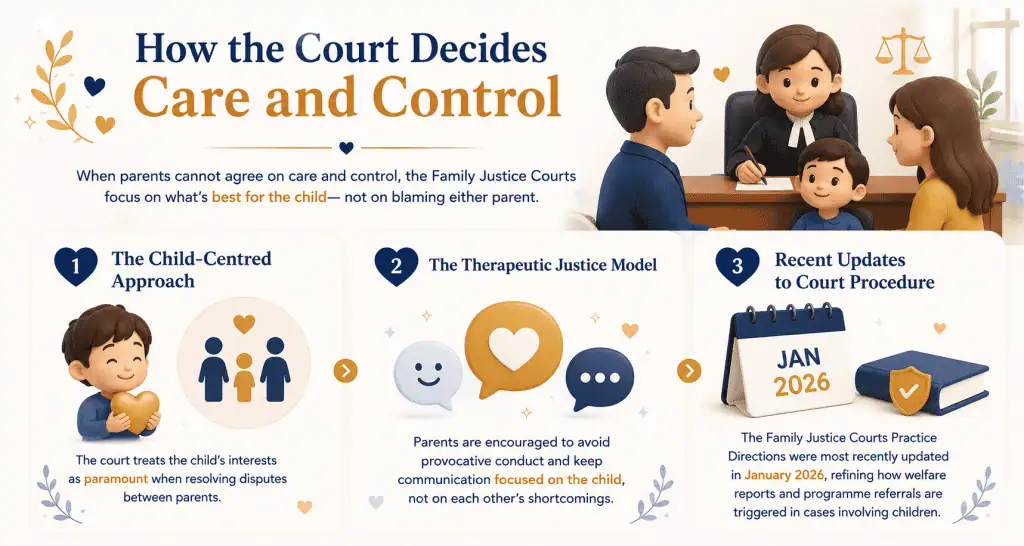
The Child-Centred Approach
The court treats the child’s interests as paramount when resolving disputes between divorcing parents. Focusing on the child’s needs, rather than each parent’s grievances, tends to reduce the intensity and duration of conflict and supports a healthier parent-child relationship after the divorce.
The Therapeutic Justice Model
This is reflected in the courts’ Therapeutic Justice Model, which asks parents to avoid provocative or inflammatory conduct in their court documents and correspondence, and to keep communication focused on the child rather than on the other parent’s shortcomings.
Recent Updates to Court Procedure
The Family Justice Courts Practice Directions were most recently updated in January 2026, refining how welfare reports and programme referrals are triggered in cases involving children.
Understanding this framework helps parents present their case in a way the court is more likely to respond to, rather than one built around blaming the other parent.
Common Mistakes Parents Make in Care and Control Applications
The court’s test is which parent can better meet the child’s needs, not which parent seems more sympathetic. A few habits tend to backfire.
- Attacking the other parent instead of showing your own caregiving involvement with concrete evidence.
- Relying on general statements like “I’m always there” instead of school, medical, or daily-care records.
- Assuming gender or income alone will decide the outcome.
- Proposing a care plan that doesn’t realistically fit your work hours or support system.
- Involving the child in the conflict, which courts view as working against the parent who does it.
Practical Questions to Think Through
Before applying for or negotiating a care arrangement, it helps to work through the same questions the court will effectively be asking.
- Who has been the primary or main caregiver for most of the child’s life?
- Which parent is the child closer to, and why?
- Which parent should the child live with day to day, bearing in mind this parent would hold care and control?
- If you would be the parent with care and control, will you need to adjust your work schedule, routines, or living arrangements to accommodate the child?
- If you would not have care and control, what access schedule realistically fits your work and living arrangements?
- If you have access, what frequency and duration would you want, including school holidays?
- If you have care and control, what access arrangement do you think is fair to propose to the other parent?
Applying for a Variation of a Care and Control Order
A care and control order is not fixed forever. Under Section 128 of the Women’s Charter, any interested person can apply to vary an existing order for custody or care and control at any time, whether or not the original order was made by consent.
The court will only grant a variation where it is satisfied that the original order was based on a misrepresentation or mistake of fact, or that there has been a material change in circumstances since the order was made.
Examples the courts have accepted include a parent’s health improving or worsening, a parent relocating, a significant change in a parent’s working hours, or evidence that a parent misrepresented their intentions when the original order was made.
The parent applying for the variation carries the burden of proving the change, and the court will only vary the order if doing so is in the child’s best interests. There is no limit to how many times an order can be varied.
What Happens If the Other Parent Breaches the Order
Since 2 January 2025, enforcement of child access orders has been strengthened under the Women’s Charter. If a parent with care and control repeatedly denies access without good reason, the court can order make-up access, expense reimbursement, mandatory counselling or mediation, or a performance bond, and as a last resort, a fine or jail term.
In serious cases where a parent has deliberately undermined the child’s bond with the other parent, the court can also switch care and control to that other parent.
Keep a clear record of missed or denied access before applying to court, since the burden is on you to show the pattern.
Also Read: Child Maintenance in Singapore: Guide, Laws & Calculation
Speak With a Divorce Lawyer About Care and Control
Care and control shapes your child’s daily life long after the divorce is finalised, so it is worth getting the arrangement right from the start rather than needing to vary it later.
Whether you are negotiating a consent order, preparing for a contested hearing, or considering whether shared care and control is realistic for your family, understanding how the court weighs your child’s welfare will help you build a stronger, more child-centred case.
Ng Pui Khim has over 20 years of experience advising parents on custody, care and control, and access matters in Singapore. If you are working through a care and control arrangement, contact us or find out more about engaging a divorce lawyer.
Frequently Asked Questions
Can a father get sole care and control in Singapore
Yes. The court does not favour either parent by default. The test is the child’s welfare under Section 125(2) of the Women’s Charter, not the parent’s gender, though for very young children the courts may still weigh the mother’s caregiving role as one of several factors.
What happens if the parent with care and control wants to relocate
The parent generally needs the other parent’s written consent, or a court order, before relocating with the child overseas. Relocation is treated as a separate application from care and control, and the court will weigh the family’s ties to Singapore, how settled the child is, and the impact on the other parent’s access.
Can a care and control order be changed after the divorce is final
Yes. Either parent can apply to vary the order under Section 128 of the Women’s Charter if there has been a material change in circumstances, or a mistake or misrepresentation in the original order. See the variation section above for what counts as a material change.

Ng Pui Khim is a senior lawyer with over 20 years of private practice experience focusing on divorces (family and matrimonial law), real estate (conveyancing practice), wills and succession law.
All rights reserved. Any information of a legal nature in this website is given in good faith and has been derived from resources believed to be reliable and accurate. The author of the information contained herein this website does not give any warranty or accept any responsibility arising in any way, including by reason of negligence for any errors or omissions herein. Readers should seek independent legal advice