

Table of Contents
Filing for divorce can be a stressful process and may not be as simple as you think.
Hence, we always recommend that you seek a competent and experienced divorce lawyer to aid you through the entire divorce procedure.
Even if both parties mutually consent to the divorce, there are several requirements that need to be met before one can establish grounds for divorce under Singapore laws. The parties must be married for more than 3 years before the divorce can be filed.
Establishing Reasons & Grounds for Divorce
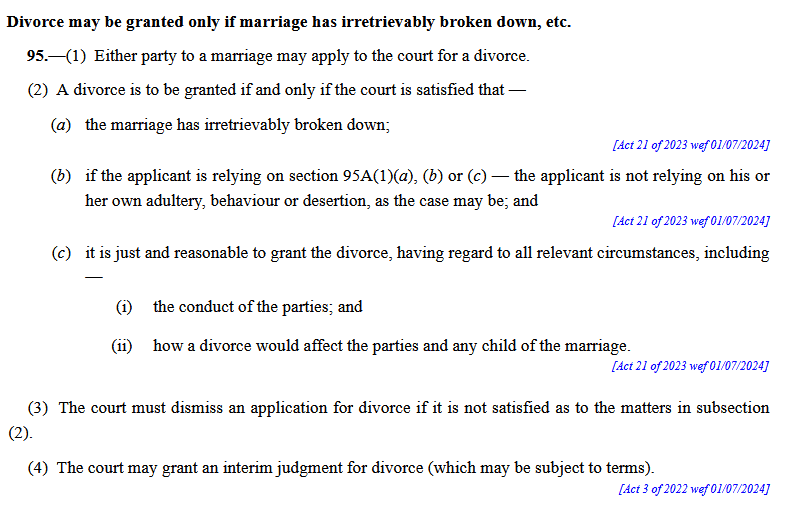
The only legal grounds for divorce is that of which ‘the marriage has irretrievably broken down’.
However, in order to prove to the court that this is indeed true, you must be able to prove one of six scenarios that have been set out in Section 95A of the Women’s Charter.
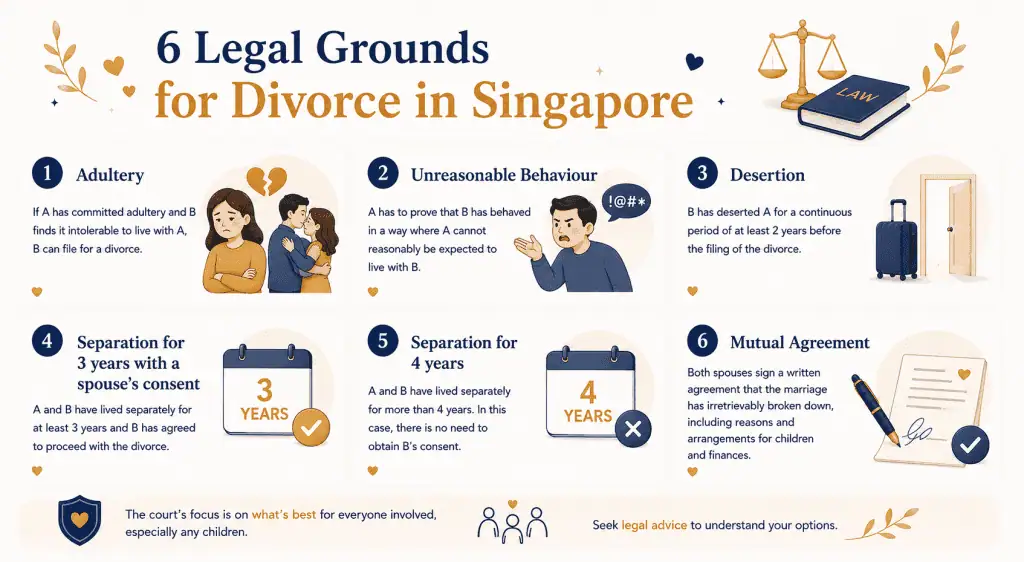
The 6 scenarios are:
- Adultery
- Unreasonable Behaviour
- Desertion
- Separation for 3 years with a spouse’s consent
- Separation for 4 years
- Mutual Agreement
What do these actually mean? Let’s get into the details.
Also Read: How Matrimonial Assets Are Divided in a Singapore Divorce
6 Legal Grounds for Divorce in Singapore
1. Adultery
If A has committed adultery and B finds it intolerable to live with A, B can file for a divorce. What is considered adultery?
B must prove that A has had sexual intercourse with the third party in order for adultery to be established. Any degree of physical intimacy lesser than sexual intercourse with a third party will not be considered as adultery.
In addition, B has to file for a divorce within 6 months of finding out about the adultery. The main challenge will be to prove adultery since A is unlikely to confess to committing adultery in Court.
B will be able to prove adultery has occurred as long as there is a written confession from A, or by producing a private investigator’s report proving that adultery is likely to have occurred.
2. Unreasonable Behaviour
A has to prove that B has behaved in a way where A cannot reasonably be expected to live with B. It is interesting to note that, ‘Unreasonable Behaviour‘ has a very vague meaning and may be subjective.
Unreasonable behaviour may be found in situations where there is domestic violence.In situations where there is a list of seemingly less serious and non-aggressive behaviour, but when considered cumulatively, it is possible to prove unreasonable behaviour has occurred.
We recommend that you consult with an experienced divorce lawyer who can give you proper legal advice for what would consider being “unreasonable behaviour” in the eyes of the law.
Some examples of unreasonable behaviour may include:
- Physical violence directed at your spouse
- Infidelity
- Verbal and emotional abuse directed at your spouse
- Drug addiction
- Compulsive gambling habit
- Emotional neglect
- Financial irresponsibility
If B cheats on A and A files the divorce based on the act of unreasonable behaviour, A does not need to obtain the confession of B admitting to unreasonable behaviour.
There is no need for A to engage the services of a private investigator to prove that unreasonable behaviour has occurred.
Generally, cases of divorce whereby the spouse has been unfaithful, the party filing for divorce would choose to file under the act of unreasonable behaviour, rather than adultery.
3. Desertion
B has deserted A for a continuous period of at least 2 years before the filing of the divorce.It is important to show that B had intended to bring the marriage to a permanent end by deserting A and having no intention of returning.
4. Separation for 3 years with a spouse’s consent
A has to prove that A and B have lived separately for a continuous period of at least 3 years and B has agreed to proceed with the divorce.The separation in terms of living apart has to be based on choice and not of necessity.
For example, if B is out-stationed overseas for work or B is serving a prison sentence during this period, it may not be considered as separation as there is no intention to separate.A deed of separation can also be used to show evidence of intention to live separately.
It is also possible to prove separation even in cases whereby A and B live in the same house. In such a scenario, there must be a loss of consortium and a breakdown of the marriage between A and B.Both A and B must maintain separate households by not performing typical spousal duties for each other (i.e. cooking, sharing meals together, doing each other’s laundry, caring for each other).
5. Separation for 4 years
A and B have lived separately for more than 4 years. The criteria of separate living are similar to separation for 3 years except that in this case, there is no need to obtain B’s consent for the divorce.
6. Mutual Agreement
Divorce by Mutual Agreement (DMA) has been available since 1 July 2024 as the sixth fact under the Women’s Charter, giving couples a way to divorce without blaming either party.
To rely on DMA, both spouses must sign a written agreement stating that the marriage has irretrievably broken down, which must include the reasons for the breakdown, the efforts made to reconcile, and how children and finances will be arranged. Common accepted reasons include irreconcilable differences in values or culture, and prolonged lack of intimacy.
The 3-year marriage bar still applies to DMA. If there are children under 21, both parties must also complete the Mandatory Co-Parenting Programme before filing. The court can reject a DMA application, and direct parties to counselling instead, if it believes there is a reasonable possibility of reconciliation.
Can You Divorce Before 3 Years of Marriage
Section 94 of the Women’s Charter bars divorce filings within the first 3 years of marriage, with one narrow exception: showing that you have suffered exceptional hardship, or that your spouse engaged in exceptional depravity.
The threshold is high. In the leading case of Ng Kee Shee v Fu Gaofei, the court granted leave partly because the wife left the marriage within months and refused any prospect of reconciliation. Ordinary marital problems, including isolated incidents of adultery or physical abuse, generally will not meet this bar on their own.
If you don’t meet this threshold and still want to formally separate before the 3-year mark, Judicial Separation is an alternative, though it does not end the marriage itself.
What Happens After You Establish Your Grounds
Once you can show one of the 6 facts, your case proceeds on either the simplified or the normal track. If you and your spouse agree on the divorce and the ancillary matters (children’s arrangements, maintenance, and division of assets), your case goes on the simplified track, which typically takes around 4 months. If you disagree on either, it proceeds on the normal track, which can take 12 to 18 months or longer.
Either way, the court first grants an Interim Judgment dissolving the marriage. The Final Judgment, which fully ends the marriage, can only be extracted at least 3 months after the Interim Judgment, once ancillary matters are settled. You can find the full filing process on the Family Justice Courts’ website.
Why You Should Engage an Experienced Divorce Lawyer
Choosing the wrong ground, or filing before you’re eligible to, can delay your case by months. An experienced lawyer helps you avoid this, and other costly missteps, by handling the details that most people don’t know to look out for.
- Picking the right fact. A lawyer helps you choose the ground most likely to succeed and be least contested, based on your actual circumstances.
- Gathering the right evidence. From written confessions to documentation of unreasonable behaviour, a lawyer knows what the court will and won’t accept.
- Avoiding delays from paperwork errors. Incomplete or incorrectly filed documents are one of the most common reasons divorce cases drag out.
- Navigating ancillary matters. Custody, maintenance, and division of assets are often more contentious than the divorce itself, and benefit from experienced negotiation.
- Keeping costs predictable. For uncontested cases, a lawyer can work within a fixed fee, so you know the cost upfront.
Also Read: Care and Control of Children in Singapore: a Legal Guide
Speak With an Experienced Divorce Lawyer Today
Every divorce is different, and the ground that works best for one couple may not be the right fit for another. What looks straightforward on paper, like a clear case of adultery or a long separation, can still run into complications once evidence, timelines, or an uncooperative spouse enter the picture.
Getting the right ground and process sorted from the start helps you avoid delays, keeps your case moving smoothly through the court, and puts you in a stronger position when it comes to negotiating the ancillary matters that often matter more in the long run.
Ng Pui Khim has over 20 years of experience advising clients on divorce grounds and procedure in Singapore, and can help you work out which fact best fits your situation before you file. If your case is uncontested, view our fixed-fee divorce packages, or contact us to discuss your situation.
Frequently Asked Questions
Can I cite more than one fact for my divorce
Yes. You’re not limited to just one of the 6 facts. If more than one applies to your situation, such as unreasonable behaviour alongside a period of separation, you can rely on multiple facts in the same application to strengthen your case.
What happens if my spouse disagrees with the ground I’ve cited
Your case becomes a contested divorce. You’ll need to present evidence to the court to prove the fact you’re relying on, and a judge will decide whether it’s been established. Contested divorces take significantly longer than uncontested ones, typically 12 to 18 months or more.
Which ground for divorce is most commonly used in Singapore
According to the Singapore Department of Statistics, unreasonable behaviour is consistently the most commonly cited fact in civil divorces, followed by 3-year separation with consent. Adultery, desertion, and 4-year separation are cited far less often, largely because they’re harder to prove or require a longer wait.
Can foreigners file for divorce in Singapore
Yes, provided the residency requirement is met. Either you or your spouse must be domiciled in Singapore, or have lived here continuously for at least 3 years before filing, regardless of nationality or where the marriage took place.
Does a brief reconciliation reset my separation period
Not necessarily. Courts generally allow couples relying on the 3-year or 4-year separation facts to attempt reconciliation for up to 6 months without resetting the clock, as long as they resume living apart afterward.

Ng Pui Khim is a senior lawyer with over 20 years of private practice experience focusing on divorces (family and matrimonial law), real estate (conveyancing practice), wills and succession law.
All rights reserved. Any information of a legal nature in this website is given in good faith and has been derived from resources believed to be reliable and accurate. The author of the information contained herein this website does not give any warranty or accept any responsibility arising in any way, including by reason of negligence for any errors or omissions herein. Readers should seek independent legal advice