

Table of Contents
- What is the Mandatory Co-Parenting Programme?
- How to Register for CPP
- How to Apply for the Mandatory Co-Parenting Programme
- Cost and Certificate Validity
- Why Co-Parenting Doesn’t End When the Marriage Does
- Who Must Attend, and Who’s Excluded
- Can I skip the Mandatory Co-Parenting Programme?
- Can a Lawyer Attend on Your Behalf
- CPP and Your Divorce Filing
- Ready to Take the Next Step with Professional Divorce Lawyer
- Frequently Asked Questions
If you are planning to file for divorce in Singapore and have at least one child below the age of 21, you may be required to complete the Mandatory Co-Parenting Programme (CPP) before commencing divorce proceedings.
In this guide, we explain who needs to attend the Mandatory Co-Parenting Programme, how the programme works, how to register, what to expect during the consultation, and what happens if you do not complete the CPP before filing for divorce.
What is the Mandatory Co-Parenting Programme?
The Mandatory Co-Parenting Programme (CPP) is a compulsory pre-divorce programme introduced by Singapore’s Ministry of Social and Family Development (MSF) for married parents with at least one child below the age of 21.
Before filing for divorce, eligible parents must complete the CPP. The programme helps parents understand how divorce may affect their children and encourages them to make informed decisions about parenting arrangements, housing, finances, and their children’s long-term well-being after the marriage ends.
Upon successful completion, participants will receive a Certificate of Completion, which must be submitted when filing for divorce. Without a valid certificate, an eligible applicant cannot commence divorce proceedings.
| CPP at a Glance | Details |
|---|---|
| Cost | Free |
| Structure | E-learning + counsellor consultation |
| Time required | ~1.5 hours e-learning, plus 1 to 3 sessions |
| Certificate validity | 2 years from date of issue |
| Languages | English, Mandarin; Tamil or others on request |
| Who must attend | Parents with children below 21 filing for divorce |
Ministry of Social and Family Development (MSF) reports that more than 90% of parents who complete CPP say they came away better informed about how divorce affects both themselves and their children. That’s the underlying intent, helping you make decisions with your children’s interests at the centre, rather than defaulting to conflict.
How to Register for CPP
Registration follows a straightforward sequence, and you won’t need to prepare any documents beforehand.
- Check if you’re required to attend. Start with the CPP questionnaire on the Family Assist portal to confirm whether CPP applies to your situation.
- Log in with Singpass and complete the e-learning. This is Part 1, and it’s done individually.
- Get routed to the booking platform. Once you finish the e-learning, you’ll be directed here to book your consultation. Note that available slots typically only open up 3 days after you first log in to the booking platform, so it’s worth planning ahead if you’re working against a filing deadline.
- Choose a FAM@FSC centre and book your session. This is Part 2, attended alone or with your spouse.
- Need an earlier slot? If you’re working against a deadline, for example to meet a cross-application timeline, contact FAM@FSC directly rather than waiting out the standard booking window.
How to Apply for the Mandatory Co-Parenting Programme
CPP has two parts, and you’ll go through them in sequence.
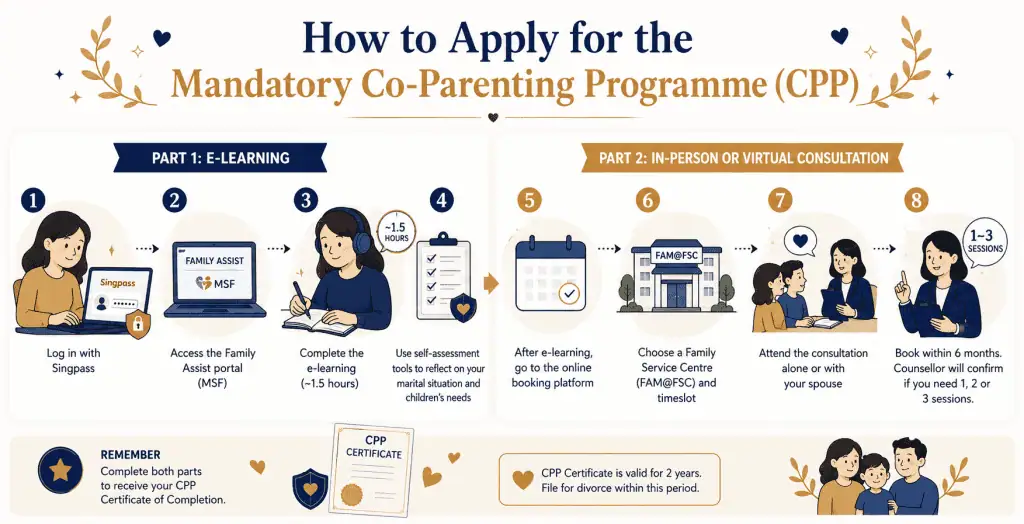
Part 1: E-Learning
You complete this on your own, logging in with Singpass on the Family Assist portal run by the Ministry of Social and Family Development. It takes about 1.5 hours and includes self-assessment tools to help you think through your marital situation and your children’s needs.
Part 2: In-Person or Virtual Consultation
Once you’ve finished the e-learning, you’ll be directed to an online booking platform to choose a Family Service Centre (FAM@FSC) and timeslot. You can attend alone or with your spouse. Most parents are expected to book this consultation within six months of finishing the e-learning, and the counsellor will confirm after your first session whether you need one, two, or three sessions in total.
| Key Difference | E-Learning | Consultation |
|---|---|---|
| Format | Self-paced, online | With a counsellor, in-person or virtual |
| Where | Family Assist portal (Singpass login) | FAM@FSC centre, booked after e-learning |
| Time | ~1.5 hours | 1 to 3 sessions |
Cost and Certificate Validity
This programme is free of charge, both the e-learning and the consultation.
Once you’ve completed the required session(s), you’ll receive a Certificate of Completion. A few things to know about it:
- You’ll need to hand this certificate over to the lawyer filing your divorce.
- It’s valid for 2 years from the date it’s issued.
- If you don’t file for divorce within that 2-year window, you’ll need to redo the CPP before you can proceed.
Also Read: What is Care and Control?
Why Co-Parenting Doesn’t End When the Marriage Does
The Purpose Behind Co-Parenting Requirements
Co-parenting refers to how separated parents share responsibility for raising their children. Even once the divorce is finalised, both parents still carry that responsibility until their children reach adulthood, this doesn’t stop at the courtroom door.
A study by the Ministry of Social and Family Development found that a cooperative co-parenting style is linked to better outcomes for children, including:
- Fewer behavioural and emotional problems compared to children of less cooperative co-parents
- Better adjustment to changes in living arrangements and routines
- Stronger relationships with both parents post-divorce
What the Programme Aims to Achieve
CPP is designed to better protect children affected by their parents’ divorce. Specifically, it helps parents by:
- Guiding decisions on living arrangements, so children have stability on where and how they’ll live
- Addressing the financial and housing implications of divorce that directly affect the children
- Raising awareness of how the divorce process affects children emotionally and practically, not just logistically
- Equipping parents with practical co-parenting skills to reduce ongoing conflict after the divorce is finalised
Who Must Attend, and Who’s Excluded
If you’re the applicant starting the divorce and have a child under 21, you cannot file without completing CPP, even if you and your spouse agree on every term. If you’re the respondent and don’t attend the consultation, you won’t be able to make a cross-application.
Exclusions are narrow. A few points worth knowing:
- Mental incapacity — exclusion only applies if you’ve been legally assessed as lacking the mental capacity to make decisions, for example, being unable to understand, retain, evaluate, or communicate relevant information. This needs to be backed by proper documentation, and the exclusion application is submitted through MSF.
- Court-ordered exemption — in certain situations, such as cases involving domestic violence or abuse, the court may allow the divorce process to proceed without CPP to avoid delays. Each application is assessed on a case-by-case basis, with the family’s and children’s welfare as the primary consideration.
- CPP doesn’t apply to Muslim marriages. Parents in a Muslim marriage with children under 21 instead attend counselling through the Syariah Court’s Marriage Counselling Programme (MCP) before filing.
- Overseas parents aren’t exempt, but arrangements can be made. Contact FAM@FSC directly, and they can arrange for your consultation to be conducted virtually.
Can I skip the Mandatory Co-Parenting Programme?
If you are the applicant who wants to start the divorce, and you have child/children under 21, you will not be able to file the divorce if you do not attend the programme. This programme is compulsory even if you and your spouse agree to all the terms of the divorce.
If you are the applicant’s spouse and you do not attend the consultation, you will not be able to make a cross-application during the divorce.
Can a Lawyer Attend on Your Behalf
No, you must personally attend CPP yourself, this can’t be delegated to your lawyer. That said, engaging a lawyer early still helps: they can guide you through registration and make sure your CPP timeline lines up with the rest of your filing, so completing the programme doesn’t end up delaying your divorce.
CPP and Your Divorce Filing
Whether you’re on the Simplified or Non-Simplified divorce track, CPP applies the same way if you have children under 21, and your certificate gets submitted alongside your other filing documents either way. For a full breakdown of what each track involves, see our divorce procedure guide.
Also Read: Child Maintenance in Singapore: Guide, Laws & Calculation
Ready to Take the Next Step with Professional Divorce Lawyer
CPP can feel like one more hurdle in an already difficult process, but it exists to make the rest of your divorce, especially the parts involving your children, easier to navigate. Knowing the two stages, the certificate timeline, and where the exclusions genuinely apply means you won’t be caught off guard when it’s time to file.
Every divorce comes with its own complications, and CPP is just one piece of the puzzle. If you want an experienced hand guiding you through the rest, from your parenting plan to the court documents, Ng Pui Khim has over 20 years handling divorce, custody, and family law matters in Singapore. Contact us for a conversation about your situation.
Frequently Asked Questions
Can I attend CPP before I’ve fully decided to divorce?
Yes. While CPP is typically attended once divorce proceedings are already underway, some couples choose to complete it earlier to get a clearer picture of co-parenting strategies before making a final decision. It’s worth confirming your eligibility and timing directly with FAM@FSC if you want to start early.
Do both parents need to complete the e-learning separately?
Yes. The e-learning module is completed individually by each parent, even if you and your spouse later choose to attend the consultation session together.
Does CPP apply if I only have one child under 21?
Yes. The requirement applies to any parent with at least one child below 21, it doesn’t matter if you have one or several.
How soon after my final session do I receive the certificate?
Processing time can vary by centre. Your counsellor will usually be able to confirm this during your last session, so it’s worth asking directly before you leave.
Can I request an interpreter if I’m not comfortable in English or Mandarin?
Yes. While the e-learning itself is only available in English and Mandarin, you can request assistance in Tamil or other languages by contacting a FAM centre directly.

Ng Pui Khim is a senior lawyer with over 20 years of private practice experience focusing on divorces (family and matrimonial law), real estate (conveyancing practice), wills and succession law.
All rights reserved. Any information of a legal nature in this website is given in good faith and has been derived from resources believed to be reliable and accurate. The author of the information contained herein this website does not give any warranty or accept any responsibility arising in any way, including by reason of negligence for any errors or omissions herein. Readers should seek independent legal advice