

A communication breakdown in marriage often feels like you’re living with a stranger — conversations turn transactional, or stop almost entirely.
According to the Singapore Department of Statistics, marital dissolutions rose to 7,382 in 2024, up 3.7% from the year before, with couples married 5 to 9 years accounting for the largest share at 29%. Communication problems are consistently named among the leading contributors to this kind of marital breakdown.
While that’s a sobering backdrop, identifying the root cause of a breakdown is usually the first step toward either reconciliation or a clear-headed legal decision. Below, we explore the 11 most common reasons communication fails in a marriage, how to start fixing it, and when it may start to carry legal weight.
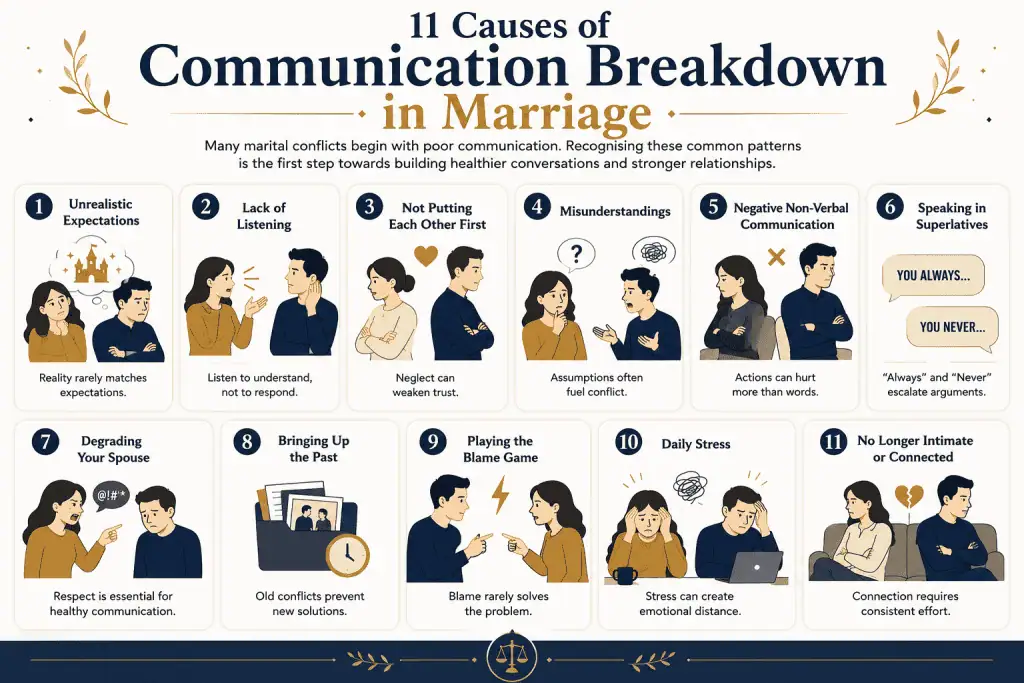
11 Causes of Communication Breakdown in Marriage
Marriage is a union between two people and communication is essential to ensure that it remains strong. Unfortunately, even the most loving marriages can suffer from communication breakdowns, resulting in an unhappy marriage. Here are several causes of communication breakdown in marriage:
1. Unrealistic Expectations
With fairy tale-like romance often portrayed through movies, books and the media these days, it is inevitable for couples to accumulate unrealistic expectations about love and marriage. Having these expectations unmet over time can put a strain on the relationship and lead to feelings of disappointment, frustration and unhappiness.
2. Lack of Listening
Not taking the time to listen closely to one another is a common occurrence in most marriages. Oftentimes, individuals want to be heard more than they want to listen. When this problem persists over time, both partners may begin to feel unheard or as if their opinions don’t matter, resulting in them not wanting to engage in future conversations.
3. Not putting each other first
When one partner doesn’t prioritize their spouse’s needs over their own, it can breed feelings of neglect and insecurity. This can often lead to more frequent fights between the couple as they each try to get what they want out of the relationship. The lack of trust that results from not putting your partner first can also cause power struggles within the marriage.
4. Misunderstandings
Conflict arises when one partner fails to understand their counterpart’s feelings or perspective. Failing to recognize how their words or actions will be interpreted by each other often leads to arguments and animosity that prevent any meaningful dialogue from taking place.
5. Negative non-verbal communication
Non-verbal communication, such as body language, facial expressions, and tones of voice, can convey emotions more strongly than words. When couples communicate in a negative way without saying anything, it is easy for misunderstandings to arise.
Additionally, turning away from each other while talking or avoiding physical contact are forms of silent rejection that could lead to mistrust between partners over time.
6. Speaking in superlatives
Speaking in superlatives is when an individual makes exaggerated statements or opinions while trying to make a point – you always, you never. When someone speaks in superlatives, they are essentially creating an unrealistic view of their partner’s actions or behaviors. They are also invalidating their feelings by making one-sided judgments about them without taking into account their own feelings or opinions, which can be harmful to their marriage.
7. Degrading your spouse
Sarcasm, name-calling, criticism and humiliation – it is no surprise that such degrading behaviors can be damaging for a marriage. Not only does it erode trust, but it also serves as a reminder of how little regard one has for their partner’s feelings or needs.
This lack of respect can lead to reduced communication between partners as they may become afraid to express themselves openly out of fear that what they say will be dismissed or ridiculed.
8. Bringing up the past
Keeping scores and dredging up the past can lead to intense arguments and tension that could potentially damage a relationship. People may do this out of habit, as a way of trying to defend themselves against perceived criticism, or simply because they want an apology. However, doing so can be extremely damaging to their marriage.
9. Playing the blame game
When partners look for someone else to take responsibility for their problems and issues, they are avoiding addressing the real issue at hand. Such a behavior perpetuates an unhealthy dynamic wherein both parties are unwilling to take ownership of their issues and instead point fingers at each other when things go wrong, which can result in serious disconnection in the marriage if left unresolved.
10. Daily stress
When individuals are feeling overwhelmed by life’s stresses, they tend to withdraw from their partner both physically and emotionally. This lack of connection fosters tension in the relationship and a breakdown in communication, and may also lead to conflict and resentment.
11. No longer intimate or connected
Lack of intimacy in marriage is a major problem which can have many negative repercussions on the relationship. Intimacy is an essential aspect of any marriage, as it allows couples to bond and build trust between each other. Without intimacy, marriages may become strained and distant, eroding the quality of the couple’s connection.
Although lack of intimacy between a married couple is often the root cause of tension in their marriage, this problem gets swept under the carpet without being ever resolved, due to parties’ reluctance to talk about it.
Also Read: How to Cope with Divorce
5 Steps to Rebuild Communication Before Giving Up
- Name the pattern, not just the problem. Instead of relitigating the last argument, try to identify which of the patterns above shows up most often in your relationship. Naming it takes the heat out of it and makes it easier to address.
- Set a regular, low-stakes time to talk. A 15-minute daily check-in — away from phones, work, and the kids — gives both partners a predictable space to be heard, rather than only talking when something has already gone wrong.
- Swap “you” statements for “I” statements. “You never help out” tends to trigger defensiveness. “I feel overwhelmed managing this alone” opens the door to a conversation instead of an argument.
- Address daily stress as a shared problem, not a personal failing. If work, finances, or digital burnout are driving the withdrawal, tackle the stressor together rather than letting it quietly erode the relationship.
- Bring in a neutral third party early, not as a last resort. Marriage counselling — through a private therapist or MSF’s FAM@FSC family service centres — works best before resentment has fully set in, not after months or years of silence.
Legal Perspective: When Does Communication Breakdown Become a Legal Issue?
Not every rough patch is a legal matter, and most communication breakdowns are repairable with effort and, often, professional support.
But where the breakdown is severe, prolonged, or accompanied by patterns like the ones above, persistent criticism, emotional withdrawal, or hostility, it can become relevant if a divorce is later filed on the ground of unreasonable behaviour under Singapore’s Women’s Charter.
The legal test isn’t about who’s “right” in an argument; it’s whether the affected spouse can reasonably be expected to continue living with the other party’s behaviour. For more on how communication issues intersect with the legal grounds for divorce, see our guide on signs of an unhappy marriage.
Also Read: 10 Secrets You Wish Knew Before Your Divorce
Considering Your Next Step? Talk to Us in Confidence
Communication breakdown doesn’t always mean a marriage is over, many couples work through it with time, effort, and the right support. But if you’ve reached a point where reconciliation feels out of reach, or you simply want to understand your legal options before deciding anything, it helps to speak with someone who can give you clear, judgment-free guidance.
Ng Pui Khim has over 20 years of experience advising couples in Singapore through exactly this kind of decision, whether that means understanding what unreasonable behaviour looks like in the eyes of the law, or simply knowing where you stand before you decide what’s next. Contact us here!
Frequently Asked Questions
Can communication breakdown be used as grounds for divorce in Singapore?
On its own, communication breakdown isn’t a standalone legal ground — but persistent, serious communication problems can form part of a case for divorce on the ground of unreasonable behaviour, particularly where they involve hostility, neglect, or emotional harm.
What’s the difference between a rough patch and a total communication breakdown?
A rough patch usually involves specific, identifiable disagreements that both partners are still willing to work through. A total communication breakdown tends to be characterised by sustained silence, withdrawal, or hostility where neither partner feels able, or willing to engage constructively at all.
Should we try marriage counselling before seeing a divorce lawyer?
For most couples, yes, counselling is worth exploring first, especially if both partners are still willing to put in the effort. That said, speaking to a divorce lawyer doesn’t commit you to divorce; it simply gives you clarity on where you legally stand, which can be useful information whichever path you choose.

The PKNG Editorial Team researches and maintains general Singapore legal information for iLawyer. Its work follows the site editorial policy and uses authoritative sources where available.
All rights reserved. Any information of a legal nature in this website is given in good faith and has been derived from resources believed to be reliable and accurate. The author of the information contained herein this website does not give any warranty or accept any responsibility arising in any way, including by reason of negligence for any errors or omissions herein. Readers should seek independent legal advice