

Table of Contents
- You Signed the Papers, But Are You Legally Divorced Yet
- Marriage Revokes a Will But Divorce Does Not
- What Happens If You Don’t Update Your Will After Divorce
- What Happens If You Die Without a Will at All
- Does Divorce Affect a Lasting Power of Attorney
- Your CPF Nomination Works the Same Way
- How to Properly Update or Revoke Your Will
- When Should You Update Your Will During the Divorce Process
- Steps to Take After Your Divorce
- Talk to Ng Pui Khim About Your Will and Divorce
- Frequently Asked Questions
No, a divorce does not automatically revoke a will in Singapore. Unlike marriage, which cancels any previous will under the Wills Act 1838, your existing will remains fully valid after a divorce. This is not the only document affected either.
Your CPF nomination and Lasting Power of Attorney follow similar rules, which means your ex-spouse could still hold legal authority over your money, your property, and even your medical decisions long after your marriage has ended, unless you take the step of updating each of these yourself.
You Signed the Papers, But Are You Legally Divorced Yet
Not quite. Filing for divorce, and even having both parties agree, does not make you legally divorced right away. Singapore’s divorce process happens in two stages, and your marital status for legal purposes, including your will, depends on which stage you’re at.
- Interim Judgment: the court has agreed your marriage has broken down, but you are still legally married at this point.
- Final Judgment: this is the point your divorce is actually complete, usually issued a few months after the Interim Judgment once ancillary matters like assets and custody are settled.
This distinction matters a great deal for wills and inheritance. If you pass away after the Interim Judgment but before the Final Judgment, you are still considered legally married in the eyes of the law. That means your spouse still holds the rights of a spouse, not an ex-spouse, under both your will and the Intestate Succession Act, even if you both already agreed the marriage is over.
Marriage Revokes a Will But Divorce Does Not
This is the point that trips most people up, so it helps to see it side by side.
| Life Event | Effect on Your Existing Will |
|---|---|
| Marriage | Automatically revoked, unless the will was expressly made in contemplation of that marriage |
| Divorce (Interim Judgment) | No effect, your will remains fully valid |
| Divorce (Final Judgment) | No effect, your will remains fully valid |
| Remarriage after divorce | Automatically revoked, the same as any first marriage |
Under Section 13 of the Wills Act 1838, getting married cancels any will you made before that marriage, unless the will specifically states it was made in contemplation of the marriage. There is no equivalent provision for divorce anywhere in the Act. The law simply assumes that if you want to change your beneficiaries after a split, updating the will is a decision only you can take, on your own initiative.
What Happens If You Don’t Update Your Will After Divorce
If you pass away after your Final Judgment without having reviewed your will, a few things can happen that most people don’t expect.
- Your ex-spouse may still receive the share of your estate you left them, even years after the marriage ended, exactly as written in the original will.
- Your ex-spouse may still have the legal authority to manage your bank accounts, property, and investments as executor, which gives them significant control over your estate’s administration.
- If you had named your ex-spouse as guardian for your children in the will, that appointment technically still stands on paper, though it is usually overtaken in practice by whatever custody and care and control arrangements were ordered in your divorce.
What Happens If You Die Without a Will at All
If you never made a will and pass away while still legally married, meaning before your Final Judgment, the Intestate Succession Act decides how your estate is split, and it does not distinguish between a happy marriage and one that is ending.
- If you have a spouse and children, your spouse receives half your estate, and your children share the other half.
- If you have a spouse and no children, your spouse receives half your estate, and your parents share the other half.
It is only once the Final Judgment is issued that your former spouse loses these intestacy rights entirely. Before that point, they are treated exactly like any other spouse under the law, regardless of how far along your divorce proceedings are.
Also Read: 6 Legal Grounds for Divorce in Singapore: How to Prove Them
Does Divorce Affect a Lasting Power of Attorney
A Lasting Power of Attorney, or LPA, is easy to overlook during a divorce because it only matters if you lose mental capacity while you’re alive, unlike a will which only takes effect after death.
If you appointed your spouse as your donee, meaning the person authorised to make financial or personal welfare decisions on your behalf, that appointment does not automatically end just because you divorce.
Under the Mental Capacity Act, the dissolution of a marriage does not by itself void the donee’s powers unless the LPA document specifically says it should.
This means your ex-spouse could still end up managing your bank accounts, property, or medical decisions if you were to lose capacity, even after your divorce is finalised. Since this involves decisions made while you’re still alive, many people consider it even more pressing than updating a will.
To revoke it, you need to submit a Revocation of LPA form to the Office of the Public Guardian, notify your donee in writing, and pay a small cancellation fee. This is worth doing as soon as you’re no longer comfortable with your ex-spouse holding this authority, rather than waiting for your Final Judgment.
Your CPF Nomination Works the Same Way
Many people update their will after a divorce and assume their CPF savings are covered too. They are not. CPF nominations are treated separately from a will, but they follow the exact same revocation rule as wills do: marriage cancels an existing nomination, and divorce does not.
The CPF Board has confirmed this directly, and it applies regardless of what your will says. If you want your ex-spouse removed as a CPF nominee, you need to log in and submit a new nomination through CPF’s own online service, since a new will alone will not change it.
How to Properly Update or Revoke Your Will
Deciding you want your ex-spouse removed from your will is only the first step. The change has to be made in a legally valid way, or it may not hold up.
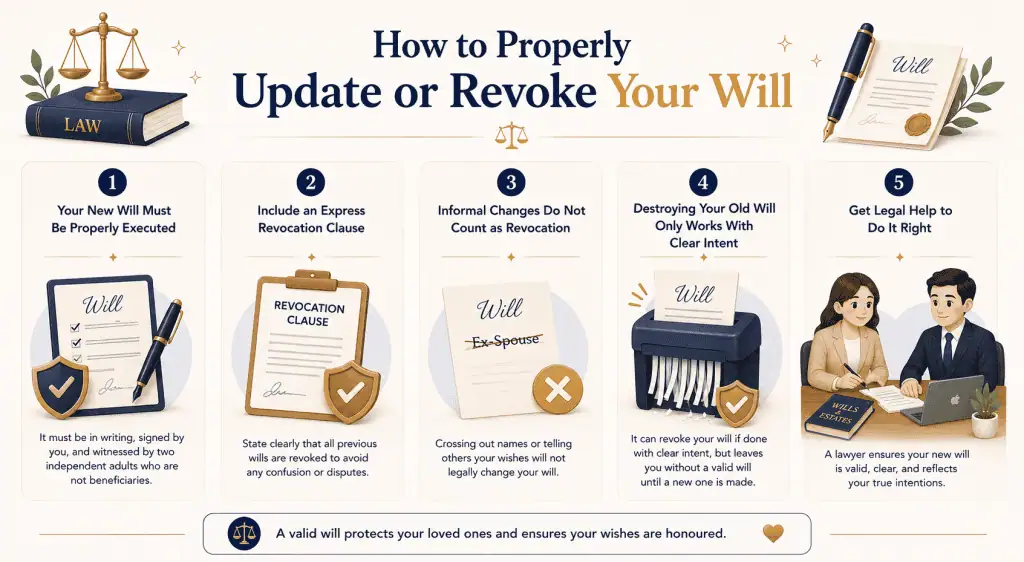
Your New Will Must Be Properly Executed
A new will must be in writing, signed by you, and witnessed by two people who are not beneficiaries. This last part catches people off guard, since a witness who is also named as a beneficiary can end up voiding their own gift under the will, even though the rest of the document stays valid.
Include an Express Revocation Clause
Most new wills include an express revocation clause, typically along the lines of revoking all previous wills made by you. Relying on the new will simply being more recent, without this clause, can create ambiguity about which document actually governs your estate if both are ever found.
Informal Changes Do Not Count as Revocation
Crossing out your ex-spouse’s name on the original document, or telling family members you no longer want them included, does not count as a valid revocation. Without a properly executed replacement, the original will as written is what the court and your executor will still have to follow.
Destroying Your Old Will Only Works With Clear Intent
Physically destroying your old will can revoke it, but only if that is done with the clear intention to revoke it, not by accident or loss. It also still leaves you without a valid will until a new one is executed, which means your estate would fall under the Intestate Succession Act in the meantime.
Given how easy it is to get one of these steps wrong, most people are better served having a lawyer draft the replacement will rather than attempting it alone.
When Should You Update Your Will During the Divorce Process
You do not need to wait for your Final Judgment to update your will. Since Singapore’s divorce process can take anywhere from several months to a few years in contested cases, waiting means your ex-spouse remains a beneficiary, executor, or guardian in your will for the entire time your case is ongoing.
Many people choose to update their will as soon as they’ve decided to divorce, or at the latest once the Interim Judgment is granted, rather than treating it as a final step to handle only after everything else is settled.
Steps to Take After Your Divorce
Once your Final Judgment is granted, a short checklist can save your family a lot of complication later.
- Draft a new will that expressly revokes all previous wills, rather than informally amending the old one.
- Revoke or update your Lasting Power of Attorney through the Office of the Public Guardian if your ex-spouse was named as donee.
- Update your CPF nomination separately through CPF’s online nomination service.
- Review your life insurance beneficiaries to make sure payouts go where you actually want them to.
- Check how any property is held. If your flat is under joint tenancy, it passes automatically to the surviving owner regardless of your will, so this may need to be restructured as part of your HDB divorce arrangements.
Also Read: How Matrimonial Assets Are Divided in a Singapore Divorce
Talk to Ng Pui Khim About Your Will and Divorce
Reviewing your will is not something to leave until after everything else about your divorce is settled. Between the Interim Judgment, the Final Judgment, and separate documents like your CPF nomination, your Lasting Power of Attorney, and your insurance policies, it is easy for an ex-spouse to remain entitled to things you never intended long after the marriage has ended.
Getting your will, CPF nomination, LPA, and estate plan properly updated after a divorce takes more than a single document change, and it is easy to miss a step.
Ng Pui Khim brings over 20 years of experience across divorce and wills and succession law, so your estate plan and your divorce are handled with the same lawyer who understands both sides. Contact us to review your will, or find out more about our will writing services, or call us at 6323 1261.
Frequently Asked Questions
Does divorce invalidate my will in Singapore?
No, only marriage or remarriage does. Your existing will stays legally valid after a divorce, so you need to update it yourself if you no longer want your ex-spouse included.
Can my ex-spouse still inherit if I die during the divorce process?
Yes. If you die before your Final Judgment is granted, you are still considered legally married, so your ex-spouse keeps their entitlements under your will or under the Intestate Succession Act.
Does divorce revoke my CPF nomination?
No. CPF nominations follow the same rule as wills, revoked by marriage but not by divorce, so you need to update it separately through CPF directly.
Does divorce revoke a Lasting Power of Attorney?
Not automatically. If your ex-spouse was appointed as your donee, their powers generally continue unless the LPA states otherwise, so you need to actively revoke it through the Office of the Public Guardian.
What happens to jointly-owned property if I don’t update my will?
Property held in joint tenancy passes automatically to the surviving owner by right of survivorship, regardless of what your will says, so this needs to be addressed separately as part of your divorce.
Can I revoke my will myself without a lawyer?
Technically yes, but the revocation has to meet specific legal requirements to be valid, such as proper witnessing or a clear act of destruction with intent to revoke. Given how often this goes wrong when done informally, most people have a lawyer draft the replacement will instead.

Ng Pui Khim is a senior lawyer with over 20 years of private practice experience focusing on divorces (family and matrimonial law), real estate (conveyancing practice), wills and succession law.
All rights reserved. Any information of a legal nature in this website is given in good faith and has been derived from resources believed to be reliable and accurate. The author of the information contained herein this website does not give any warranty or accept any responsibility arising in any way, including by reason of negligence for any errors or omissions herein. Readers should seek independent legal advice