

Table of Contents
- What is Alimony?
- Who Can Claim Alimony in Singapore?
- Types of Maintenance Orders in Singapore
- How Much Alimony Can I Claim in Singapore?
- Factors the Court Considers When Determining Alimony
- How Long Does Alimony Last?
- Can Alimony Be Changed? Variation Orders
- What Happens If Alimony Is Not Paid?
- What People Get Wrong About Alimony
- Navigate Your Alimony Claim With an Experienced Singapore Divorce Lawyer
- Frequently Asked Questions about Alimony
When couples go through a divorce in Singapore, one of the most commonly disputed financial issues is alimony — also known legally as spousal maintenance.
Many people are unsure who can claim maintenance, how much may be awarded, how long payments last, or what happens if the paying party refuses to comply with a court order.
Understanding how alimony works under Singapore law is important because maintenance decisions can significantly affect both parties’ financial stability after divorce.
What is Alimony?
Alimony referred to in Singapore law as ex-spousal maintenance, is a court-ordered financial payment from one former spouse to the other following a divorce. It is governed primarily by Sections 113 and 114 of the Women’s Charter (Cap. 353), which gives the Family Justice Courts the power to order one party to pay maintenance to the other during or after divorce proceedings.
The primary purpose of spousal maintenance is what courts describe as the principle of financial preservation — helping the financially weaker spouse transition from married life to independence without suffering undue hardship.
The court’s aim is to ensure the receiving spouse can maintain a standard of living reasonably similar to what they enjoyed during the marriage, to the extent that the paying spouse has the financial means to provide it.
Who Can Claim Alimony in Singapore?
Under Section 113 of the Women’s Charter, a wife or former wife may apply to the court for maintenance during or after divorce proceedings. The right to claim extends to:
- Maintenance during divorce proceedings (interim maintenance), before the divorce is finalised
- Maintenance ordered as part of the ancillary matters upon or after the Interim Judgment being granted
Can men claim alimony in Singapore?
Yes — but in limited circumstances. Following amendments to the Women’s Charter, an ex-husband may claim maintenance from his former wife if he is suffering from a physical or mental disability that was present during the marriage and continues to prevent him from earning a livelihood and supporting himself after the divorce. This is a narrow exception and is assessed case by case.
Is alimony an automatic right?
No. Spousal maintenance is never automatic. The court must be satisfied, having regard to all relevant factors, that a maintenance order is appropriate in the circumstances. A spouse with strong earning capacity and no dependants, for example, is unlikely to be awarded maintenance regardless of the marriage length.
Types of Maintenance Orders in Singapore
When the court does make a spousal maintenance order, it can take several forms depending on the financial circumstances of both parties.
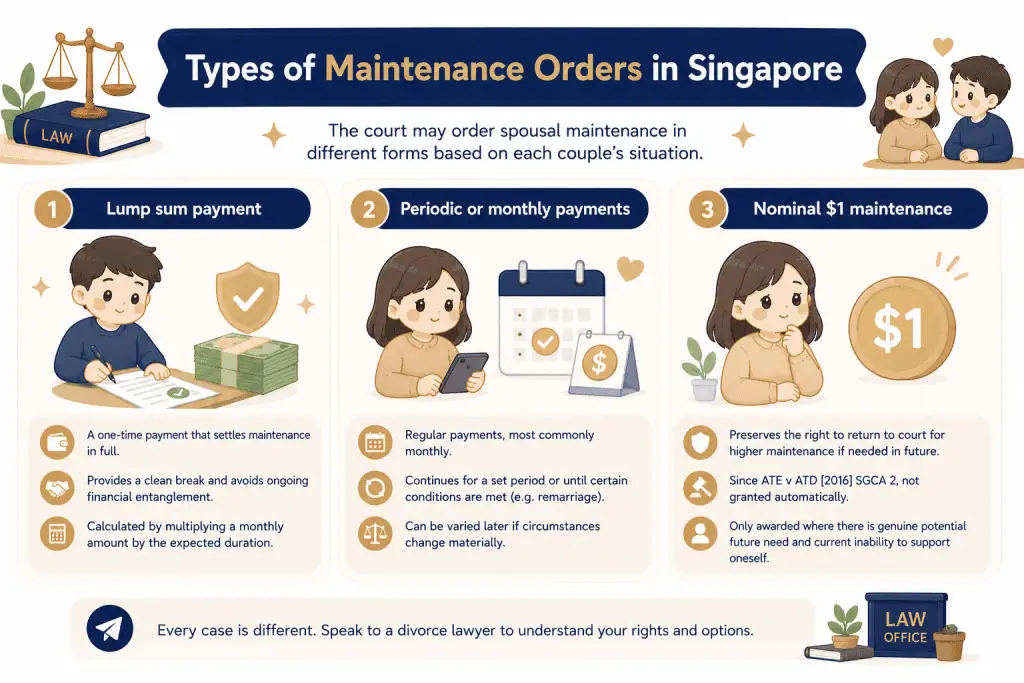
Lump sum payment
A one-time payment that settles the maintenance obligation in full. Once paid, the receiving spouse cannot return to court to claim more.
Lump sum orders are suitable where the paying spouse has sufficient capital — they provide a clean break and avoid ongoing financial entanglement between the parties. Courts often calculate lump sum maintenance by multiplying a monthly amount by the expected duration of payments.
Periodic or monthly payments
Regular payments — most commonly monthly — that continue for a specified period or until certain conditions are met (such as the receiving spouse remarrying). Monthly maintenance orders can be varied later by either party if circumstances change materially.
Nominal $1 maintenance
Historically, courts awarded $1 per month as a mechanism to preserve the receiving spouse’s right to return to court for higher maintenance if their financial situation worsened in the future.
However, following the landmark Singapore Court of Appeal case of ATE v ATD [2016] SGCA 2, nominal maintenance is no longer granted automatically. It will only be awarded where the court sees a genuine potential future need and the receiving spouse currently lacks the ability to fully support themselves. A financially independent ex-spouse will generally not receive the $1 order.
How Much Alimony Can I Claim in Singapore?
This is the question most people want answered, and it is also the one that has no fixed formula. Singapore courts do not apply a percentage-of-income rule or a standard calculator. Every case is assessed on its individual facts under Section 114 of the Women’s Charter.
That said, experienced family lawyers can offer realistic guidance based on the length of the marriage and the parties’ respective circumstances:
| Marriage Length | Typical Maintenance Outcome |
|---|---|
| Short (under 5 years) | Often no maintenance, or a time-limited order for 1–2 years to allow financial adjustment |
| Medium (5–15 years) | Typically 2–5 years of monthly maintenance, commonly in the range of S$800–S$3,000/month depending on income disparity, or an equivalent lump sum |
| Long (15+ years, spouse out of workforce) | Longer or indefinite maintenance; amount reflects the standard of living during the marriage |
A real example from case law: In Lee Yong Chuan Edwin v Tan Soan Lian [2000] SGCA 68, the Court of Appeal upheld a lump sum maintenance award of S$960,000, calculated on the basis of S$8,000 per month over ten years — reflecting a long marriage with a significant income disparity and an established standard of living.
These figures are illustrative only. The actual outcome in any given case depends on the specific facts, both parties’ financial positions, the standard of living enjoyed during the marriage, and the court’s assessment of what is fair and reasonable.
Also Read: Child Maintenance in Singapore: Laws & Calculation
Factors the Court Considers When Determining Alimony
Before making any maintenance order, the court must have regard to all the circumstances of the case, including the following factors set out in Section 114 of the Women’s Charter:
- Income, earning capacity, and financial affairs
The court looks at the current and foreseeable future income, earning capacity, assets, and financial resources of each party — including CPF savings, investments, and business interests.
- Financial needs, obligations, and responsibilities
Each party’s ongoing financial commitments are considered, including housing costs, loans, and the care of children or other dependants.
- Standard of living during the marriage
The lifestyle the family enjoyed before the breakdown of the marriage is a key reference point. A spouse accustomed to a high standard of living will generally receive more consideration than one from a more modest household.
- Duration of the marriage and age of the parties
Longer marriages — particularly where one spouse sacrificed career opportunities to care for the family — carry greater weight. The age of both parties also matters, as it affects future earning capacity.
- Physical and mental health
A disability or chronic illness that affects a party’s ability to work is a significant factor in both entitlement and quantum.
- Contributions to the welfare of the family
This includes non-financial contributions such as homemaking, childcare, and supporting the other spouse’s career — not just income earned.
- Loss of benefits from the divorce
The court considers the value of any benefits either party loses as a result of the divorce, such as pension entitlements or insurance policies.
How Long Does Alimony Last?
There is no fixed term, but Singapore courts firmly favour a rehabilitative approach following the Women’s Charter amendments in 2016 and ATE v ATD. The aim is to help the receiving spouse regain financial independence — not to provide a permanent income stream. A spouse capable of returning to work will typically receive a time-limited order of 2 to 5 years.
Lifetime or indefinite maintenance is reserved for cases where the receiving spouse genuinely cannot re-enter the workforce due to age, health, or long-term caregiving responsibilities. Monthly maintenance automatically ends upon the receiving spouse’s remarriage, either party’s death, or when the court grants a variation.
Can Alimony Be Changed? Variation Orders
Yes. Either party may apply to the Family Justice Courts for a variation order to increase, reduce, or suspend maintenance if there has been a material change in circumstances — such as job loss, a significant income change, the receiving spouse’s improved financial position, or a serious health change.
The application must be supported by documentary evidence. Poorly prepared applications risk dismissal and adverse cost orders.
What Happens If Alimony Is Not Paid?
Non-payment is a serious breach of a court order. The updated Maintenance Enforcement Process (MEP) gives courts significantly expanded enforcement powers, including:
- Attachment of Earnings Order — salary deductions until arrears are cleared
- Garnishee Order — redirecting bank funds to satisfy the debt
- Seizure and Sale Order — seizing assets to recover arrears
- Committal Order — up to one month’s imprisonment per month of unpaid maintenance in wilful cases
Imprisonment does not extinguish the debt. If you are genuinely unable to pay, apply for a variation order rather than stopping payments. Bankruptcy also does not cancel maintenance obligations — orders remain fully enforceable regardless of a bankruptcy declaration.
What People Get Wrong About Alimony
- “I stayed home for the children — I’m automatically entitled to maintenance.” Homemaking contributions are recognised and will work in your favour, but they do not guarantee an order. If you have earning capacity, maintenance may be time-limited.
- “My spouse committed adultery — the court will increase my maintenance.” Singapore courts do not generally use fault-based conduct to determine maintenance quantum. The focus is on financial need and fairness.
- “Negotiations can wait until the hearing.” Early negotiation on ancillary matters almost always produces better outcomes. A negotiated consent order gives both parties more control and avoids costly litigation.
Also Read: How Matrimonial Assets Are Divided in a Singapore Divorce
Navigate Your Alimony Claim With an Experienced Singapore Divorce Lawyer
Spousal maintenance is one of the most fact-sensitive areas of Singapore divorce law. Whether you are seeking maintenance or responding to a claim, the outcome will shape your financial position for years.
Ng Pui Khim, has advised clients on spousal maintenance and contested ancillary matters for over two decades. Book a consultation for practical, clear advice grounded in real-world experience.o issuing fair and balanced maintenance orders that address the unique circumstances of each case.
Frequently Asked Questions about Alimony
How long must maintenance/alimony be paid in Singapore?
The order for ex-spouse maintenance granted by the Court would specify the duration. In event the duration is not specified, and the order is a periodic monthly maintenance, generally, the maintenance must continue to be paid until the recipient ex-spouse remarries, until the order is varied or suspended by the same Court or until either party dies.
Are men entitled to alimony in Singapore?
Yes, after the Women’s Charter was revised in 2016, an ex-wife can be ordered to maintain her ex-husband if the ex-husband suffered from a physical or mental disability or illness during the marriage which would continue to prevent him from earning a livelihood and maintain himself after the divorce.
What can happen to me if I refuse to pay alimony to my ex-spouse in Singapore?
Your ex-spouse can enforce the order for maintenance against you in Court. The punishment for deliberately not paying maintenance is serious. The Court can impose a sentence of imprisonment for a term of up to one month for each month of unpaid maintenance. The imprisonment sentence does not affect or reduce the obligation of the payer spouse to pay the maintenance order. In the event you are unable to continue paying the ordered maintenance sum to your ex-spouse, it is advisable to engage a lawyer to apply to the Court for a variation order to reduce or suspend the maintenance amount. The variation application will need to be accompanied by supporting documents showing your reduced income or increased financial expenses.
What happens if an ex-husband refuses to pay?
If an ex-husband refuses to pay, the ex-wife may apply to the Family Justice Courts for enforcement. The application can be made by the ex-wife without the need to engage a lawyer. The ex-wife will need to provide documentary proof to the Court that the maintenance payments have been unpaid. The Court has powers to make certain orders against the ex-husband to ensure future compliance.
Photo by Christian Lue

The PKNG Editorial Team researches and maintains general Singapore legal information for iLawyer. Its work follows the site editorial policy and uses authoritative sources where available.
All rights reserved. Any information of a legal nature in this website is given in good faith and has been derived from resources believed to be reliable and accurate. The author of the information contained herein this website does not give any warranty or accept any responsibility arising in any way, including by reason of negligence for any errors or omissions herein. Readers should seek independent legal advice