

Table of Contents
- What is Child Maintenance?
- What Do Maintenance Orders in Singapore Entail?
- How Is a Child Maintenance Order Enforced?
- How Is Child Maintenance Calculated?
- Eligibility for Child Maintenance
- Can Child Maintenance Be Varied After the Order Is Made?
- Child Maintenance for Children Above 21
- Documents Needed for a Maintenance Application
- Speak to a Singapore Divorce Lawyer About Child Maintenance
- Frequently Asked Questions about Child Maintenance
Navigating child maintenance in Singapore can be one of the most stressful parts of a divorce. Under the Women’s Charter, both parents have a legal duty to provide for their children, regardless of who has care and control. But how is the amount actually calculated, and what happens if the other parent simply refuses to pay?
This guide explains how the Family Court determines child maintenance, what documents you’ll need to apply, how enforcement works if a parent defaults, and how our experienced divorce lawyers can protect your child’s future.
What is Child Maintenance?
Child maintenance is the financial support provided by the parent towards the living expenses of his or child. The living expenses include accommodation, clothing, food and education or any other expenses as may be reasonable having regard to the parents’ means and station in life.
Usually, the non-custodial parent (meaning, the parent who does not have care and control of the child), is ordered to pay child maintenance to the custodial parent (meaning, the parent granted with the care and control of the child. For those cases in which the parent
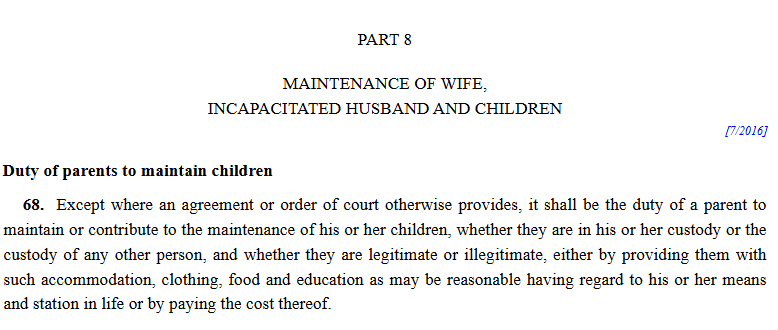
Under Singapore law, (see section 68 of the Women’s Charter 1961), by default both parents (not just the father) have legal duty to maintain or contribute towards the maintenance of their child until the child reaches 21 years old. However, it does not mean that the financial burden is equally borne by each parent. The apportionment is dependent on a list of relevant factors.
The primary aim of child maintenance is to ensure that the child’s financial needs are met so that, subject to parents’ financial abilities, the child may continue to enjoy a standard of living similar to what they were accustomed to during the marriage.
If there are minor children involved in a divorce case, the Court will issue an order of child maintenance upon divorce. This is to ensure that the minor child’s financial needs are protected by an order of maintenance.
Also Read: 8 Signs of an Unhappy Marriage: Legal Advice for Divorce in Singapore
What Do Maintenance Orders in Singapore Entail?
In Singapore, if there is no agreement by the parents on the child maintenance amount payable by the non-custodial parent upon divorce, the Family Court will determine the child maintenance amount payable after considering relevant factors on a case-by-case basis. There are no fixed formula or statutory schedules to follow.
The Maintenance Order may provide for the maintenance amount to be paid in various ways, including:
- Monthly Basis: Regular periodic monthly payments that provide steady funds for day-to-day living expenses such as food, clothing, and school fees.
- Yearly Basis: Specific payments for certain types of living expenses that are applicable on a yearly basis such as end of year school textbooks and school uniforms.
- Ad Hoc or One-Off Expenses: Payments for specific needs like computer laptop for the child, big ticket expenses such as hospital bills.
- Lump Sum Payment: A one-time payment. However, it is not very common for the Court to order just a one-time lumpsum payment for child maintenance because the child’s financial needs may change in future, especially for young children.
- Direct Payments to Third-Party Service Providers: Payments made directly to service providers for specific expenses such as enrichment class agency and childcare centre.
How Is a Child Maintenance Order Enforced?
If a parent fails to comply with a maintenance order, the Court can take several enforcement actions against the respondent, including:
- Imprisonment of the respondent
- An Attachment of Earnings Order, directing the respondent’s employer to deduct maintenance directly from their salary and pay it to the applicant
- An Enforcement Order for Attachment of a Debt, redirecting money a third party owes the respondent toward the applicant instead
- An order for the respondent to provide a banker’s guarantee against future defaults
- Mandatory financial counselling
- Community service
- A show-payment order, requiring the respondent to prove that arrears or payable maintenance have been paid by a specified date
How Is Child Maintenance Calculated?
While there is no fixed formula, the Court works through a structured comparison of both parents’ financial positions against the child’s needs. Consider this simplified example:
| Factor | Father | Mother |
|---|---|---|
| Monthly income | $6,000 | $3,000 |
| Monthly expenses (self) | $2,500 | $2,000 |
| Disposable income | $3,500 | $1,000 |
| Child’s monthly needs | $1,800 (combined) |
Based on disposable income alone, the father has a greater capacity to contribute. The Court might apportion maintenance such that the father pays around $1,200–$1,400 per month, with the mother absorbing the remainder through direct care and lower-cost contributions.
This is illustrative only — actual outcomes depend on the full set of factors below, and each case is unique.
Eligibility for Child Maintenance
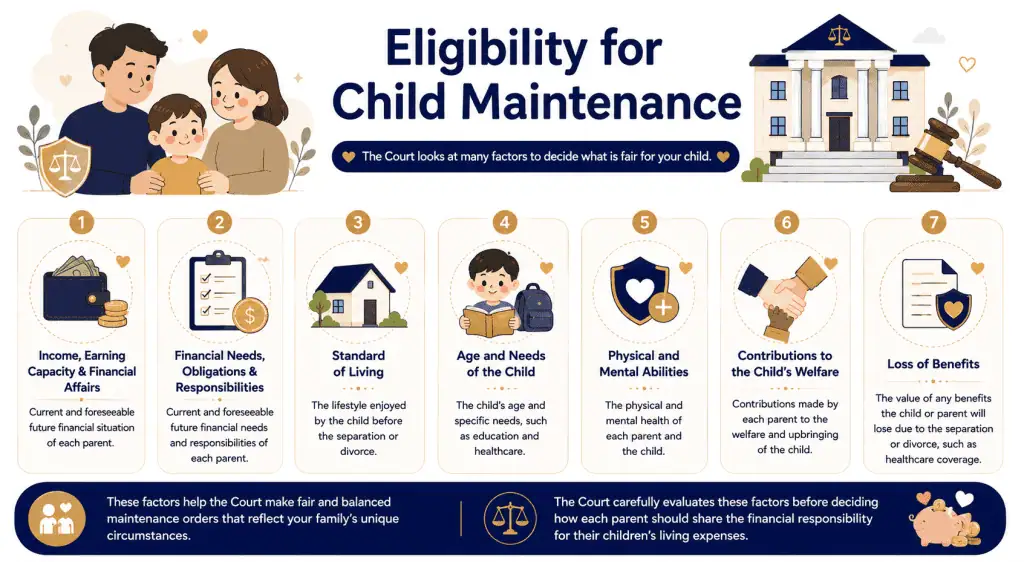
The Court considers several factors before making a decision, including (but not limited to):
| Factor | Details |
| Income, Earning Capacity, and Financial Affairs | Current and foreseeable future financial situation of each parent |
| Financial Needs, Obligations, and Responsibilities | Current and foreseeable future financial needs and responsibilities of each parent |
| Standard of Living | The lifestyle enjoyed by the child before the separation or divorce |
| Age and Needs of the Child | The child’s age and specific needs, such as education and healthcare |
| Physical and Mental Abilities | The physical and mental health of each parent and the child |
| Contributions to the Child’s Welfare | Contributions made by each parent to the welfare and upbringing of the child |
| Loss of Benefits | The value of any benefits the child or parent will lose due to the separation or divorce, such as healthcare coverage |
These factors underscore the Court’s commitment to issuing fair and balanced maintenance orders that address the unique circumstances of each case.
The Court carefully evaluates the above factors before deciding how each parent should share the financial responsibility for their children’s living expenses.
Can Child Maintenance Be Varied After the Order Is Made?
Yes. If your financial circumstances change significantly — for example, retrenchment or a substantial pay cut — you can engage a family lawyer to apply to the Court to vary the existing maintenance order, supported by documents proving the change.
Variation applications are not limited to reductions. Custodial parents may also apply to increase maintenance due to rising child expenses. Common types of variation include:
- Increasing the fixed monthly payments
- Decreasing the fixed monthly payments
- Inserting or removing clauses in the maintenance order
- Suspending maintenance for a period of time
Child Maintenance for Children Above 21
Maintenance does not automatically stop the day a child turns 21. If the child is pursuing full-time tertiary education — such as a university degree, diploma, or national service deferment leading into further studies — the Court may extend maintenance beyond 21 to cover this period.
This typically requires a separate application or a clause built into the original maintenance order anticipating continued education. Parents should plan for this possibility when negotiating maintenance terms, particularly where the child is approaching secondary or pre-university level at the time of divorce.
Documents Needed for a Maintenance Application
To support a maintenance application, you will generally need:
- Proof of income (payslips, IRAS tax statements, or CPF contribution history)
- A breakdown of the child’s monthly expenses (school fees, enrichment, medical, daily costs)
- Birth certificate of the child
- Marriage certificate and any existing Court orders related to the divorce
- Bank statements showing financial capacity, if available
- Any documentation supporting special needs (medical reports, school recommendations)
Having these documents prepared in advance allows your lawyer to file the application more efficiently and strengthens your position before the Court.
Also Read: Divorce Procedure in Singapore: Step-by-Step Process, Timeline and Requirements
Speak to a Singapore Divorce Lawyer About Child Maintenance
Every family’s situation is different, and maintenance amounts are not calculated by a fixed formula. A lawyer ensures that your child’s actual needs — not just the minimum the other parent is willing to offer — are accurately represented before the Court.
This is especially important in contested cases, where presenting the right financial evidence can significantly affect the outcome.
Securing fair child maintenance requires more than just citing the law — it requires presenting the right financial evidence in a way the Family Court will recognise. Ng Pui Khim has over 20 years of experience handling child maintenance applications, variations, and enforcement matters in Singapore.
Call us at 6323 1261 or submit an enquiry here to speak with Pui Khim today.
Frequently Asked Questions about Child Maintenance
How does child support work in Singapore?
Singapore refers to this as “child maintenance” rather than “child support.” Either parent can apply to the Family Court for an order requiring the other to contribute toward the child’s living expenses, which the Court calculates based on both parents’ means and the child’s needs, with no fixed formula applied.
How long must child maintenance be paid in Singapore?
The Court decides the duration, usually until the child reaches 21 years of age, or completes their tertiary education if applicable.
Are parents required to pay child maintenance even if they do not have custody?
Yes, the non-custodial parent is still required to pay child maintenance to support the child’s needs.
Can child maintenance payments be avoided in Singapore?
No, avoiding payment is illegal, and enforcement actions can be taken if a maintenance order is not followed.
What happens if a parent refuses to pay child maintenance?
If a parent refuses to pay, the Court can be applied for enforcement. The Court can take legal actions to ensure compliance with the maintenance order, including garnishing wages or seizing assets.
This guide aims to provide a clear understanding of child maintenance in Singapore, helping parents navigate the complexities of post-separation financial support to ensure their child’s well-being.
Who Can Apply for Child Maintenance?
The following individuals can apply for a Maintenance Order:
– The parent of minor child
– Guardian of the minor child
– The child themselves, if he or she is an adult
The custodial parent does not allow me to see my child for access. Can I withhold child maintenance payment?
No. The Court looks at maintenance payment and access as two separate and distinct issues. If you withhold child maintenance payment, the custodial parent has a right to apply for legal enforcement of maintenance arrears against you.
For breach of access order, you may separately apply to the Court to enforce your right of access against your ex-spouse. The Court may award you with make-up access to compensate for the lost time with your child and/or order mandatory counselling/mediation for the parent in breach of access order.

Ng Pui Khim is a senior lawyer with over 20 years of private practice experience focusing on divorces (family and matrimonial law), real estate (conveyancing practice), wills and succession law.
All rights reserved. Any information of a legal nature in this website is given in good faith and has been derived from resources believed to be reliable and accurate. The author of the information contained herein this website does not give any warranty or accept any responsibility arising in any way, including by reason of negligence for any errors or omissions herein. Readers should seek independent legal advice