

Table of Contents
- What is Divorce Mediation?
- When Is Mediation Mandatory in a Singapore Divorce
- Divorce Mediation Process in Singapore
- What if You Don’t Qualify for FDR Mediation
- How Much Does Divorce Mediation Cost in Singapore
- What Are the Benefits of Mediation Compared to Litigation
- What Is the Mediator’s Role in a Divorce Mediation
- Is Information Shared During Mediation Confidential
- Will You Be Forced Into a Settlement During Mediation
- Why You Should Have a Lawyer at Divorce Mediation
- Need a Lawyer for Your Divorce Mediation? Talk to Ng Pui Khim
- Frequently Asked Questions
If you’re going through a divorce in Singapore, there’s a good chance you’ll be asked to attend mediation before your case ever reaches a judge.
Divorce mediation gives both spouses a structured, confidential way to work out disputes over children, finances, and property with the help of a neutral third party, rather than fighting it out in court.
Understanding how the process works, when it’s compulsory, and what it costs can help you prepare for it with confidence.
What is Divorce Mediation?
Divorce mediation is a process where a husband and wife work with a neutral mediator to communicate openly and reach a voluntary settlement on the issues arising from their divorce, such as the children’s care arrangements, division of matrimonial assets, and maintenance.
Unlike a judge, the mediator cannot impose a decision. Their role is to facilitate discussion and help both parties find common ground.
When Is Mediation Mandatory in a Singapore Divorce
Mediation isn’t always optional. Under the Family Dispute Resolution (FDR) process at the Family Justice Courts, parties with at least one child aged 21 and below who haven’t yet agreed on child or parenting matters are required to attend mediation and counselling.
This applies whether the divorce itself is contested or not, as long as arrangements for the children remain unresolved. The Family Court derives this power from Section 26(9) of the Family Justice Act 2014, which allows the court to direct parties to mediation, counselling, or family support programmes.
If you don’t have children under 21, or you and your spouse have already agreed on parenting matters, mediation isn’t automatically compulsory. However, either party can still request mediation at the FDR Division at any stage of the case, and the court may direct it where it considers this would help resolve the dispute.
Divorce Mediation Process in Singapore
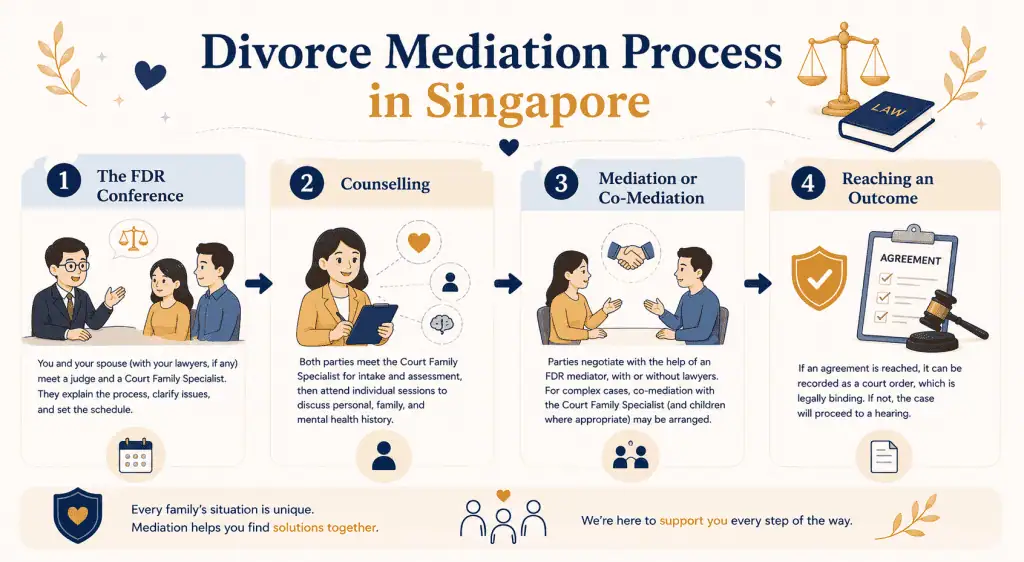
The FDR process typically unfolds in three stages, and it can take more than one session to reach a settlement depending on how complex the case is.
Step 1: The FDR Conference
You and your spouse (with your lawyers, if any) meet a judge and a Court Family Specialist, who explain how mediation and counselling work, clarify the issues in dispute, and schedule your sessions. The judge may also give directions on documents both parties need to prepare and exchange beforehand.
Step 2: Counselling
Both parties meet jointly with the Court Family Specialist for an intake and assessment session, then attend individual sessions to discuss their personal, family, and mental health history. Lawyers do not attend counselling. If both parties reach an agreement on the children’s arrangements at this stage, it can be recorded as a draft agreement.
Step 3: Mediation or Co-Mediation
Parties negotiate directly with the help of an FDR mediator, with or without their lawyers present. If the case involves complex legal or emotional issues, the mediator may call for co-mediation with the Court Family Specialist, who may also involve the children where appropriate.
Step 4: Reaching an Outcome
If both parties reach an agreement, the terms can be recorded as a court order, which is legally binding. If not, the court will give directions for the case to proceed to a hearing.
Also Read: Child Maintenance in Singapore: Guide, Laws & Calculation
What if You Don’t Qualify for FDR Mediation
The FDR Division doesn’t handle every case. Divorces where the matrimonial assets are valued at S$2 million or more, and there’s no dispute over the children, are generally directed to private mediation instead. The same applies to cases under the International Child Abduction Act.
For these cases, mediation is usually conducted through the Singapore Mediation Centre (SMC) under its Family Mediation Procedure Rules, the Law Society Mediation Scheme, or a private mediator agreed on by both parties.
Couples may also opt for Collaborative Family Practice (CFP), where specially trained lawyers and other professionals, such as financial advisors or child specialists, work with both parties to reach a settlement without going to court.
How Much Does Divorce Mediation Cost in Singapore
Mediation at the FDR Division is free of charge, as it’s a court-administered process. Private mediation through the SMC, comes with a non-refundable filing fee of S$272.50 per party, plus a mediation fee of S$2,783.58 per party for each full-day session, inclusive of GST.
Sessions held on a weekend or public holiday carry a 20% surcharge on top of this fee, and running past 6pm adds overtime charges. Collaborative Family Practice fees vary based on the estimated number of hours the case requires, which your lawyer can advise on during an initial consultation.
Collaborative Family Practice fees vary based on the estimated number of hours the case requires, which your lawyer can advise on during an initial consultation.
What Are the Benefits of Mediation Compared to Litigation
Compared to a fully contested divorce, mediation offers several practical and emotional advantages for both spouses and any children involved.
- Lower costs
Mediation avoids the legal fees that build up across multiple court hearings, interlocutory applications, and a prolonged litigation process, since most matters are resolved within a handful of sessions. - Faster resolution
Sessions can be scheduled around your availability rather than waiting for court dates, which means disputes are often settled in weeks rather than the months or years a contested hearing can take. - Less adversarial
Mediation is non-confrontational by design. Instead of building a case against your spouse, you work together with a neutral mediator to find common ground, which tends to preserve a more workable relationship afterward. - Greater control over the outcome
Both parties actively shape the terms of the settlement instead of having a decision imposed by a judge, which often means the outcome fits your family’s actual circumstances more closely than a standard court order would. - Higher compliance with the agreement
Because both spouses had a hand in reaching the settlement, they tend to feel more invested in it and are less likely to breach the terms later on. - Protects children from conflict
For couples with children, a bitterly contested court battle can deepen the emotional toll of the divorce on the whole family. Mediation encourages parents to stay focused on practical, child-centred arrangements instead of scoring points against each other.
What Is the Mediator’s Role in a Divorce Mediation
The mediator is a neutral third party, whether a judge, a staff family mediator, or a trained legal professional, whose job is to help both sides communicate and explore options. They cannot act as a judge or force a solution on either party. Their role is purely to facilitate a fair, structured conversation that helps you and your spouse arrive at your own agreement.
Is Information Shared During Mediation Confidential
Yes. Everything discussed during mediation is confidential and cannot be used as evidence if the case later proceeds to a hearing. The judge who eventually hears your case will also be a different person from the mediator you worked with, so nothing said during mediation affects how your case is heard in court.
Will You Be Forced Into a Settlement During Mediation
No. Any agreement reached in mediation is entirely voluntary. No one, not the mediator, the court, or your spouse, can compel you to accept terms you’re not comfortable with. If you and your spouse cannot agree, the case simply proceeds to a hearing.
Why You Should Have a Lawyer at Divorce Mediation
Mediation isn’t a legal requirement to have a lawyer, but going in without one can leave you at a real disadvantage, especially if your spouse is represented. A family lawyer’s role at this stage isn’t to make the process adversarial, it’s to make sure you’re negotiating from an informed position.
Assessing whether a proposal is fair
Your lawyer can tell you how similar cases involving care arrangements, maintenance, or division of assets are typically decided in Singapore, so you know whether what’s on the table is reasonable or falls short.
Preparing you properly
Before the first mediation session, parties are expected to prepare a Summary for Mediation (Form 83) along with supporting documents. A lawyer can help you put this together so you walk in organised rather than caught off guard.
Attending sessions with you
Lawyers can be present at the FDR Conference and mediation or co-mediation sessions (though not counselling), and can step in to clarify the legal implications of a proposal before you agree to it
Drafting an enforceable agreement
If you and your spouse reach a settlement, it needs to be worded precisely enough to be recorded as a court order. A lawyer helps make sure the terms are clear and won’t cause disputes over interpretation later.
Keeping you from settling out of pressure
It’s common to want mediation over quickly, especially in an emotionally draining process. A lawyer can advise you when a proposal genuinely isn’t in your interest, rather than something worth accepting just to end the session.
Also Read: 10 Secrets You Wish Knew Before Your Divorce
Need a Lawyer for Your Divorce Mediation? Talk to Ng Pui Khim
Divorce mediation gives couples a chance to settle the difficult parts of a divorce, from parenting arrangements to the division of assets, without the cost, delay, and acrimony of a fully litigated case.
Whether you’re required to attend under the FDR process or considering private mediation for a more complex matter, going in prepared with the right documents and a clear understanding of what’s negotiable makes a real difference to how smoothly it goes.
Ng Pui Khim has over 20 years of experience guiding divorcing couples in Singapore through mediation and the wider divorce process, from preparing for FDR sessions to representing your interests in private mediation.
If you’d like to discuss your situation or need help preparing for an upcoming mediation, contact us or read more about how we can represent you through your divorce.
Frequently Asked Questions
Can I ask a friend or relative to mediate instead of a trained mediator?
No. FDR and private mediation must be conducted by an appointed mediator, whether a judge, staff family mediator, or an SMC-appointed professional, who is trained to remain neutral and manage the process effectively.
What happens if mediation doesn’t result in an agreement?
The court will give directions for the case to proceed to a hearing. Nothing discussed during mediation can be used against you at that hearing.
How many mediation sessions will I need?
This depends on how many issues are in dispute and how complex your case is. Some couples resolve everything in one session; others need several sessions across mediation and counselling.
Can I request mediation even if my children are above 21?
Yes. While FDR mediation is mandatory only where there’s at least one child aged 21 and below with unresolved parenting matters, either party can request mediation at the FDR Division at any stage of the case.

Ng Pui Khim is a senior lawyer with over 20 years of private practice experience focusing on divorces (family and matrimonial law), real estate (conveyancing practice), wills and succession law.
All rights reserved. Any information of a legal nature in this website is given in good faith and has been derived from resources believed to be reliable and accurate. The author of the information contained herein this website does not give any warranty or accept any responsibility arising in any way, including by reason of negligence for any errors or omissions herein. Readers should seek independent legal advice