
Table of Contents
- What Is an Interim Judgment?
- Interim Judgment: Uncontested vs Contested Divorce
- What Happens During the 3-Month Interim Period?
- What If Ancillary Matters Take Longer Than 3 Months?
- Can an Interim Judgment Be Set Aside?
- How to Extract the Final Judgment After the Interim Period
- Timeline of Divorce Proceedings in Singapore
- Navigate Your Interim Judgment With an Experienced Singapore Divorce Lawyer
- FAQs – Important Things You Need to Know About Interim Judgment
Filing for divorce is never easy, but many are surprised to learn that getting the certificate of divorce (the legal term is “Final Judgment”) is not instantaneous.
In Singapore, once the Court declares that the marriage is terminated by divorce, the Court first issues an Interim Judgment—not a Final Judgment.
This can be confusing for those expecting a quick end to the divorce. So, what is an Interim Judgment, and what happens during this “in-between” stage?
Understanding this step is essential, especially if you are concerned about dealing with related matters such as children custody, maintenance, or property division. You may also want to know when exactly your marital status changes from being “married” to being “divorced”. Once the Final Judgment is issued, each party is free to remarry.
What Is an Interim Judgment?
An Interim Judgment is a provisional court order issued by the Family Justice Courts of Singapore confirming that the marriage has irretrievably broken down and is to be dissolved by divorce.
It is granted at the end of the first stage of divorce proceedings, the dissolution of marriage stage once the court is satisfied that valid legal grounds for divorce exist under the Women’s Charter (Cap. 353).
At this point, the court formally declares that the marriage should end. However, the Interim Judgment is exactly what its name suggests: interim. The divorce is not legally complete until a separate order — the Certificate of Final Judgment — is issued.
The distinction matters for several important reasons. Until the Final Judgment is granted, your marital status remains “married” in the eyes of Singapore law. You cannot remarry, and certain legal rights and obligations that flow from marriage — including inheritance rights and CPF nomination validity — remain in effect.
Interim Judgment vs Final Judgment: Key Differences
| Key Difference | Interim Judgment | Final Judgment (Certificate) |
|---|---|---|
| What it confirms | Marriage has irretrievably broken down | Marriage is legally dissolved |
| Marital status after | Still “married” | “Divorced” |
| Can remarry? | No | Yes |
| When issued | After first-stage hearing | Min. 3 months after IJ, and after all ancillary matters resolved |
| Automatic? | Granted by court | Must be applied for — not automatic |
Interim Judgment: Uncontested vs Contested Divorce
The path to an Interim Judgment differs significantly depending on whether your divorce is contested or uncontested.
Uncontested divorce (simplified track)
In an uncontested divorce, both parties agree on the fact of divorce and the grounds being relied upon. The court will schedule a hearing date, typically within 4 to 6 weeks of the documents being properly filed. Crucially, parties and their lawyers are generally not required to attend this hearing — it is conducted in chambers and is private.
If the court is satisfied that the marriage has irretrievably broken down, the Interim Judgment is granted at that hearing. For uncontested divorces proceeding on the simplified track, the entire process from filing to Interim Judgment can take as little as 3 to 4 weeks.
Contested divorce
In a contested divorce, the Defendant disputes either the fact of divorce or the grounds being relied upon. Pre-Trial Conferences (PTCs) are typically scheduled to narrow the issues in dispute. If the parties cannot reach agreement through mediation or the PTC process, the matter proceeds to a full hearing before a judge.
The judge will hear evidence from both parties and any witnesses before determining whether to grant the Interim Judgment. This process can take considerably longer — often several months to over a year from the date of filing, depending on the complexity of the dispute and the court’s calendar.
In both cases, once the Interim Judgment is granted, the second stage — ancillary matters — begins.
Also Read: Child Maintenance in Singapore: Laws & Calculation
What Happens During the 3-Month Interim Period?
Once the Interim Judgment is granted, a mandatory waiting period of at least 3 months begins before the Final Judgment can be applied for. During this time, several important things take place.
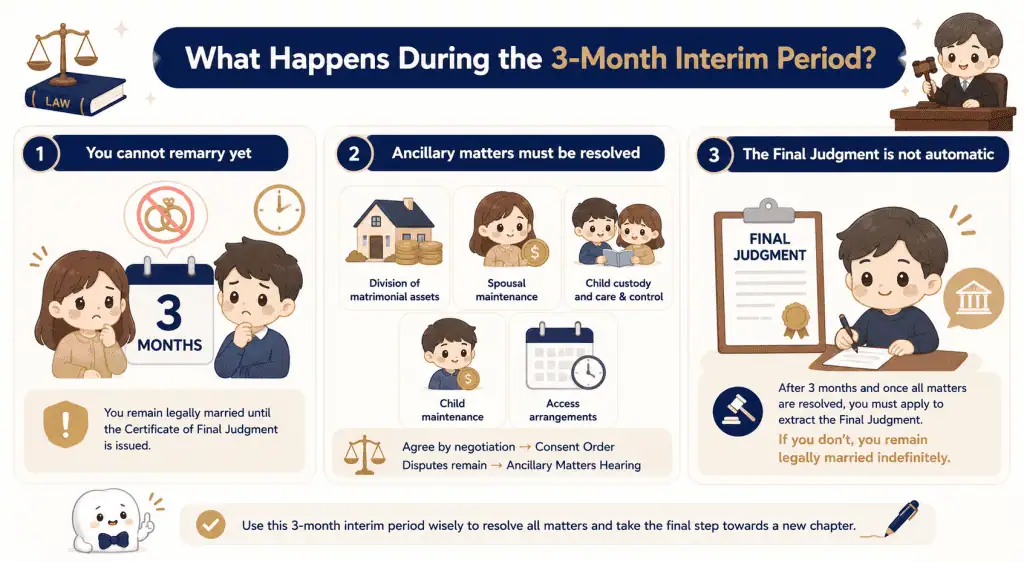
You cannot remarry yet
Until the Certificate of Final Judgment is issued, your legal marital status remains “married.” Entering into any new marriage — whether in Singapore or abroad — before the Final Judgment constitutes bigamy under Singapore law, which is a serious criminal offence.
Ancillary matters must be resolved
The interim period is when the court — or the parties themselves, through negotiation — addresses the remaining issues arising from the marriage. These are known collectively as ancillary matters and typically include:
- Division of matrimonial assets — including the HDB flat, private property, CPF savings, bank accounts, investments, and other jointly or solely held assets
- Spousal maintenance — whether one party will pay the other financial support, and if so, how much and for how long
- Child custody and care and control — who makes major decisions for the children, and who the children live with day-to-day
- Child maintenance — the financial support each parent contributes toward the children’s expenses
- Access arrangements — the schedule and terms under which the non-custodial parent spends time with the children
Where parties can agree on all ancillary matters by negotiation, a consent order is recorded with the court. Where disputes remain, the court will schedule an Ancillary Matters hearing and issue binding orders.
The Final Judgment is not automatic
Even after 3 months have passed and all ancillary matters are resolved, the Certificate of Final Judgment does not issue automatically. One party must formally apply to extract it. If you do not take this step, you remain legally married indefinitely.
What If Ancillary Matters Take Longer Than 3 Months?
This is one of the most common situations divorcing couples face, and it is important to understand the implications clearly.
Under Singapore law, the Certificate of Final Judgment can only be issued once both conditions are met: (1) at least 3 months have passed since the Interim Judgment, and (2) all ancillary matters have been fully resolved — either by a recorded consent order or by a court judgment following an Ancillary Matters hearing.
If ancillary matters remain unresolved after the 3-month period, the Final Judgment will not be granted. The divorce proceedings remain open until every outstanding issue — asset division, maintenance, custody — has been dealt with to the court’s satisfaction.
In contested ancillary matters, it is not uncommon for this stage to take anywhere from several months to over a year. This is one of the strongest arguments for attempting to negotiate a settlement on ancillary matters early, even before or shortly after the Interim Judgment is granted.
A partial settlement order — where parties agree on some issues but not others — can also help narrow the scope of litigation and reduce costs.
Also Read: Divorce by Mutual Agreement in Singapore
Can an Interim Judgment Be Set Aside?
Yes, though it is uncommon. An Interim Judgment can be set aside (cancelled) in limited circumstances, typically where:
- The judgment was obtained by fraud, misrepresentation, or material non-disclosure
- There was a procedural irregularity in the way the divorce proceedings were conducted
- There has been reconciliation between the parties and both agree the marriage should continue
An application to set aside an Interim Judgment must be made to the Family Justice Courts, and the court will consider whether it is just and equitable to do so. If you believe the Interim Judgment granted against you was improperly obtained, you should seek legal advice promptly, as delay can prejudice your ability to challenge it.
It is worth noting that the 3-month waiting period exists in part as a cooling-off window — the law contemplates that parties may reconsider. If both parties genuinely wish to reconcile after the Interim Judgment is granted, the Final Judgment can simply not be extracted, and the proceedings can be discontinued.
How to Extract the Final Judgment After the Interim Period
Once the 3-month waiting period has passed and all ancillary matters have been resolved, the next step is applying to extract the Certificate of Final Judgment. This is a formal application process and is not automatic.
- Step 1: Confirm all ancillary matters are settled All orders relating to asset division, maintenance, custody, and access must be finalised — either by consent order or court judgment.
- Step 2: Prepare and file the extraction documents Your lawyer (or you, if unrepresented) will prepare and file the necessary documents with the Family Justice Courts, including the application to extract the Certificate of Final Judgment.
- Step 3: Obtain leave of court if more than 1 year has passed Under the Family Justice Rules, if more than 1 year has elapsed since the Interim Judgment was granted, you must first apply for leave of court before extracting the Final Judgment. This is an additional step that requires a separate application explaining the delay.
- Step 4: Receive the Certificate of Final Judgment Once granted, the Certificate of Final Judgment is issued. Your marital status formally changes to “divorced.” You are free to remarry.
If you are represented by a lawyer, your lawyer will handle the extraction on your behalf. If you are acting in person, the Family Justice Courts’ registry can provide procedural guidance.
Timeline of Divorce Proceedings in Singapore
The timeline from filing to Final Judgment varies significantly depending on the complexity of the case. As a general guide:
| Stage | Uncontested (simplified) | Contested |
|---|---|---|
| Filing to Interim Judgment | 4 – 8 weeks | 3 months – 1+ year |
| Interim period (mandatory wait) | 3 months minimum | 3 months minimum |
| Ancillary matters resolution | 1 – 3 months (by consent) | 6 months – 2+ years |
| Extraction of Final Judgment | 1 – 2 weeks after application | 1 – 2 weeks after application |
| Total (estimated) | 5 – 7 months | 1 – 3+ years |
These are estimates only. Every divorce is different, and the actual timeline depends on the parties’ ability to reach agreement on ancillary matters, the complexity of the assets involved, the number of children, and the court’s scheduling.
Navigate Your Interim Judgment With an Experienced Singapore Divorce Lawyer
Receiving an Interim Judgment can feel like the hardest part is over — but the interim period is often when the most consequential decisions of the divorce are made. How matrimonial assets are divided, what maintenance is ordered, and what custody arrangements are put in place will directly shape your financial position and your relationship with your children for years to come.
Ng Pui Khim, has guided clients through every stage of Singapore divorce proceedings for over two decades.
Whether you have just received your Interim Judgment or are trying to understand your options before proceedings begin, Pui Khim provides practical, clear legal advice tailored to your situation, from negotiating ancillary matters to representing you in court if needed. Contact us, here!
FAQs – Important Things You Need to Know About Interim Judgment
Is an Interim Judgment the same as a divorce?
Not quite. It means the Court has agreed the marriage should end, but it is not final until a Final Judgment is issued.
What happens during the 3-month interim period?
This mandatory period allows both parties to consider whether there is any possibility of reconciliation. If only one party wants to reconcile but the other party does not, the Court will still issue the Final Judgment after the end of 3 months (provided that all ancillary issues are resolved by then).
Can I remarry after getting an Interim Judgment?
No. You can only remarry after receiving the Final Judgment.
What if the ancillary issues are not resolved in 3 months?
The Final Judgment will be held back by the Court, until all outstanding ancillary issues are fully resolved.
Can Pui Khim help during this stage?
Yes. Pui Khim seeks to help clients resolve ancillary issues fairly and efficiently, so that their divorce can be finalised without unnecessary delay.

The PKNG Editorial Team researches and maintains general Singapore legal information for iLawyer. Its work follows the site editorial policy and uses authoritative sources where available.
All rights reserved. Any information of a legal nature in this website is given in good faith and has been derived from resources believed to be reliable and accurate. The author of the information contained herein this website does not give any warranty or accept any responsibility arising in any way, including by reason of negligence for any errors or omissions herein. Readers should seek independent legal advice