

Table of Contents
- Understanding divorce in Singapore before Divorce by Mutual Agreement (DMA)
- What is a Divorce by Mutual Agreement (DMA)?
- Key Features of Divorce by Mutual Agreement
- Requirements for DMA
- How Does the Divorce by Mutual Agreement Process Work?
- Why the court might reject a DMA filing
- Mandatory Co-Parenting Programme (CPP)
- Benefits of divorce by mutual agreement
- How Much Does a Divorce by Mutual Agreement Cost?
- Why You Should Engage a Divorce Lawyer
- A Progressive Step
- Get Professional Guidance for Your Divorce by Mutual Agreement
- Frequently Asked Questions
Since 1 July 2024, married couples in Singapore no longer need to blame each other to get a divorce. Divorce by Mutual Agreement, or DMA, lets both spouses simply agree that the marriage cannot be saved, without pointing to adultery, desertion, or years of separation.
For couples who will keep co-parenting long after the marriage ends, that difference matters. It means the divorce paperwork does not have to become the first chapter of a hostile custody battle.
This guide walks through what DMA actually requires, how it compares with the five facts couples relied on before it existed, what it costs, how the courts decide whether to accept it, and where a lawyer’s involvement changes the outcome rather than just the paperwork.
Understanding divorce in Singapore before Divorce by Mutual Agreement (DMA)
Divorce in Singapore has always worked in two stages.
- The first is the dissolution of marriage, where the court decides whether the marriage has irretrievably broken down.
- The second is the ancillary matters stage, where the court works out maintenance, the division of matrimonial assets, and arrangements for any children.
A divorce is only truly uncontested when both stages are agreed. Couples sometimes assume that agreeing on the divorce itself is enough, then find the process becomes contested anyway once they cannot agree on the flat or on maintenance.
Before DMA existed, proving the marriage had irretrievably broken down meant relying on one of five facts:
- adultery, where the other spouse’s infidelity has made it intolerable to continue the marriage
- unreasonable behaviour, where one spouse has behaved in a way the other cannot reasonably be expected to live with
- desertion for at least two years
- separation for three years with the other spouse’s consent
- separation for four years without consent.
Every one of these requires either proving fault or waiting out a separation period, which is often what drags a divorce out and turns it adversarial.
What is a Divorce by Mutual Agreement (DMA)?
Starting from 1 July 2024, married couples in Singapore can file for a divorce citing the reason of “Divorce by Mutual Agreement” (“DMA”), if both parties agree that their marriage has irretrievably broken down.
This new pathway, introduced as part of the various amendments to the Women’s Charter, allows married couples to divorce, without assigning fault on one another, thus reducing reduce acrimony and promotes a more peaceful resolution.
As compared to fault-based reasons such as filing for divorce based on adultery and unreasonable behaviour, filing a divorce via DMA route is better in preserving a cordial relationship between the couple. This is important when they must continue to co-parent their children long after the divorce ends.
Key Features of Divorce by Mutual Agreement
DMA is the sixth fact couples can rely on to prove their marriage has irretrievably broken down, added under Section 95A of the Women’s Charter 1961. It differs from the other five facts in two concrete ways.
It requires no fault
Neither spouse has to be cast as plaintiff or defendant, and neither has to gather evidence of the other’s wrongdoing. The couple files jointly, and the reasons stated in the agreement can reflect shared responsibility, such as growing apart or an irreconcilable difference in values, rather than a one-sided accusation.
It requires no separation period
Couples do not need to live apart for three or four years before filing. They can still be living under the same roof right up to the point of filing. The one timing requirement that still applies, because it applies to every divorce in Singapore regardless of the fact relied on, is that the couple must have been married for at least three years.
Who can apply
Both spouses must have been married for at least three years, the same minimum that applies to every other basis for divorce in Singapore. There is no separate waiting period for DMA itself.
What the written agreement must contain
The couple’s written agreement must set out three things: the reasons they believe the marriage has broken down beyond repair, the efforts they made to reconcile, such as attending counselling, and how they have considered arrangements for their finances and any children.
This is not a formality. The court reads this document to decide whether the marriage is genuinely over, and it can send the couple to mediation, counselling, or a family support programme if it is not convinced.
Also Read: How Matrimonial Assets Are Divided in a Singapore Divorce
Requirements for DMA
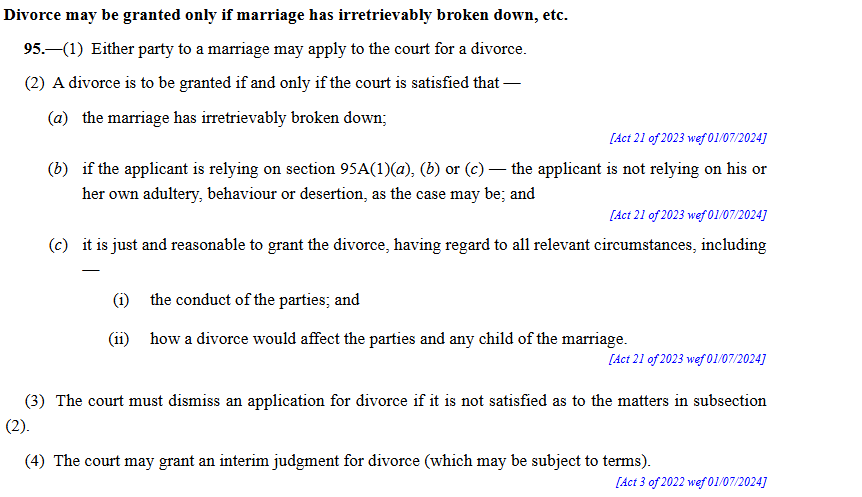
Under sections 94(1), 95A(1)(f) and 95A (6) of the Women’s Charter 1961, married couples must satisfy the following conditions: –
- Be married for at least three years.
- Provide a written agreement signed by both parties stating:
- Reasons to conclude that their marriage has irretrievably broken down. Their efforts and attempts made to reconcile the marriage such as attending marriage counselling sessions.
- They have considered and attempted to make arrangements relating to their financial matters and care of their children.
How Does the Divorce by Mutual Agreement Process Work?
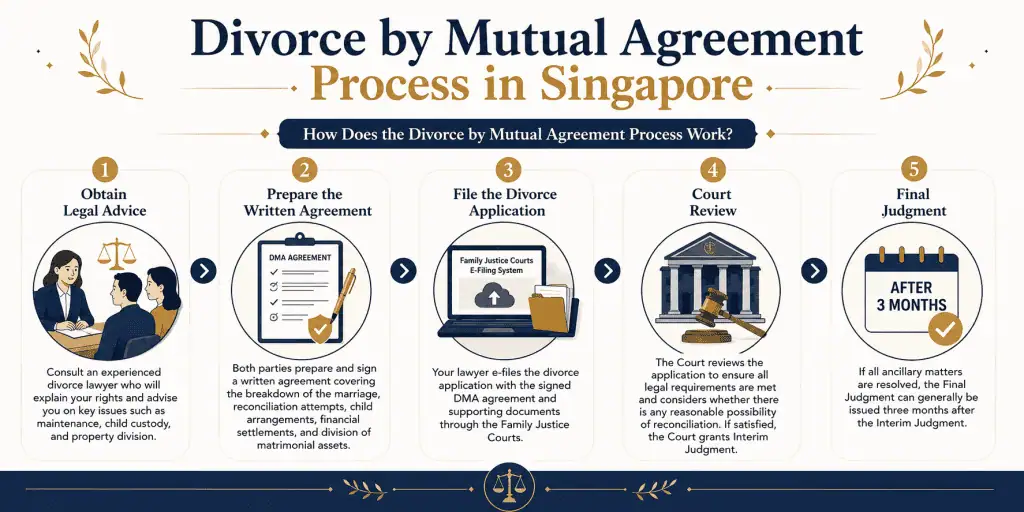
Step 1: Obtain Legal Advice
The process typically begins with consulting an experienced divorce lawyer.
Your lawyer will explain your legal rights, assess whether you qualify for the DMA route, and advise you on important issues such as maintenance, child custody, and property division.
Step 2: Prepare the Written Agreement
Both parties work together to prepare the written DMA agreement.
The agreement should clearly explain:
- why the marriage has irretrievably broken down;
- previous attempts at reconciliation;
- arrangements for children;
- financial settlements; and
- division of matrimonial assets.
Careful drafting helps reduce the likelihood of delays or rejection by the Court.
Step 3: File the Divorce Application
Your lawyer electronically files the divorce application, together with the signed DMA agreement and supporting documents, through the Family Justice Courts.
Step 4: Court Review
The Court examines the application to ensure all statutory requirements have been satisfied. The Judge will consider whether there remains any reasonable possibility that the parties could reconcile before deciding whether to grant the divorce. If satisfied, the Court grants an Interim Judgment.
Step 5: Final Judgment
Where all ancillary matters have been resolved, the Final Judgment can generally be issued three months after the Interim Judgment.
Why the court might reject a DMA filing
Agreeing to divorce is not the same as being granted one. Under Section 95A(6), the court checks whether the agreement was entered voluntarily and with full understanding of its terms, and it can direct the couple toward mediation or counselling if it believes there is a reasonable chance of reconciliation.
If the court is satisfied that reconciliation remains possible, it must reject the application. This is why the reasons stated in the written agreement need to be substantive rather than a formality copied from a template, and it is one of the more common reasons a DIY DMA filing stalls partway through.
Also Read: HDB Divorce Guide: Can You Keep Your Flat?
Mandatory Co-Parenting Programme (CPP)
From July 1, 2024, couples with minor children opting for DMA must attend the Co-Parenting Programme even if they have agreed on children’s arrangements. This programme helps parents to focus on their children’s welfare and establish effective co-parenting arrangements.
Benefits of divorce by mutual agreement
Because DMA removes the need to prove fault or wait out a separation period, the biggest gains show up in how the process feels and how quickly it moves, not just in the legal outcome itself.
- Reduced conflict: by eliminating the need for fault-based reasons, DMA helps reduce emotional distress and conflict between spouses.
- Cost-effective: the process is typically cheaper than contested divorces due to the simplified legal procedure.
- Faster resolution: without the need for trials, a divorce via the DMA route can be finalised more quickly than a contested divorce.
These benefits become clearer when compared side by side with a fault-based divorce.
Divorce by mutual agreement compared with fault-based divorce
| Key Difference | Divorce by mutual agreement | Fault-based divorce |
|---|---|---|
| Timeline | Around 4 to 6 months if ancillary matters are agreed | Often 9 to 18 months or longer if contested |
| Cost | Lower, especially on the simplified track | Higher, due to trial preparation and hearings |
| Emotional impact | Lower, no blame is assigned or argued in court | Higher, fault must be proven and often disputed |
| Best suited for | Couples who agree the marriage is over, even if some ancillary matters still need working out | Couples who disagree on whether the marriage should end, or where one spouse’s conduct is central to the case |
How Much Does a Divorce by Mutual Agreement Cost?
The overall cost depends on factors such as:
- whether the divorce proceeds under the Simplified Track;
- whether both spouses agree on ancillary matters;
- the complexity of financial arrangements; and
- whether additional negotiations become necessary.
A fully agreed Divorce by Mutual Agreement generally costs significantly less than a contested divorce because it involves fewer court hearings and reduced legal work.
An experienced divorce lawyer can provide a clearer estimate based on your circumstances.
Why You Should Engage a Divorce Lawyer
Although Divorce by Mutual Agreement is designed to simplify the divorce process, preparing the necessary documents requires careful legal drafting.
An experienced divorce lawyer can help you:
- determine whether you qualify for DMA;
- prepare a legally compliant written agreement;
- negotiate fair financial settlements;
- advise on child custody arrangements;
- minimise delays during the filing process; and
- reduce the risk of the Court rejecting your application.
Professional legal advice also ensures you fully understand the long-term implications of any agreement before signing legally binding documents.
A Progressive Step
Divorce by Mutual Agreement represents a progressive step in Singapore’s family law, offering a more compassionate and streamlined approach to ending marriages. For more detailed information and assistance, it’s advisable to seek legal counsel to navigate this new process effectively.
Get Professional Guidance for Your Divorce by Mutual Agreement
Ending a marriage is never simple, even when both spouses agree it is the right decision. Divorce by Mutual Agreement removes the need to assign blame, but it does not remove the need to get the paperwork, the finances, and the arrangements for your children right the first time.
If you and your spouse are considering a DMA, Ng Pui Khim can review your situation and advise whether your case is ready for the simplified track. Contact us here for a confidential consultation, or find out more about our divorce and family law services.
Frequently Asked Questions
How long does a Divorce by Mutual Agreement (DMA) take?
On the simplified track with ancillary matters agreed, most cases take around 4 to 6 months from filing to Final Judgment. Contested ancillary matters extend this.
Can we change our mind after signing the agreement?
Yes, up until the divorce is finalised. Either party can also raise new concerns during the process, though doing so may shift the case toward the normal track.
What if we can’t agree on the HDB flat?
You can still file for divorce under DMA. The flat is then dealt with as an ancillary matter, through negotiation, mediation, or a court decision if needed, separately from the divorce itself.
Does filing under DMA affect how our assets are divided?
No. The division of matrimonial assets is assessed on each spouse’s financial and non-financial contributions to the marriage, regardless of which fact was used to establish the divorce.
Do we still need a lawyer if we agree on everything?
You are not required to have one, but a lawyer reviews whether your agreement will hold up under Section 95A’s requirements and whether your financial settlement accounts for everything it should, including CPF and property.
Can one spouse file for DMA if the other wants to use a fault-based fact instead?
No. DMA requires both spouses to agree that the marriage has irretrievably broken down and to file jointly. If one spouse disagrees or insists on a fault-based fact, the case proceeds on that basis instead, not on DMA.

The PKNG Editorial Team researches and maintains general Singapore legal information for iLawyer. Its work follows the site editorial policy and uses authoritative sources where available.
All rights reserved. Any information of a legal nature in this website is given in good faith and has been derived from resources believed to be reliable and accurate. The author of the information contained herein this website does not give any warranty or accept any responsibility arising in any way, including by reason of negligence for any errors or omissions herein. Readers should seek independent legal advice