

Table of Contents
- What is a Lasting Power of Attorney (LPA)?
- Why You Need an Lasting Power of Attorney (LPA)
- How is a “lack of mental capacity” defined?
- What can a donee do?
- Choosing and Appointing Your Donees
- What Is a Certificate Issuer and Why You Need One
- LPA Form 1 vs LPA Form 2
- How to Apply for an Lasting Power of Attorney (LPA) in Singapore
- How Much Does an Lasting Power of Attorney Cost in Singapore
- What Is a Professional Donee or Deputy
- What if the Donee Does Not Act in My Best Interest
- What if I regain my mental capacity?
- Protect Your Family With a Properly Drafted Lasting Power of Attorney
- Frequently Asked Questions
Singaporeans are becoming aware of the importance of writing will in order to distribute their assets according to their wishes in the event of death.
However in numerous scenerios, the Lasting Power of Attorney is often left out. Many of them have not thought about the possible situation when they are still living but are unable to make any decisions on their own.
This leaves their assets frozen and decisions on their personal well-being open to any potential disputes between their family members. Unsettled disputes would then need to be channelled to the court to make a decision.
What is a Lasting Power of Attorney (LPA)?
Lasting Power of Attorney is a legal document that permits someone who is at least 21 years old (the donor) to nominate one or more persons (the donee(s)) to act on his behalf in the event of a loss of mental capacity. A donee is empowered by the donor (while he is still capable of making decisions) to make decisions on the donor’s assets and/or personal welfare.
Why You Need an Lasting Power of Attorney (LPA)
Without an LPA, losing mental capacity means your family has to go through the court to get someone appointed as your decision-maker.
- Court application required. A family member must apply to the court to be appointed as your deputy before they can act on your behalf.
- Costly and time-consuming. The OPG notes this process takes significantly longer and costs more than registering an LPA in advance.
- Potential for family conflict. If family members disagree on who should take on the role, the court process itself can become a source of dispute.
- You lose the choice. An LPA lets you choose your own decision-makers in advance, while you’re still able to, rather than leaving that decision to the court.
How is a “lack of mental capacity” defined?
The Mental Capacity Act defines the lack of mental capacity as being “unable to make a decision for himself in relation to the matter because of an impairment of, or a disturbance in the functioning of, the mind or brain”, regardless of whether the condition is temporary or permanent.
This person is deemed to be unable to make any independent decision if he is unable to “understand the information relevant to the decision, retain that information, use or weigh that information as part of the process of making the decision or communicate his decision (whether by talking, using sign language or any other means)”.
A lack of mental capacity can be due to medical conditions such as coma, dementia or a mental health problem.
What can a donee do?
Through an Lasting Power of Attorney, authority can be conferred to the donee to make decisions about the donor’s personal welfare and/or property and affairs.
Some of the decisions a donee has to make as a personal welfare donee include, but are not limited to, where the donor should live, who should live with the donor, what the donor eats and what activities should the donor participate in.
If the donee is authorised to make decisions on property and affairs for the donor, the donee is able to access the donor’s assets, utilise and distribute them if specified in the LPA. Some of the decisions he can make include, but are not limited to, managing your property, tax matters and investment.
Also Read: 10 Common Mistakes To Avoid When Writing Your Will
Choosing and Appointing Your Donees
If you appoint more than one donee, you’ll need to decide whether they act jointly, meaning all decisions must be made together, or jointly and severally, meaning they can act together or separately. Each donee can be given the same powers or different ones, depending on what you specify.
Choose someone you trust to act in your best interest, who is at least 21 years old and not an undischarged bankrupt. If you’re appointing joint donees, make sure they’re able to work well together, since disagreements between them can complicate decision-making down the line.
What Is a Certificate Issuer and Why You Need One
Every LPA must be witnessed and certified by a Certificate Issuer before it can be registered. This can be a practising Singapore lawyer, an accredited medical practitioner, or a psychiatrist. The Certificate Issuer’s role is to confirm that you understand the purpose of the LPA and the powers you’re granting, and to make sure you’re not being pressured or defrauded into signing it.
If you’re using Form 2, the lawyer who draft your customised powers can often also act as your Certificate Issuer, which is one reason many donors with more complex arrangements choose to work with a lawyer from the start rather than a medical Certificate Issuer.
LPA Form 1 vs LPA Form 2
Before applying, you’ll need to decide which form suits your situation.
Form 1 is the standard form, which grants your donee general powers with basic restrictions already built in, and lets you appoint up to 2 donees plus 1 replacement donee. It’s straightforward enough to complete on your own through the OPG’s online portal, and the OPG reports that 98% of Singapore citizens who’ve made an LPA used Form 1.
Form 2 is for donors who want to customise their donee’s powers, appoint more than 2 donees or more than 1 replacement donee, or set specific conditions. It must be drafted by a lawyer qualified to practise Singapore law.
| Key Difference | LPA Form 1 | LPA Form 2 |
|---|---|---|
| Powers granted | General, with standard restrictions | Fully customisable |
| Number of donees | Up to 2, plus 1 replacement | No limit |
| Who can prepare it | Donor, on the OPG online portal | Must be drafted by a lawyer |
| Best suited for | Straightforward family arrangements | Complex assets, specific conditions, or more than 2 donees |
How to Apply for an Lasting Power of Attorney (LPA) in Singapore
Applying for an LPA is now largely a digital process through the OPG’s online portal (OPGO).
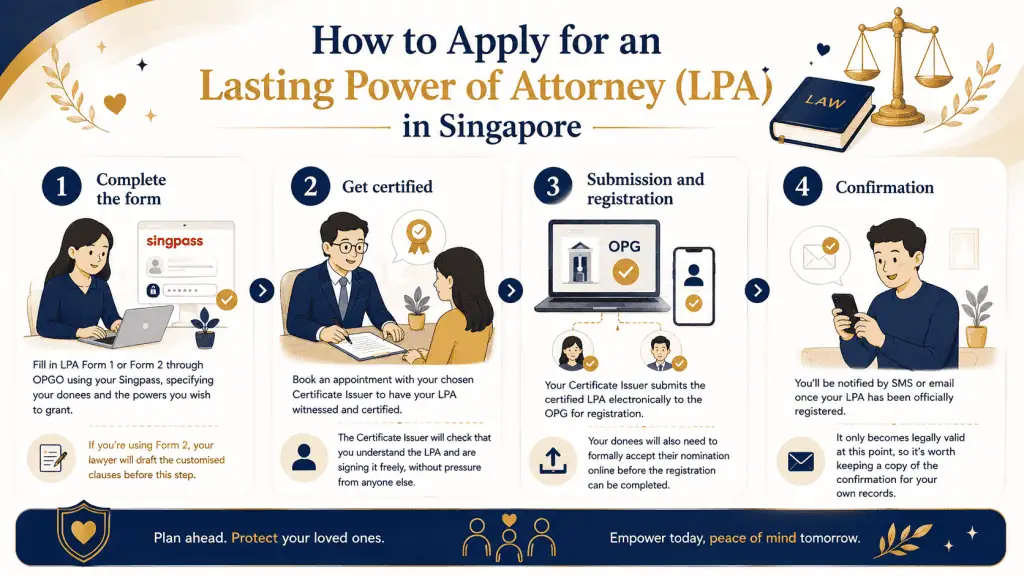
1. Complete the form
Fill in LPA Form 1 or Form 2 through OPGO using your Singpass, specifying your donees and the powers you wish to grant. If you’re using Form 2, your lawyer will draft the customised clauses before this step.
2. Get certified
Book an appointment with your chosen Certificate Issuer, who can be found through the Health Appointment System, to have your LPA witnessed and certified. The Certificate Issuer will check that you understand the LPA and are signing it freely, without pressure from anyone else.
3. Submission and registration
Your Certificate Issuer submits the certified LPA electronically to the OPG for registration. Your donees will also need to formally accept their nomination online before the registration can be completed.
4. Confirmation
You’ll be notified by SMS or email once your LPA has been officially registered. It only becomes legally valid at this point, so it’s worth keeping a copy of the confirmation for your own records.
How Much Does an Lasting Power of Attorney Cost in Singapore
From 1 April 2026, LPA Form 1 applications are free of charge for Singapore citizens on a permanent basis. Other applicants pay an application fee that depends on residency status and the form used, as set out in the OPG’s official LPA fees table.
| Residency status | Form 1 | Form 2 |
|---|---|---|
| Singapore Citizen | Free | $185 |
| Singapore PR | $90 | $230 |
| Foreigner | $230 | $275 |
On top of the application fee, every applicant, regardless of citizenship, pays a separate professional fee to their Certificate Issuer, which varies depending on the provider. Cancelling a registered LPA costs $28.
Also Read: Processing a Will after Death in Singapore
What Is a Professional Donee or Deputy
Not everyone has a family member available to act as their donee. Through the OPG’s Professional Deputies and Donees scheme, registered professionals, such as lawyers, accountants, and doctors, who’ve completed a certification course can be appointed as a donee or deputy for individuals without family support, including the single elderly or those without children.
Professional deputies must submit a schedule of their fees to the court for approval before being appointed, and are required to report annually to the Public Guardian.
What if the Donee Does Not Act in My Best Interest
If a donee fails to act in your best interest, the OPG will investigate upon receiving a complaint from a concerned party. The Public Guardian has powers under the Mental Capacity Act to look into how a donee is exercising their authority and take action where necessary.
What if I regain my mental capacity?
You may in such an event be able to revoke the Lasting Power of Attorney. You will be required to show proof that you have regained your mental capacity by way of support from a competent medical professional. Complete and sign a revocation form and inform every donee and also the Public Guardian of the revocation.
Protect Your Family With a Properly Drafted Lasting Power of Attorney
Setting up an Lasting Power of Attorney is straightforward for most people using Form 1, but it becomes more involved once you want customised powers, have more than two donees in mind, or hold assets that need specific handling instructions. Getting this right the first time matters, since mistakes or ambiguous terms in the LPA can create exactly the kind of family disputes it’s meant to prevent.
Ng Pui Khim has over 20 years of experience in estate planning and can help you draft an LPA Form 2, act as your Certificate Issuer, and advise on how your LPA works alongside your will and other power of attorney arrangements. Contact us to get started on your LPA today.
Frequently Asked Questions
Can I make an LPA without a lawyer?
For Form 1, yes. You can complete and submit it yourself through OPGO, though you’ll still need a Certificate Issuer to witness it. Form 2 must be drafted by a lawyer.
How long does LPA registration take?
Processing times vary depending on application volume. The OPG has noted that current processing may take longer than usual during periods of high demand.
Is the Certificate Issuer fee fixed?
No, it’s a professional fee set by the individual Certificate Issuer, separate from the OPG’s application fee.
What happens if I never make an LPA and lose mental capacity?
A family member would need to apply to the court for a deputyship order to be appointed as your decision-maker. The OPG notes this process is costly and time-consuming compared to registering an LPA in advance.
Can I appoint a family member and a professional donee together?
Yes, there’s no restriction against combining family and professional donees, provided their roles and powers are clearly specified in the LPA.

Ng Pui Khim is a senior lawyer with over 20 years of private practice experience focusing on divorces (family and matrimonial law), real estate (conveyancing practice), wills and succession law.
All rights reserved. Any information of a legal nature in this website is given in good faith and has been derived from resources believed to be reliable and accurate. The author of the information contained herein this website does not give any warranty or accept any responsibility arising in any way, including by reason of negligence for any errors or omissions herein. Readers should seek independent legal advice