

Table of Contents
- Legal Requirements for a Valid Will in Singapore
- 5 Steps to Writing Your Will in Singapore
- 10 Common Mistakes To Avoid When Writing Your Will
- Where to Store Your Will After Signing
- How Much Does It Cost to Write a Will in Singapore
- Will Writing for Expatriates
- Speak With a Wills Lawyer in Singapore
- Frequently Asked Questions
Writing a will in Singapore is the only way to make sure your assets are distributed according to your wishes, rather than by a default legal formula, in the event you pass away.
You do not strictly need a lawyer to draft a will, and it is legally possible to write your own. However, a will governed by the Wills Act must meet strict formalities, and even small oversights can leave it open to challenge or leave parts of your estate distributed against your intentions.
This guide covers the legal requirements for a valid will, the steps to writing one, and the 10 common mistakes people make, so that your last wishes can be properly fulfilled.
Legal Requirements for a Valid Will in Singapore
Wills in Singapore are governed by the Wills Act 1838. A will is only legally valid if it meets a specific set of formalities, and missing any one of them can render the entire document invalid, meaning your estate would then be distributed under the Intestate Succession Act instead of according to your wishes.
To be valid, your will must satisfy the following:
- You must be at least 21 years old at the time of signing.
- You must be of sound mind and understand the nature and effect of making a will.
- The will must be in writing, either typed or handwritten. Singapore does not recognise oral or video wills.
- You must sign the will at the foot of the document, or direct someone to sign on your behalf, in your presence.
- Your signature must be made or acknowledged in the presence of at least 2 witnesses, who are present at the same time, and who then also sign the will in your presence.
- Your witnesses must each be at least 21 years old, and must not be a beneficiary of the will or the spouse of a beneficiary. A gift to a witness, or their spouse, is void even if the rest of the will remains valid.
5 Steps to Writing Your Will in Singapore
Once you understand the legal requirements, the actual process of writing a will follows a fairly predictable sequence.
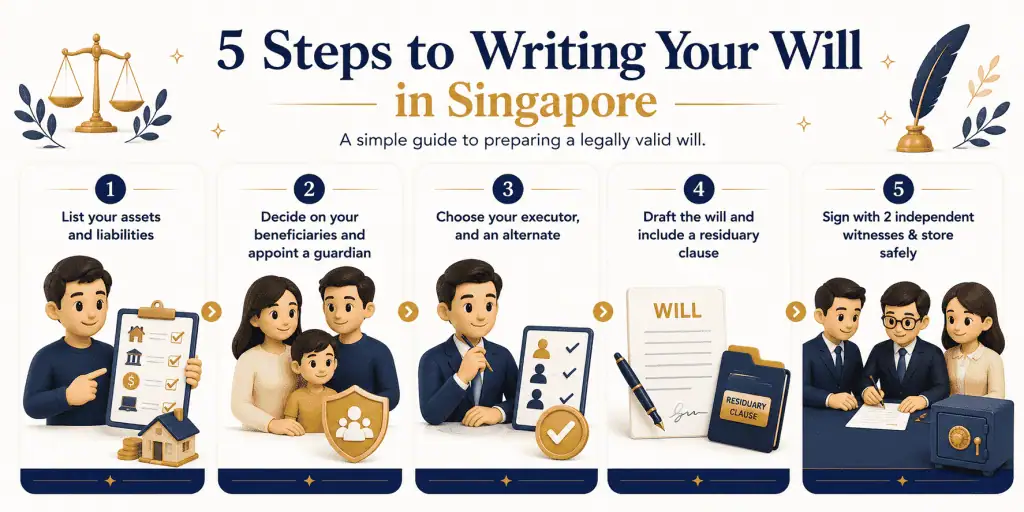
Step 1: List your assets and liabilities
Draw up a full inventory of what you own (property, bank accounts, investments, valuables, digital assets) and what you owe (loans, mortgages). CPF savings and insurance proceeds with a trust nomination fall outside this list, since they’re handled separately from your will.
Step 2: Decide on your beneficiaries and, if you have young children, appoint a guardian
Use full legal names and NRIC numbers to avoid ambiguity, and name a contingent beneficiary in case your first choice predeceases you. If you have children under 21, appoint a guardian (and ideally an alternate) and discuss it with them first.
Step 3: Choose your executor, and consider naming an alternate in case your first choice is unable or unwilling to act
Pick someone organised and trustworthy, aged at least 21, of sound mind, and not an undischarged bankrupt, this can be a family member, friend, or professional for larger estates. Discuss the appointment with them beforehand rather than making it a surprise.
Step 4: Draft the will itself, making sure to include a residuary clause that covers any asset not specifically mentioned
A properly structured will revokes any previous wills, appoints your executor and beneficiaries, and closes with a residuary clause so nothing defaults to intestacy rules. This is also where a lawyer adds the most value, by catching gaps or ambiguous wording before signing.
Step 5: Sign the will in the presence of 2 independent witnesses who are not beneficiaries or their spouses, then store it safely and let your executor know where to find it.
Sign with both witnesses present at the same time, then have them sign in your presence. Keep the document secure, consider registering it with the SAL Wills Registry, and make sure your executor knows where to find it.
Also Read: Processing a Will after Death in Singapore
10 Common Mistakes To Avoid When Writing Your Will
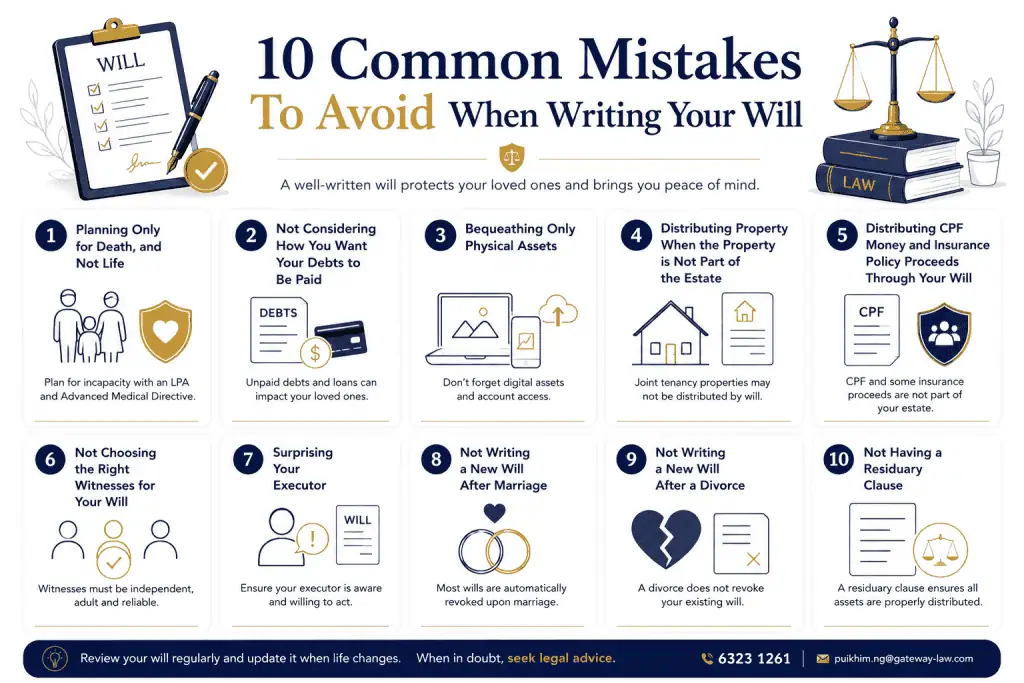
Mistake #1: Planning Only for Death, and Not Life
Your will comes in useful when you die. But have you considered what happens in the event you meet with a serious accident, suffer a stroke or dementia?
If you wish to provide and take care of the needs of your loved ones, just simply writing your will would be incomplete if it only addresses what happens upon your death. You may wish to address what happens while you are still alive.
This is best accomplished by preparing complementary documents such as the Lasting Power of Attorney (LPA) and Advanced Medical Directive.
- Why do you need LPA when writing your will?
When you make an Lasting Power of Attorney (LPA), you legally appoint someone you trust to decide and act on your behalf if you should lose the mental capacity to make decisions on your financial and personal matters.
If you do not make an LPA and subsequently lose your mental capacity, one of your family members would need to apply to the Court for an order to appoint him/her as a deputy to make decisions on your behalf. Such court applications would usually involve spending much time and money.
- What is Advanced Medical Directive?
Advanced Medical Directive is a legal document that you sign in advance to inform the doctor treating you, in the event, you become terminally ill and unconscious, that you do not want any extraordinary life-sustaining treatment to be used to prolong your life.
A will and an LPA serve different purposes and neither substitutes for the other.
| Aspect | Will | Lasting Power of Attorney |
|---|---|---|
| Takes effect | After you pass away | While you are alive but have lost mental capacity |
| Covers | Distribution of your estate | Financial and personal welfare decisions on your behalf |
| Who acts | The executor named in the will | The donee(s) appointed under the LPA |
| Registration | Optional, with the SAL Wills Registry | Must be registered with the Office of the Public Guardian to take effect |
Mistake #2: Not Considering How You Want Your Debts to Be Paid
Your family members would not be responsible for the debts left behind by you if you should pass away. However, in the event you have a personal loan taken jointly with a family member, that family member would have to assume the responsibility to repay the loan.
If you took a mortgage loan from a bank to finance a property, the joint owner of this property would have to take over the repayment of the mortgage loan upon your death. For HDB flats, it is compulsory for flat owners to buy mortgage insurance. However, for private properties, it is not compulsory to buy such mortgage insurance. It would be prudent for owners of private properties to consider buying mortgage insurance to protect their loved ones from the sudden financial burden of a mortgage loan.
Any debts left unpaid by you upon death will have to be paid out of your estate before your executor is able to distribute the remaining estate to the beneficiaries under your will.
Mistake #3: Bequeathing Only Physical Assets
In this digital era, overlooking online assets such as social media accounts and email accounts is a common blunder that is overlooked when preparing wills. Some of these assets, such as digital photos, might hold financial or sentimental value. Others, like login credentials, could be misused if distributed to someone you had not intended to.
If you have online accounts, it may be important to bequeath your digital information and property in your will. Your loved ones need to be able to log into your accounts, get the information they need, and close those accounts based on your instructions in your will.
Mistake #4: Distributing Property When the Property is Not Part of the Estate
Although there are many ways to distribute your assets, one easy way is to distribute your entire estate to your beneficiaries by percentages or fractions.
Should you wish to leave your property to specific individuals, do note that if you are not the sole owner of this property, check if the property is held in joint tenancy. Properties held in joint tenancy cannot be willed to someone else. This is because, for properties held in joint tenancy, the surviving owner takes ownership of the entire property automatically. Basically, joint tenancy supersedes intentions of any will. For a property that is held as tenants-in-common, you can will away your share of the property. It is possible to convert a joint tenancy to tenants-in-common, but you will need to get a conveyancing lawyer to do the legal documentation.
Mistake #5: Distributing CPF Money and Insurance Policy Proceeds Through Your Will
CPF money does not form a part of the estate and cannot be distributed by your will. For CPF money, you will have to make a nomination under the CPF Act.
For insurance policy proceeds, procedures are a little more complicated. Whether your will can determine the beneficiaries for your insurance policy depends on the kind of nomination that you make for your insurance policy.
Under the Insurance Act, you can make a trust nomination to benefit your spouse and children. When you make a trust nomination, you lose all rights to the ownership of the policy. The benefits of the policy no longer belong to you and are therefore not yours to distribute in your will.
Alternatively, you can also make a revocable nomination under the Insurance Act. Such a nomination can be revoked, and therefore can be distributed according to your will.
Mistake #6: Not Choosing the Right Witnesses for Your Will
For the signing of your will, you need to have 2 adult witnesses to your will.
Note that the 2 witnesses must not be beneficiaries or spouses of your beneficiaries in your will. This legal requirement ensures that the witnesses do not have a direct interest in your estate and as such would be impartial.
Failing to choose the right witnesses to your will could lead to your will becoming invalid.
Witnesses should preferably be literate and reliable individuals who would be able to help support the validity of the will should there be any doubts raised in Court, if the will becomes contested.
Mistake #7: Surprising Your Executor
It is important to discuss and inform your family member or friend before you appoint them as your executor in your will. It is probably not a good idea to “surprise” the executor of their appointment.
As the executor’s signature on the will is not necessary, there may be situations whereby the appointed executor had not been made aware of his or her appointment. In cases whereby the executor is unwilling to take on the role, it would mean that there would be additional costs and time delay in court applications to appoint a substitute administrator for the estate.
Mistake #8: Not Writing a New Will After Marriage
Some people forget that generally, a will is automatically revoked upon marriage or re-marriage. The exception is if the will expressly contemplate the marriage. Therefore, remember to write a new will after your marriage.
Mistake #9: Not Writing a New Will After a Divorce
A divorce does not revoke a will. You may have previously made a will to distribute your assets to your ex-spouse after your death, and this will remain valid even when your marriage has legally ended if you have not created a new will.
Remember that an estranged couple going through a separation is still a legally married couple, and if you have not done a will then under the provision of the Intestate Succession Act, the estranged spouse could very well inherit 50% of deceased’s estate. Further, as most couples hold their matrimonial home as joint tenants, under the right of survivorship, the other spouse will inherit the whole of the property upon the death of one spouse.
Hence, it is crucial to re-write your will if you are planning to go through with a divorce. If you have made a will previously, it is time to review it, having gone through a divorce. Appoint an appropriate executor to distribute your assets per your wishes and a reliable trustee to provide for your young children if anything untoward happens to you.
Mistake #10: Not Having a Residuary Clause
A residuary clause is a ‘catch-all’ clause that describes how to distribute the rest of the assets that you have not accounted for. This clause is useful in the case that you do not provide beneficiaries for all your assets. A residuary clause covers the rest of your property that has not been specifically mentioned in your will. Without such a clause, you risk having a complicated probate case in which assets not covered by the will end up being distributed by intestacy laws instead of according to your wishes.
Where to Store Your Will After Signing
A will is only useful if your executor can find it. Since 4 May 2020, the Wills Registry has been managed by the Singapore Academy of Law rather than the Public Trustee’s Office. Depositing information about your will with the Registry is optional, but it records the fact that a will exists and where it is kept, which makes it considerably easier for your executor or family to locate it after your death.
This is particularly useful for seniors living alone or anyone without a family member readily available to search for the document. Note that the Registry keeps a record of your will’s existence and location, not the contents of the will itself, so you should still inform your executor directly and keep the physical document somewhere safe.
How Much Does It Cost to Write a Will in Singapore
A DIY will costs little to nothing upfront, but the risk of a drafting error invalidating the document, or leaving it open to a challenge, generally outweighs the savings. Non-lawyer will-writing services are typically cheaper than engaging a lawyer directly, but they do not offer the same professional indemnity protection.
Engaging a lawyer to draft a simple, straightforward will in Singapore commonly costs a few hundred dollars, with fees increasing for more complex estates involving multiple properties, overseas assets, or trust arrangements for young beneficiaries.
It is not a legal requirement to engage a lawyer, but given how affordable professional will-writing fees generally are relative to the value of most estates, it is worth weighing the cost against the risk of a DIY will being found invalid.
Also Read: Selling House After Death in Singapore: When a Loved One Passes Away
Will Writing for Expatriates
For expatriates, if you have assets here in Singapore, different inheritance laws may apply to different types of assets.
For immovable properties such as apartments, local inheritance laws apply. However, for movable properties such as bank accounts, stock, and shares, the governing laws on inheritance would be your home country’s inheritance laws.
It is advisable to seek professional advice when drawing up a will to ensure that your concerns are dealt with appropriately. In situations of expatriates owning assets in Singapore, you may wish to consult a lawyer who is experienced with inheritance matters in Singapore for advice.
Speak With a Wills Lawyer in Singapore
Hiring a lawyer to help with your will preparation helps reduce the likelihood of your will being contested, and minimize leakages of wealth through taxes or complicated probate applications.
It is not a legal requirement to engage a lawyer to draft your will. However, professional fees charged for preparing a will is affordable and as such, it would be unwise of any person to attempt to create a DIY will, and risk having the will found to be invalid upon his/her death.
People most commonly engage a lawyer to make one’s will for several benefits, including:
- Obtaining professional advice on the distribution of your assets
- Ensuring clarity of the will
- Avoiding mistakes during the drafting procedure
- Reducing the likelihood of your will being contested
At iLawyer, we have helped individuals prepare wills of varying complexity, sparing our clients the stress of second-guessing whether their document will hold up. Planning ahead, and getting your will, LPA, and other legal documents in order, gives you and your family peace of mind today and in the future. Contact us for a consultation on your will, probate, and estate matters today.
Frequently Asked Questions
Can I change my will after it is signed?
Yes. You can amend a will with a codicil for minor changes, or revoke it entirely and write a new one. Any major life event, such as marriage, divorce, the birth of a child, or a significant change in assets, is a good reason to review your existing will.
Does divorce automatically revoke my will?
No. A divorce or annulment does not, by itself, remove a former spouse’s appointment as executor or beneficiary under a will made during the marriage. You need to actively update your will if you no longer want your ex-spouse to inherit or act as executor.
What happens if I die without a will in Singapore?
Your estate is distributed under the Intestate Succession Act, following a fixed legal formula that may not reflect your actual wishes. This can also mean a longer, more complicated process for your loved ones compared to a clear, validly executed will.

Ng Pui Khim is a senior lawyer with over 20 years of private practice experience focusing on divorces (family and matrimonial law), real estate (conveyancing practice), wills and succession law.
All rights reserved. Any information of a legal nature in this website is given in good faith and has been derived from resources believed to be reliable and accurate. The author of the information contained herein this website does not give any warranty or accept any responsibility arising in any way, including by reason of negligence for any errors or omissions herein. Readers should seek independent legal advice