

Table of Contents
- Obtain the Digital Death Certificate
- Arrange the Funeral and Wake
- Notify Relatives and Friends
- Consider Counselling and Support Services
- Legal Process After Death in Singapore
- Documents to Prepare Before Meeting a Probate Lawyer
- How Long Does Probate or Letters of Administration Take
- Get Help Settling Your Family’s Estate with Ng Phui Kim
- Frequently Asked Questions
Losing a family member is overwhelming enough without having to think about paperwork. But in Singapore, a few legal and administrative steps need to happen fairly quickly, from registering the death to eventually settling the estate.
This guide walks through what to do in the days and weeks after a loved one passes away, so you know what to expect at each stage.
Obtain the Digital Death Certificate
Since May 2022, Singapore no longer issues physical death certificates. Once a doctor certifies the death online, it is automatically registered with the Immigration and Checkpoints Authority (ICA), and a digital death certificate is generated immediately. There is nothing to do at a registration counter.
- If death occurs in a hospital, hospital staff will certify the death and provide a death document number.
- If death occurs at home, contact the family doctor, or any nearby doctor willing to make a house call, to issue a Certificate of Cause of Death. If the death is unexpected or suspicious, call the police at 999 instead.
- Once certified, the next-of-kin downloads the digital death certificate from MyLegacy using Singpass. This must be done within 30 days, and there is no fee.
- The deceased’s NRIC is automatically invalidated in ICA’s system once the death is registered. Families are advised to destroy the physical card (cutting or punching a hole through it) to prevent misuse, since it is no longer surrendered at a counter.
Arrange the Funeral and Wake
With the death document number in hand, you can engage a funeral director, who will help coordinate the wake, transport, and the permit for burial or cremation from the National Environment Agency (NEA). You can find a list of licensed directors on the Association of Funeral Directors Singapore website.
- HDB estate: Get a permit from your Town Council, and apply to HDB for temporary parking for the wake.
- Private landed property: If the wake spills onto public roads or walkways, apply for a Temporary Occupation Licence from the Singapore Land Authority. For URA-managed parking lots, apply directly through URA’s e-services.
- Wakes can generally run up to seven days without special approval. If you need more time, your funeral director can help apply to NEA for an extension.
Notify Relatives and Friends
Beyond informing close family, many families choose to place an obituary in the local newspapers to reach a wider circle of relatives and friends.
Consider Counselling and Support Services
Grief affects people differently, and it’s worth knowing where to turn if the loss becomes difficult to manage. Government-funded Family Service Centres, voluntary welfare organisations, and the Samaritans of Singapore all offer support for bereaved families, at no cost in most cases.
Also Read: Selling House After Death in Singapore: When a Loved One Passes Away
Legal Process After Death in Singapore
Once the immediate arrangements are settled, the family still needs to work through the legal side of things, mainly deciding how the deceased’s assets get accessed and distributed. What applies depends largely on whether the deceased left a valid will.
| Conditions | Grant of Probate | Letters of Administration |
|---|---|---|
| When it applies | Deceased left a valid will | Deceased left no valid will |
| Who applies | Executor named in the will | Next-of-kin, in the priority order set by law |
| How shares are decided | Follows the instructions in the will | Follows the Intestate Succession Act |
| Typical timeline | Around 2 to 6 months for uncontested cases | Similar or slightly longer, since the court must first confirm who is entitled to apply |
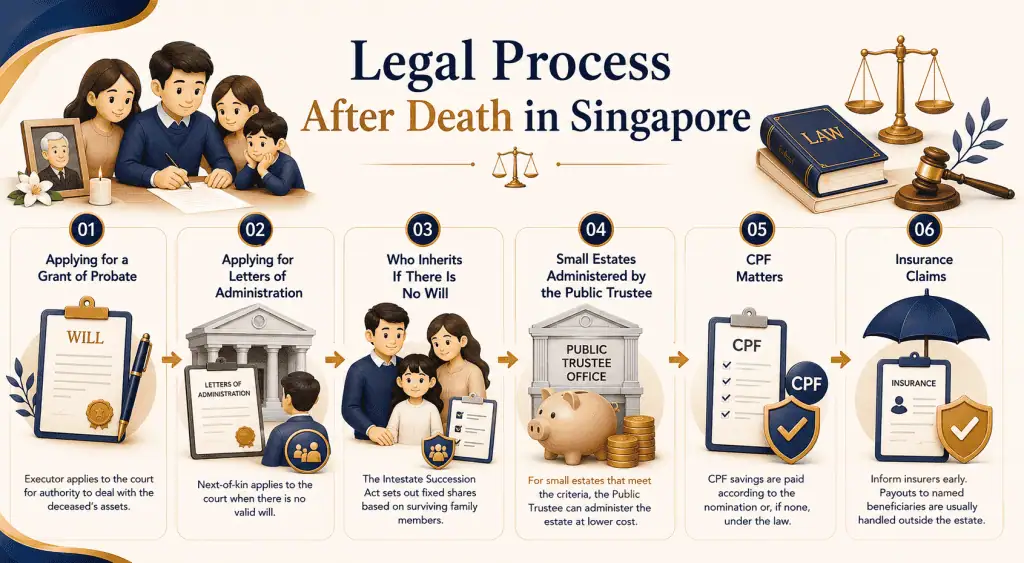
1. Applying for a Grant of Probate
If there’s a will, the named executor applies to the Family Justice Courts for a Grant of Probate. This is the document that legally authorises them to deal with the deceased’s assets, and most institutions, banks, insurers, property agents, won’t act without seeing it. Gathering the original will, the digital death certificate, and a full list of assets and debts before filing helps keep the timeline on track.
2. Applying for Letters of Administration
If there’s no valid will, the closest next-of-kin applies for a Grant of Letters of Administration instead. The process is broadly similar to Probate, except the court must first establish who is entitled to apply and how the estate should be divided, since there are no written instructions to follow.
3. Who Inherits If There Is No Will
Where there’s no will, the Intestate Succession Act sets out fixed shares based on surviving family members, rather than personal wishes.
| Surviving family | Distribution |
|---|---|
| Spouse only | Spouse receives the whole estate |
| Spouse and children | Spouse receives half, children share the other half equally |
| Spouse and parents, no children | Spouse receives half, parents share the other half equally |
| Children only, no spouse | Children share the estate equally |
| Parents only, no spouse or children | Parents share the estate equally |
| No spouse, children or parents | Passes to siblings, then grandparents, then aunts and uncles |
This framework doesn’t apply to Muslims. For a Muslim estate, a beneficiary applies to the Syariah Court for an Inheritance Certificate, which determines distribution under Muslim law instead.
4. Small Estates Administered by the Public Trustee
Not every estate needs to go through the courts. If the total value doesn’t exceed S$50,000 (excluding debts), there’s no immovable property involved, and the deceased left no will, the family may apply to the Public Trustee’s Office to administer the estate instead, at a lower cost and without a Grant of Probate or Letters of Administration.
The Public Trustee will decline to act if there are outstanding debts, a pending court application, business interests, or ongoing lawsuits involving the deceased.
5. CPF Matters
A Grant of Probate is never required to claim CPF savings, regardless of whether the deceased made a nomination. If there is a valid CPF nomination, the CPF Board pays the nominated beneficiaries directly. If there is no nomination, the monies go to the Public Trustee for distribution, either under the Intestate Succession Act (non-Muslims) or according to Muslim inheritance law (Muslims).
Singapore citizens and PRs don’t need to notify CPF Board separately, since the Board is informed automatically.
6. Insurance Claims
Inform the deceased’s insurance companies as early as possible. Payouts from policies with a named beneficiary are usually handled outside the estate, similar to CPF nominations, though each insurer has its own claims process and documentation requirements.
Documents to Prepare Before Meeting a Probate Lawyer
If you’re applying for a Grant of Probate or Letters of Administration, having these documents ready before your first consultation makes the process considerably faster.
- The deceased’s original will, if one exists
- Digital death certificate
- NRIC of the deceased and the applicant
- Marriage certificate and children’s birth certificates, where relevant
- Bank statements and CPF statement
- Insurance policies
- Property title deeds or HDB particulars
- A list of known debts and outstanding bills
Also Read: How to Process a Will after Death in Singapore?
How Long Does Probate or Letters of Administration Take
In straightforward, uncontested cases, obtaining a Grant of Probate or Letters of Administration typically takes a few months from filing to the grant being issued. After that, the executor or administrator still needs to identify assets, settle debts, and distribute what remains, which adds further time.
Disputes among beneficiaries, contested wills, or assets held overseas can extend the process well beyond a year, so it’s worth setting realistic expectations with your lawyer from the outset rather than working off a fixed number.
Get Help Settling Your Family’s Estate with Ng Phui Kim
Handling a family member’s affairs after their passing is rarely simple, even when the paperwork looks straightforward on paper. Knowing which process applies to your situation, and getting the documents in order early, makes a real difference to how smoothly the estate gets settled.
If you need help applying for a Grant of Probate, Letters of Administration, or have questions about a loved one’s will, Ng Pui Khim can guide you through the process.
Get in touch through iLawyer’s contact page or call 6323 1261 to arrange a consultation. Explore our Probate and Letters of Administration and Will Writing services for more information.
Frequently Asked Questions
How soon should I apply for Probate or Letters of Administration?
There’s no fixed deadline for Probate, but it’s best to apply as soon as the estate’s documents are in order. For Letters of Administration, aim to file within six months of the date of death; applying later isn’t impossible, but you’ll need to explain the delay to the court.
Do I need a lawyer to apply for a Grant?
Not always. Very simple, uncontested cases can sometimes be filed without one, but a lawyer is strongly recommended once property, overseas assets, or family disagreements are involved, since errors in the filing can set the timeline back by weeks.
Can I access the deceased’s bank account before getting a Grant?
Most banks won’t release funds without a Grant of Probate or Letters of Administration. For small estates under S$50,000, the Public Trustee route may let you access certain assets without going through the courts.
Is there a fee to download the digital death certificate?
No. It’s free via MyLegacy using Singpass, and must be downloaded within 30 days of issuance.
What if there’s no will and the estate is small?
If the estate is worth S$50,000 or less, has no property, and the deceased left no will, the family can apply directly to the Public Trustee’s Office instead of going through the Family Justice Courts.

The PKNG Editorial Team researches and maintains general Singapore legal information for iLawyer. Its work follows the site editorial policy and uses authoritative sources where available.
All rights reserved. Any information of a legal nature in this website is given in good faith and has been derived from resources believed to be reliable and accurate. The author of the information contained herein this website does not give any warranty or accept any responsibility arising in any way, including by reason of negligence for any errors or omissions herein. Readers should seek independent legal advice