

You’re grieving a loved one’s passing when another major responsibility lands on your plate—figuring out what to do with their property. Maybe you’re the eldest child, or the only one living in Singapore, and the responsibility naturally falls on you. But can you legally sell the house?
In Singapore, selling a deceased person’s house requires following a legal process that depends on whether a will was left behind and who has been appointed to manage the estate. Many families face delays, disagreements, or complications because they weren’t aware of these steps—or the legal deadlines involved.
If you’re in this situation, understanding your rights, obligations, and the relevant timelines can save you time, money, and emotional stress.
What Is “Selling House After Death”?
The legal process involved before you can sell a house belonging to the deceased after someone’s death falls under probate and estate administration law. A personal representative of the estate of the deceased needs to be granted by the Court with authority to sell the house.
This personal representative is either:
- An executor, if the deceased left a valid will; or
- An administrator, if there was no will.
Before any sale can proceed, the personal representative must apply to the Family Justice Courts for a:
- Grant of Probate (if there is a will), or
- Grant of Letters of Administration (if there is no will).
Only after this grant is obtained can they legally manage the estate—including selling any property on behalf of the Estate before distribution of sale proceeds to the beneficiaries.
Also Read: Processing a Will after Death in Singapore
Common Scenarios That Trigger This Issue
These situations are more common than you might expect:
| Scenario | What Typically Happens |
|---|---|
| Parent passes away without a will | Children are unsure who can legally sell the flat or how proceeds should be divided |
| Parent leaves a will, but house must be sold | Executor tries to sell the property to distribute assets fairly, but may face delay in getting the Grant from the Court. |
| One sibling wants to sell, another does not wish to sell | Disagreements arise over what to do with the property |
| HDB flat that is still within the MOP period or the beneficiary does not satisfy eligibility rules | Family unsure whether the flat can be legally sold or transferred. |
| Buyer is ready, but probate has not been granted | Transaction stalls because no one has legal authority to sell the house. |
Legal Steps for Selling a Deceased’s Property in Singapore
Here’s how the process usually unfolds:
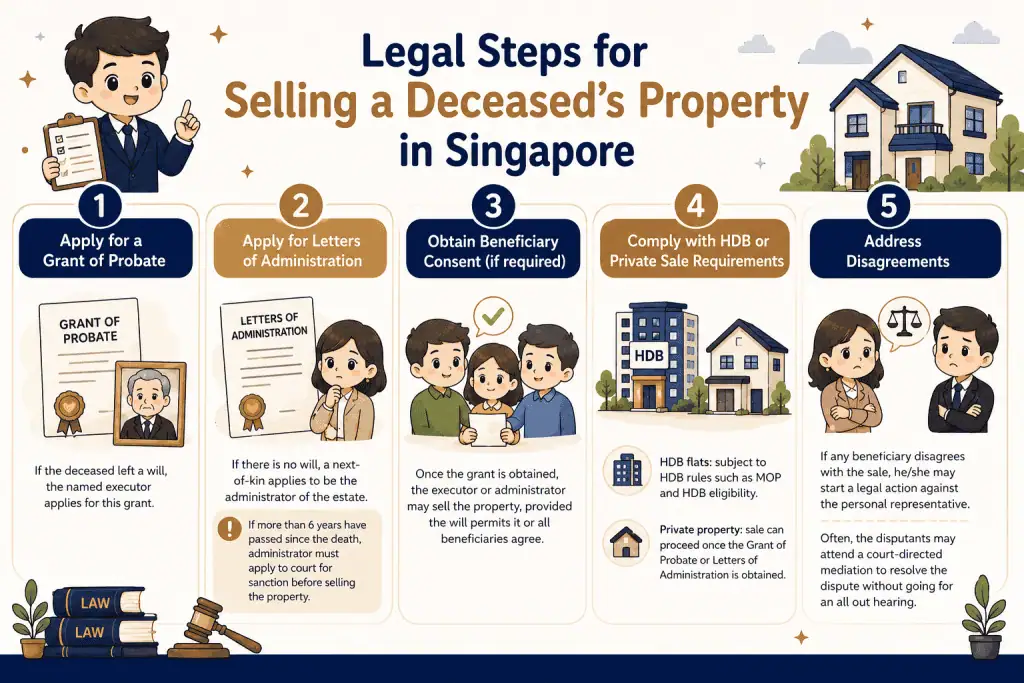
1. Apply for a Grant of Probate
If the deceased left a will, the named executor applies for this grant, which gives them authority to manage the estate and sell the property.
2. Apply for Letters of Administration
If there is no will, a next-of-kin (e.g. spouse, adult child) must apply to be appointed as the administrator of the estate.
Important: If more than 6 years have passed since the death, the administrator must also apply to court for sanction (special permission) before selling the property—even after getting the grant.
3. Obtain Beneficiary Consent (if required)
Once the grant is obtained, the executor or administrator may sell the property, provided the will permits it or all beneficiaries agree to the terms.
4. Comply with HDB or Private Sale Requirements
For HDB flats, resale is subject to HDB rules such as Minimum Occupation Period (MOP) and HDB eligibility. For private property, the sale can proceed once the personal representative has received the Grant of Probate or Letters of Administration.
5. Address Disagreements
If any beneficiary disagrees with the sale, he/she may start a legal action against the personal representative. Often, the disputants may attend a court-directed mediation in an attempt to resolve the dispute without going for an all out hearing.
Why Timing Matters
Many families delay the probate process out of grief or confusion—but there are real legal consequences for waiting too long:
1. Limitation Period for Claims
Under Singapore’s Limitation Act, any person seeking to bring a claim against the estate (e.g. debts owed, disputes over distributions) will need to ensure that he brings out the action before the 12 year or 6 year limitation period, depending on the nature of the claim.
2. Court Sanction Required After 6 Years (usually in cases whereby the deceased did not leave a will)
If a loved one passed away more than 6 years ago and did not leave a will, the appointed Administrator must apply for court sanction—basically a judge’s approval—before the property can be sold. This step is meant to ensure proper administration of the estate and protect beneficiaries’ interest.
The Administrator will need to engage a lawyer to apply to the High Court to obtain the court sanction and the entire legal process can take about 2–3 months to complete.
3. Delays Create Financial and Legal Risks
- Buyers may walk away if documents are not ready
- Gross value of the estate Estate value may reduce may fall due to delays in selling property. maintenance or tax issues There could be delays in renting out the house to potential tenants.
- Family conflict may occur or escalate over time
- Property tax may increase if transfer of properties to the beneficiaries are not done within reasonable time frame.
Getting legal advice early helps you meet deadlines, preserve estate value, and avoid unnecessary escalations in legal costs.
Also Read: When a Joint Flat Owner Passed Away in Singapore
How Pui Khim Can Help with Property Sales After Death
Pui Khim has helped many families in Singapore navigate the sensitive and often complex process of selling a loved one’s home after death. Whether you’re dealing with probate for the first time, facing a time-sensitive sale, or needing court sanction for an older estate, she can guide you through each step.
Clients trust her for:
- Clear, practical legal advice
- Efficient handling of court applications and property transactions
- Calm, compassionate support during emotionally difficult times
With Pui Khim’s help, you can ensure that the property sale is done correctly, legally, and without unnecessary delays. Contact us, here!
FAQs – Selling a House After Death in Singapore
Can I sell my parent’s house immediately after they pass away?
No. You must first obtain a Grant of Probate (if there’s a will) or Letters of Administration (if not). Without this, no one has the legal right to sell the property.
What if my parent passed away more than 6 years ago and didn’t leave a will?
In such cases, the administrator must obtain court sanction—official permission from the court—before the property can be sold.
How long does probate take?
For straightforward estates, 2 to 3 months. 4–6 weeks. Complex probate cases (incomplete documentation provided by executor, foreigner executor, extensive assets, foreigner deceased, discrepancies in the will disputes raised by beneficiaries about the will) may take many months.
Can a HDB flat be sold after the owner’s death?
Yes, but HDB resale conditions like the Minimum Occupation Period (MOP) still apply. You must also complete the probate process before proceeding.
What happens if the beneficiaries do not agree to the sale of the deceased’s house?
Mediation is often the recommended first step. If no resolution is found, the next step is the litigation route in which the Court may will make a determination after a full hearing of the disputing parties and issue a judgement.
Is there a time limit for handling estate matters?
Yes. Court sanction is needed to sell property if the death occurred more than 6 years ago and the deceased did not leave a will.
Do I need a lawyer to sell the property?
It’s not mandatory, but having a probate lawyer like Pui Khim helps you avoid delays, comply with Singapore laws and regulatory authorities, thus preventing the occurrence or escalation of family conflicts.

The PKNG Editorial Team researches and maintains general Singapore legal information for iLawyer. Its work follows the site editorial policy and uses authoritative sources where available.
All rights reserved. Any information of a legal nature in this website is given in good faith and has been derived from resources believed to be reliable and accurate. The author of the information contained herein this website does not give any warranty or accept any responsibility arising in any way, including by reason of negligence for any errors or omissions herein. Readers should seek independent legal advice