

Table of Contents
- What Is Division of Matrimonial Assets?
- Common Scenarios That Trigger Division Disputes
- Legal Remedies in Singapore for Division of Matrimonial Assets
- How the Court Divides Matrimonial Assets: The Just and Equitable Principle
- The Just and Equitable Principle: How Ratios Are Calculated
- Why Early Legal Advice Matters for Division of Matrimonial Assets
- How Pui Khim Can Help with Division of Matrimonial Assets
- FAQs – Division of Matrimonial Assets in Singapore
When a couple decides to divorce, the emotional weight is often compounded by practical concerns especially around property and finances.
One common source of tension? ? Figuring out who gets what after the split.
Many people assume that if their asset is under their sole name, it automatically belongs to them but that is not always the case under Singapore family law.
The division of matrimonial assets is a central part of any divorce proceeding, covering everything from the family home and savings to CPF monies and even inheritance gifts.
In Singapore, this issue is more relevant than ever due to rising property values and dual-income households. Understanding how assets are classified and divided can reduce unnecessary stress and help you make informed decisions during this transition.
What Is Division of Matrimonial Assets?
In Singapore, the division of matrimonial assets refers to how a couple’s shared property is split during a divorce. It’s not just about who paid for what.
The Courts look at contributions from both spouses, which includes those that are financial as well as those that are non-financial in nature.
Under the Women’s Charter, the Court makes a “just and equitable” division of the matrimonial assets of the couple. This applies to assets acquired during the marriage, or those substantially improved by either party. Even assets in one spouse’s sole name may be included if the assets meet this threshold.
The term “just and equitable” focuses on fairness, and it does not necessarily mean equal division.
What counts as a matrimonial asset?
- Family home (HDB flat, private property)
- CPF savings used or accumulated during the marriage
- Joint bank accounts and savings
- Investments and shares acquired during the marriage
- Businesses started or grown during the marriage
- Assets substantially improved by either spouse during the marriage
What is typically excluded?
- Assets acquired before the marriage
- Inheritances or gifts received from a third party — unless they were substantially improved or used as a matrimonial home during the marriage
Also Read: 10 Secrets You Wish Knew Before Your Divorce
Common Scenarios That Trigger Division Disputes
Disagreements over asset division are more common than people think especially when emotions run high and finances are intertwined. Here are typical scenarios where this legal issue surfaces:
| Scenario | What Typically Happens |
|---|---|
| One spouse paid for the house but the other raised the children | Both want a share of the home, leading to disputes over who contributed more |
| Joint savings account built during the marriage | One party tries to withdraw large amounts before finalising the divorce |
| CPF funds used to pay for property | The working spouse who contributed more CPF funds to the property may not always be able to claim full credit especially if the non-working spouse is a full-time homemaker and caregiver for the children. |
| Gifts received by couple from one party’s parents or inherited assets | One spouse claims exclusion; the other insists it became a shared asset |
| Business started during the marriage | Disagreement arises over valuation and share of ownership |
| One spouse handled all household duties | There are differing views between the parties on the importance of the homemaker spouse’s non-financial contribution towards the matrimonial assets. |
Legal Remedies in Singapore for Division of Matrimonial Assets
While this issue is usually resolved within divorce proceedings, there are structured legal remedies to ensure fairness:
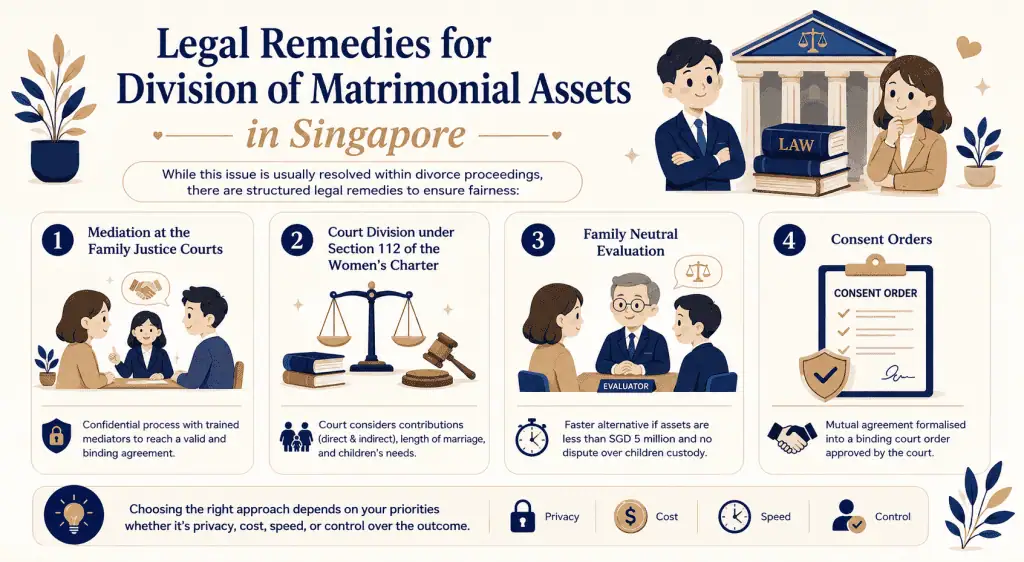
1. Mediation at the Family Justice Courts
A confidential process where both parties can reach a valid and binding agreement, guided by trained mediators. Suitable for cases in which both parties are keen on negotiating for a fair and reasonable settlement.
2. Court Division under Section 112 of the Women’s Charter
The Court decides on the division after considering both parties’ contributions (both direct and indirect), length of marriage, and needs of the children. Litigation is the most common route when the parties are unable to reach a settlement after mediation.
3. Family Neutral Evaluation
If there are no disputes over children custody and the gross value of matrimonial assets is less than SGD 5 million, the Family Neutral Evaluation Programme of the Courts is faster than the litigation route and is an alternative dispute resolution to consider.
The objective is to help parties reach an early amicable resolution without going for a hearing in court. Couples agree to appoint a private arbitrator, often a senior lawyer or judge. Both parties and respective counsels are present to make their arguments before the evaluator thoughout the joint session.
4. Consent Orders
If both parties can agree on asset division, they can submit a Consent Order for the court’s approval therefore, formalising their settlement agreement into a binding court order.
Choosing the right approach depends on your priorities whether it’s privacy, cost, speed, or control over the outcome.
| Remedy | Best For | Speed | Cost |
|---|---|---|---|
| Mediation | Amicable couples wanting control | Fast | Low |
| Court Division | High-conflict disputes | Slow | High |
| Neutral Evaluation | Complex assets under $5M | Medium | Medium |
| Consent Order | Full agreement reached | Very Fast | Low |
How the Court Divides Matrimonial Assets: The Just and Equitable Principle
The court does not simply split assets down the middle. It follows a structured assessment of each spouse’s contributions before arriving at a division ratio.
- Direct contributions include financial payments toward the acquisition of an asset — mortgage payments, CPF contributions toward property, cash payments.
- Indirect contributions include non-financial efforts that benefited the family — caregiving, managing the household, supporting a spouse’s career, raising children.
Both carry weight. A spouse who did not work but raised the children and managed the home throughout a long marriage is recognised by the court as having made substantial indirect contributions.
The court also considers:
- Length of the marriage
- Needs and welfare of any children
- Each spouse’s earning capacity and financial obligations
- Whether any agreement on asset division was reached before or during the marriage
The Just and Equitable Principle: How Ratios Are Calculated
Courts in Singapore typically approach the division of matrimonial assets using one of two methodologies, depending on the complexity of the case:
- Global Assessment Method — The court pools all matrimonial assets together and assigns a single division ratio based on the overall contributions of each party. This approach is common for straightforward cases.
- Classification Method — The court divides assets into classes (e.g. the matrimonial home separately from other assets) and assesses contributions for each class individually. This is applied where the parties’ contributions differ significantly across different assets.
In long marriages, indirect contributions carry greater weight, and courts are more willing to award a larger share to a homemaker spouse. In shorter marriages, direct financial contributions tend to dominate the assessment.
Also Read: Divorce Procedure in Singapore: Step-by-Step Process, Timeline and Requirements
Why Early Legal Advice Matters for Division of Matrimonial Assets
Many procrastinate and delay in obtaining legal advice on divorce matters, hoping things will change for the better or resolve automatically without the need to do anything . But delaying indefinitely can cause complications such as:
- Key financial records may become harder to retrieve
- Missing deadlines can limit what you can claim or defend
- Early legal advice helps one to be able to negotiate effectively and often reduces costly litigation
Getting legal clarity early isn’t about escalating conflict; it’s about protecting your rights and avoiding future regrets.
How Pui Khim Can Help with Division of Matrimonial Assets
Division of matrimonial assets is a common concern among clients going through divorce and Pui Khim has guided many through this emotionally charged process with clarity and empathy.
As a senior lawyer at Gateway Law, she offers:
- Clear legal advice on what counts as a matrimonial asset
- Practical strategies tailored to your circumstances
- Strong representation in both mediation and court proceedings
Clients value her responsive, down-to-earth approach, especially when balancing legal outcomes with long-term family well-being.
If you’re unsure how to navigate the financial side of divorce, Pui Khim can help you move forward with confidence. Contact us here!
FAQs – Division of Matrimonial Assets in Singapore
What qualifies as a matrimonial asset in Singapore?
Any asset acquired during the marriage or substantially improved during the marriage including homes, savings, CPF funds, and even certain gifts.
Will the court always split everything 50/50?
No. The court looks at both spouses’ contributions; financial and non-financial to determine a fair split. It’s about equity, not equality.
Is my HDB flat part of the matrimonial assets?
Yes, if it was acquired during the marriage or used as the family home. Even if one spouse paid for it, both may have a claim depending on their contributions.
Can I keep my inheritance or pre-marriage property?
Possibly. Inheritances and assets acquired before marriage are usually excluded unless they’ve been used or improved during the marriage in a way that makes them shared.
How can Pui Khim help me in my asset division case?
Pui Khim can clarify your rights, guide negotiations, and ensure your contributions are fully recognised—whether through mediation or court.

The PKNG Editorial Team researches and maintains general Singapore legal information for iLawyer. Its work follows the site editorial policy and uses authoritative sources where available.
All rights reserved. Any information of a legal nature in this website is given in good faith and has been derived from resources believed to be reliable and accurate. The author of the information contained herein this website does not give any warranty or accept any responsibility arising in any way, including by reason of negligence for any errors or omissions herein. Readers should seek independent legal advice