

Table of Contents
- Does Singapore probate apply to foreigners?
- What counts as “foreign assets” in this context?
- The two main paths for dealing with foreign estates in Singapore
- The impact of the Family Justice Rules 2024
- What documents are usually needed?
- Extra requirements where the deceased died domiciled outside Singapore
- What information is expected in a resealing application?
- What happens after the Singapore grant is issued?
- Small estates: can the Public Trustee help?
- Common challenges in cross-border estate administration
- Which assets may avoid probate?
- Is there inheritance tax or estate duty in Singapore?
- Example: when resealing may be the right route
- Managing Foreign Assets in Singapore? Get the Right Legal Support
- Frequently Asked Questions
Losing a loved one is difficult enough. It becomes more complicated when their estate spans more than one country and probate for foreign assets held in Singapore adds a layer of process that many families are not prepared for.
In many cases, the family already has a foreign death certificate and may even have a foreign will or foreign grant, but still cannot access or transfer the Singapore assets until the proper Singapore process is completed. That is where cross-border probate becomes critical.
This guide focuses on the reverse-inbound situation: a foreigner or overseas estate with assets in Singapore. The key question is usually not whether the family has authority somewhere else, but whether that authority is recognised in Singapore, or whether a fresh local application is needed.
Does Singapore probate apply to foreigners?
Yes. Singapore probate rules can apply even if the deceased was not a Singapore citizen or resident. The real issue is whether the deceased left assets in Singapore that require a court-recognised legal representative before banks, brokers, or other institutions will release or transfer them.
What counts as “foreign assets” in this context?
For this article, the more useful phrase is not foreign assets in the abstract, but Singapore-based assets forming part of a foreign estate. Common examples include:
- Singapore bank accounts
- Singapore-listed shares or CDP holdings
- Brokerage accounts in Singapore
- Real estate in Singapore
- Valuable personal property located in Singapore
Also Read: Selling House After Death in Singapore: When a Loved One Passes Away
The two main paths for dealing with foreign estates in Singapore
This is the most important legal distinction.
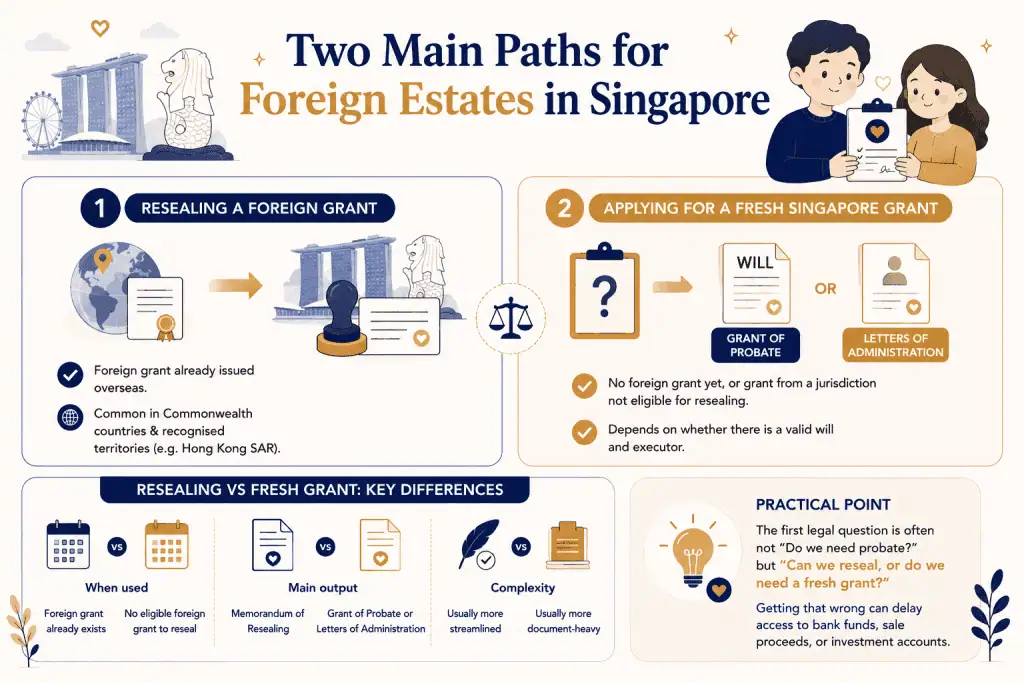
1. Resealing a foreign grant
If a grant of probate or letters of administration has already been issued overseas, it may be possible to apply for that foreign grant to be re-sealed in Singapore instead of starting a completely new probate matter.
In practical terms, this route is commonly relevant where the existing grant comes from a Commonwealth country or another recognised territory such as Hong Kong SAR.
2. Applying for a fresh Singapore grant
If there is no foreign grant yet, or the foreign grant comes from a jurisdiction that is not eligible for resealing, the estate will usually need a fresh Singapore application.
That usually means either a Grant of Probate where there is a valid will and an executor able to act, or Letters of Administration where there is no will, or no executor who can take the grant.
Resealing vs fresh grant: key differences
| Feature | Resealing of foreign grant | Fresh Singapore grant | Typical use case |
| When used | A foreign grant already exists | No eligible foreign grant to reseal | Existing overseas authority may be recognised locally |
| Main output | Memorandum of Resealing | Grant of Probate or Letters of Administration | Court-backed authority for Singapore assets |
| Complexity | Usually more streamlined | Usually more document-heavy | Depends on documents and domicile issues |
Practical point: The first legal question is often not “Do we need probate?” but “Can we reseal, or do we need a fresh grant?” Getting that wrong can delay access to bank funds, sale proceeds, or investment accounts.
The impact of the Family Justice Rules 2024
The current probate framework became more structured under the Family Justice Rules 2024, which took effect on 15 October 2024. For cross-border estates, this matters because the rules and practice directions cover non-contentious probate proceedings, resealing applications, supporting affidavits, and schedules of assets.
What documents are usually needed?
The exact set depends on whether you are resealing a foreign grant or filing a fresh local application, but the usual starting documents include:
- Death certificate
- Original will, if any, or a certified true copy where accepted
- Foreign grant, if seeking resealing
- Identification documents for the applicant
- Certified translations for non-English documents
- Supporting affidavit
- Schedule of Assets listing the Singapore estate
Certified copies and translations
For foreign estates, document quality matters. Singapore procedure expects properly certified court and estate papers. If the will or other key documents are not in English, translations may be required.
The Schedule of Assets requirement
The Schedule of Assets is not a mere formality. Applicants must declare the assets comprising the estate, and if full asset information is not available at the initial stage, the Schedule may sometimes be filed later, with a supplementary affidavit if needed.
Also Read: When a Joint Flat Owner Passed Away in Singapore
Extra requirements where the deceased died domiciled outside Singapore
Cross-border applications can become more technical when the deceased died domiciled outside Singapore. Depending on the facts, the court may require evidence on foreign law, including who is entitled to administer the estate, who the beneficiaries are under the law of the domicile, and whether the will was properly executed.
What information is expected in a resealing application?
A resealing application is still a formal court process. In practical terms, the papers should make clear:
- The deceased’s particulars
- The applicant’s capacity
- The foreign grant being relied on
- The Singapore assets concerned
- Whether the foreign grant has the equivalent legal effect of probate or letters of administration in Singapore
What happens after the Singapore grant is issued?
This is the part families usually care about most. Once the Singapore court issues the Grant of Probate, Grant of Letters of Administration, or Memorandum of Resealing, the executor or administrator can approach the bank, broker, property-related party, or other institution holding the asset.
In practical terms, the next steps are usually:
- Confirm that the asset is accurately listed in the Schedule of Assets.
- Present the relevant grant or resealed authority to the institution holding the asset.
- Provide any required death certificate, identification, and institution-specific forms.
- Arrange closure, transfer, or release of the asset into the estate account or to the legal representative.
Small estates: can the Public Trustee help?
Sometimes, yes, but this is a limited exception. Small estates of S$50,000 or less may in some cases be handled through the Public Trustee instead of a full court application, but only if the estate meets the relevant eligibility conditions and does not fall into an excluded category.
This should be treated as a narrow simplified route, not a general substitute for probate.
Common challenges in cross-border estate administration
Domicile and multiple wills
Cross-border estate matters often raise domicile questions. It is not unusual for a deceased person to have connections to several countries, or separate estate-planning documents for different jurisdictions. That can affect who is entitled to administer the estate and what evidence the Singapore court will require.
No will or no executor able to act
If there is no valid will, or no executor can take the grant, the estate will normally proceed by way of letters of administration. In broad terms, the spouse generally has first priority to apply, followed by other close family members in the order recognised by law.
Accessing Singapore bank accounts, shares, and CPF
Ordinary bank and investment assets often require a grant before they can be released. But some assets do not form part of the estate in the same way. CPF savings are a key example because they do not ordinarily form part of the deceased member’s estate, although certain CPF investment-related holdings may still fall into the estate.
Which assets may avoid probate?
Depending on the facts, assets that may not require the usual probate route include:
- CPF savings distributed under the CPF framework
- Some insurance proceeds where there is a valid nomination
- Certain jointly held assets passing by survivorship, such as some joint tenancies
Is there inheritance tax or estate duty in Singapore?
For most current estates, no. Singapore removed estate duty for deaths on and after 15 February 2008. That does not rule out tax issues elsewhere, but Singapore itself does not currently impose estate duty for deaths on or after that date.
Example: when resealing may be the right route
Assume a UK-domiciled individual dies leaving a Singapore bank account and a portfolio of Singapore-listed shares. The executor first obtains a UK grant of probate. Because the grant comes from a Commonwealth country, the executor may be able to apply in Singapore for resealing rather than filing a full new probate case.
Once the Singapore court grants resealing, the executor can then use that authority to deal with the local institutions holding the assets. This is often more efficient than starting from zero, although the filing still has to be done properly.
Managing Foreign Assets in Singapore? Get the Right Legal Support
Where a foreigner dies leaving assets in Singapore, the estate usually cannot be administered properly by relying on overseas documents alone. The first legal step is to determine whether the existing foreign grant can be re-sealed in Singapore, or whether the estate must apply for a fresh Grant of Probate or Letters of Administration here.
That distinction drives the cost, complexity, documents, and timing of the process. Cross-border estates also often involve domicile issues, foreign-law evidence, translations, and careful preparation of the Schedule of Assets.
If you need help assessing the correct route, preparing a Singapore filing, or dealing with local institutions after the grant is issued, professional probate lawyer can save time and reduce avoidable delays.
Ng Pui Khim personally handles probate and estate administration matters, including foreign estates, cross-border probate applications, and the resealing of foreign grants. With more than 20 years of legal experience, she provides practical and compassionate guidance to executors, administrators, and beneficiaries navigating complex estate matters.
Learn more about iLawyer’s Probate Services and speak with an experienced probate lawyer to discuss the most effective approach for administering foreign assets in Singapore.
Frequently Asked Questions
Are foreign assets subject to probate in Singapore?
If the relevant asset is located in Singapore and the institution holding it requires court-backed authority before transfer or release, then Singapore probate procedures usually apply. The main question is whether you can reseal an eligible foreign grant or need a fresh Singapore grant.
Which assets usually avoid probate?
Assets that pass by nomination or survivorship may not go through the normal probate route. CPF savings are a common example, as are certain insurance proceeds with nominations and some jointly held assets.
How long does resealing take?
There is no universal court-wide timeline. Timing depends on document readiness, translation requirements, whether the foreign grant is in order, and whether the court raises queries. Straightforward matters usually move faster than fresh non-Commonwealth grant applications.
Can the Schedule of Assets be filed later?
Sometimes, yes. If full asset information is not available at the initial stage, the Schedule of Assets may be submitted later, and a supplementary affidavit may be required.
Do foreigners need a Singapore lawyer for cross-border probate?
Not every case turns on the same facts, but in practice, cross-border probate and resealing matters are often handled by Singapore probate counsel because of the documentary, procedural, and foreign-law issues involved.

The PKNG Editorial Team researches and maintains general Singapore legal information for iLawyer. Its work follows the site editorial policy and uses authoritative sources where available.
All rights reserved. Any information of a legal nature in this website is given in good faith and has been derived from resources believed to be reliable and accurate. The author of the information contained herein this website does not give any warranty or accept any responsibility arising in any way, including by reason of negligence for any errors or omissions herein. Readers should seek independent legal advice