

Table of Contents
- Is “being unhappy” a legal ground for divorce in Singapore?
- 8 Signs of an Unhappy Marriage You Should Not Ignore
- Unhappy marriage vs. irretrievable breakdown: what is the difference?
- What Should You Do If You Notice These Signs?
- Speak to an Experienced Divorce Lawyer in Singapore
- FAQ About Unhappy Marriage
“I do.”
A simple promise that marks the beginning of a lifelong commitment built on love, trust, and companionship. However, marriage is not always easy. Over time, unresolved conflicts, emotional distance, financial stress, infidelity, and communication breakdowns can slowly weaken the foundation of a relationship. In many cases, couples do not suddenly fall out of love — problems often build quietly over the years until the marriage reaches a breaking point.
Marital breakdown continues to be a growing reality in Singapore. In 2024, Singapore recorded 7,382 divorces and annulments, representing a 3.7% increase compared to 2023. The median duration of marriage before divorce also increased to 12 years, showing that many couples remain in struggling marriages for years before eventually deciding to separate.
While every marriage has its challenges, certain warning signs may indicate deeper underlying problems. In this article, we discuss 8 common signs of an unhappy marriage and how they may eventually lead to divorce.
Is “being unhappy” a legal ground for divorce in Singapore?
Not directly. Under Singapore’s Women’s Charter, the only ground for divorce is that the marriage has irretrievably broken down. To prove this, a spouse must demonstrate at least one of five legally recognised facts:
- Adultery
- Unreasonable behaviour
- Desertion for a continuous period of at least 2 years
- Separation for at least 3 years (with consent from both parties)
- Separation for at least 4 years (without the other party’s consent)
This is why understanding how everyday marital signs translate into legal facts matters. The signs below are not just emotional indicators — for many couples, they form the factual basis of a divorce application.
| Unhappy marriage sign | Possible legal ground |
|---|---|
| Lack of communication / emotional withdrawal | Unreasonable behaviour |
| Criticism, contempt, stonewalling | Unreasonable behaviour |
| Abuse (physical or emotional) | Unreasonable behaviour / Desertion |
| Addiction (alcohol, gambling) | Unreasonable behaviour |
| Adultery | Adultery |
| Living separately | Separation (3 or 4 years) |
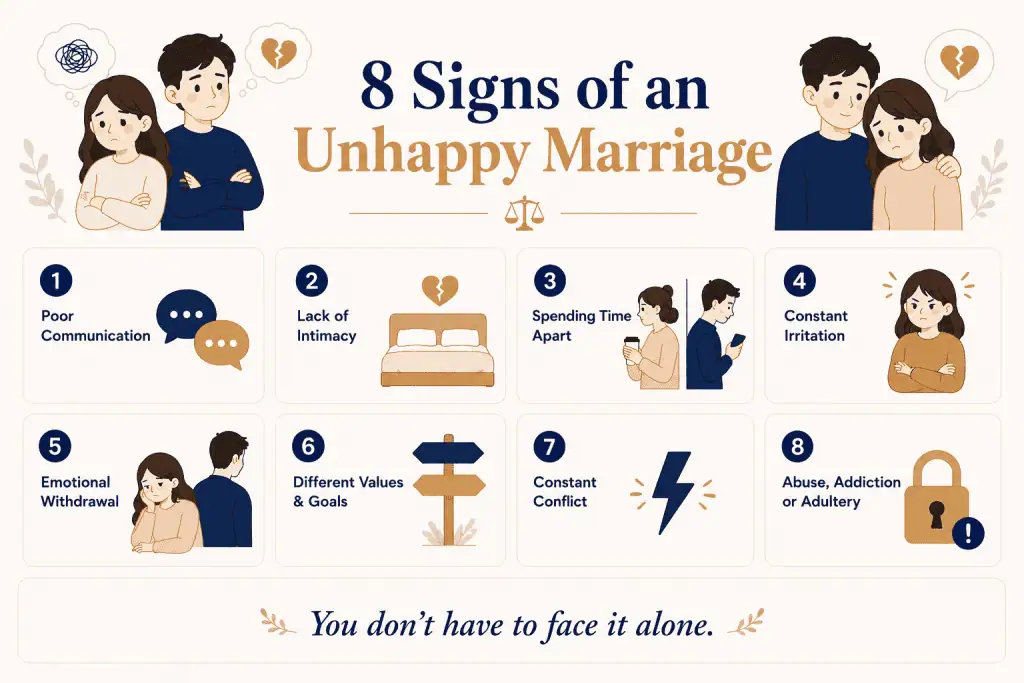
8 Signs of an Unhappy Marriage You Should Not Ignore
Given that being in an unhappy marriage can take a huge toll on our physical and emotional well-being – knowing the signs of a troubled marriage can help you decide if the red flags need to be addressed.
1. You hardly communicate anymore
At the start of the relationship, you had no shortage of things to talk about. Over time, you may find that conversations have become transactional — or have stopped almost entirely. You no longer share wins, worries, or daily moments with your partner.
Communication breakdown is not just emotionally damaging — it is often the first visible signal that a marriage is under strain. When problems go unaddressed because neither party feels heard, small issues compound into serious ones.
Persistent communication breakdown may contribute to claims of unreasonable behaviour during divorce proceedings, especially when it creates emotional distress or prolonged marital conflict.
2. There is little to no intimacy
Intimacy in a marriage extends beyond physical affection. It includes feeling emotionally safe with your partner, being able to be vulnerable, and sharing genuine connection. When intimacy — physical or emotional — disappears entirely, it often leaves both parties feeling rejected and alone within the relationship.
Warning signs include avoiding physical contact, sleeping in separate rooms over an extended period, or no longer sharing personal thoughts or feelings with one another.
Although lack of intimacy alone may not directly justify divorce, it may support broader evidence showing emotional neglect, marital dissatisfaction, or irretrievable breakdown of the marriage.
3. You Prefer Spending Time Away From Your Spouse
Healthy marriages still allow room for personal space and independence. However, consistently avoiding your spouse may indicate deeper emotional dissatisfaction.
If you find yourself intentionally staying longer at work, prioritising friends over your partner, or feeling relieved whenever your spouse is absent, this could signal emotional disconnection within the marriage. In many unhappy marriages, spouses gradually stop seeing each other as emotional support systems.
Emotional detachment and avoidance behaviours may become relevant in contested divorces where one party alleges prolonged neglect or unreasonable behaviour.
4. Everything Your Partner Does Irritates You
What once felt charming or harmless may slowly become frustrating and unbearable in an unhappy marriage. Simple habits such as the way your spouse talks, eats, or behaves may trigger irritation or anger. Frequent arguments over minor issues often suggest deeper unresolved resentment beneath the surface.
When constant criticism replaces patience and understanding, the emotional health of the relationship can deteriorate rapidly.
Frequent hostility, verbal conflict, and ongoing emotional tension may be considered supporting evidence of an unhealthy marital environment.
5. There is emotional withdrawal
Emotional withdrawal is when one or both parties disengage entirely from the relationship — not just from conflict, but from connection. You may feel physically present but emotionally absent. Neither person feels heard or seen, and both are effectively living parallel lives within the same household.
This often occurs as a self-protective mechanism — a way of preparing emotionally for a separation that feels inevitable.
Emotional neglect and withdrawal may strengthen claims that the marriage has irretrievably broken down due to unreasonable behaviour or prolonged emotional suffering.
6. You Have Completely Different Values, Beliefs, or Goals
Differences in personality can sometimes strengthen a relationship. However, major differences in core values, financial priorities, parenting styles, or long-term goals may eventually create constant conflict.
Disagreements over money management, child upbringing, religion, or lifestyle choices are among the most common causes of marital stress. Without compromise or mutual understanding, these differences may become increasingly difficult to resolve over time.
While differing values alone are not legal grounds for divorce, ongoing disputes arising from incompatible lifestyles or priorities may contribute to evidence of marital breakdown.
7. There Is Constant Criticism, Contempt, Defensiveness, or Stonewalling
Relationship experts often identify these four behaviours as major warning signs of a failing marriage:
- Criticism: Constantly attacking your partner’s personality, appearance, or character instead of addressing specific issues.
- Contempt: Showing disrespect through insults, sarcasm, humiliation, or emotional cruelty.
- Defensiveness: Refusing to take responsibility and consistently shifting blame onto your spouse.
- Stonewalling: Emotionally shutting down and refusing to communicate during conflicts.
When these behaviours become habitual, mutual respect within the marriage can quickly erode. Repeated emotional abuse, verbal hostility, or psychologically harmful behaviour may potentially support claims of unreasonable behaviour in divorce cases.
8. There is abuse, addiction, or adultery
The 3 As represent the most serious marital breakdown factors and are typically the strongest grounds for divorce in Singapore.
- Abuse: Domestic violence — whether physical, emotional, or psychological — is not only a ground for divorce but may also warrant a Personal Protection Order (PPO) under the Women’s Charter. Victims should seek legal help immediately.
- Addiction: Alcoholism or gambling addiction causes sustained harm to the marriage through financial strain, emotional instability, and loss of trust. Where a spouse’s addiction makes continued cohabitation intolerable, this constitutes unreasonable behaviour.
- Adultery: Infidelity is a standalone fact for proving irretrievable breakdown. The innocent spouse must show that they find it intolerable to continue living with the adulterous partner
Adultery and unreasonable behaviour are recognised legal facts that may be relied upon during divorce proceedings in Singapore. Victims of abuse may also seek legal protection through Personal Protection Orders (PPOs).
Also Read: Annulment of Marriage in Singapore: 2026 Guide & Legal Grounds
Unhappy marriage vs. irretrievable breakdown: what is the difference?
| Key Difference | Unhappy marriage | Irretrievable breakdown (legal standard) |
|---|---|---|
| Definition | Persistent dissatisfaction or emotional disconnect in a marriage | Legal threshold required to file for divorce in Singapore under the Women’s Charter |
| Is it a ground for divorce? | No — not on its own | Yes — when supported by one of five recognised facts |
| What is required? | Awareness of dissatisfaction | Evidence of adultery, unreasonable behaviour, desertion, or separation |
| Next step | Marriage counselling, therapy | Consult a divorce lawyer to assess your situation |
What Should You Do If You Notice These Signs?
Not every unhappy marriage ends in divorce. Some couples benefit greatly from counselling, therapy, or open communication before problems escalate further. However, if repeated efforts to repair the relationship have failed, it may be time to understand your legal options.
Possible next steps may include:
- Marriage counselling
- Legal separation
- Mediation
- Filing for divorce
- Seeking protection in cases involving abuse
Speaking with an experienced divorce lawyer in Singapore can help you better understand your rights, obligations, and possible legal outcomes.
Also Read: 11 Causes of Communication Breakdown in Marriage
Speak to an Experienced Divorce Lawyer in Singapore
If you believe your marriage may be beyond repair, obtaining proper legal advice can help you make informed decisions about your future.
Ms Ng Pui Khim is a senior divorce lawyer in Singapore with more than 20 years of experience handling divorce and annulment matters. She provides practical legal guidance tailored to each client’s circumstances.
Whether you are considering separation, counselling, or divorce proceedings, seeking professional advice early can help you better protect your interests and emotional well-being. Contact us to book your consultation today!
FAQ About Unhappy Marriage
Is being unhappy enough reason to divorce in Singapore?
Singapore law does not recognise “being unhappy” alone as a legal ground for divorce. However, ongoing emotional neglect, unreasonable behaviour, adultery, or separation may support a divorce application.
What is unreasonable behaviour in Singapore divorce law?
Unreasonable behaviour refers to conduct that makes it unreasonable for one spouse to continue living with the other. Examples may include emotional abuse, excessive conflict, neglect, addiction, or controlling behaviour.
Can counselling save an unhappy marriage?
In some cases, yes. Marriage counselling may help couples improve communication and resolve conflicts before the relationship deteriorates further.
What is the difference between legal separation and divorce?
Legal separation allows spouses to live separately without officially ending the marriage, while divorce legally dissolves the marriage entirely.

Ng Pui Khim is a senior lawyer with over 20 years of private practice experience focusing on divorces (family and matrimonial law), real estate (conveyancing practice), wills and succession law.
All rights reserved. Any information of a legal nature in this website is given in good faith and has been derived from resources believed to be reliable and accurate. The author of the information contained herein this website does not give any warranty or accept any responsibility arising in any way, including by reason of negligence for any errors or omissions herein. Readers should seek independent legal advice