

Divorce is as much a legal transition as it is an emotional one. In Singapore, the path to healing often begins with gaining legal clarity.
While the emotional weight is heavy, understanding your rights under the Women’s Charter, including newer options like Divorce by Mutual Agreement, can provide the stability needed to move forward.
This guide combines practical self-care advice with a lawyer’s perspective on navigating the process, so you are not choosing between looking after yourself and protecting your interests.
How to Cope with Divorce
Coping with divorce is not a single fix, it is a combination of small, deliberate habits that add up over time. The sections below walk through what tends to help most, in an order that roughly follows how people move through the process.
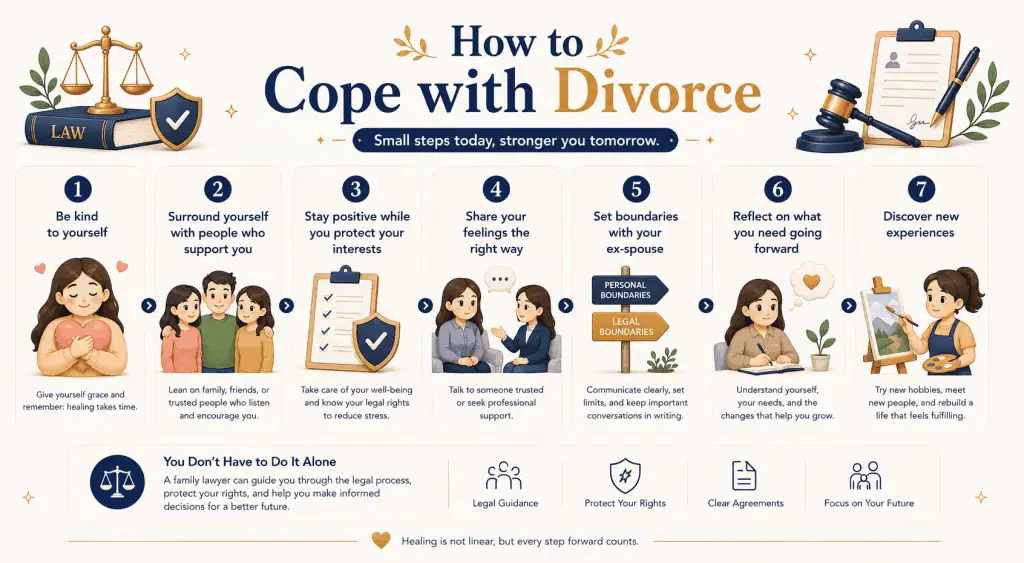
Be Kind to Yourself
The first step in coping with divorce is to be easy on yourself. While it may seem impossible during such a daunting time, reminding yourself that you will eventually come out the other side can give you the motivation and energy needed for the healing process ahead. Going through a divorce is not something you should be ashamed of, and it does not reflect a personal failure.
Surround Yourself with People Who Support You
Surrounding yourself with loved ones is a key factor in coping with divorce. Whether it is family members, close friends, or trusted co-workers, it is important to find people who can offer unconditional support during this transition. Their presence gives you the strength to get through this period and a listening ear when you need one, without the pressure of legal or financial decisions attached.
Stay Positive While You Protect Your Interests
Staying positive is easier said than done, but there is real value in managing your emotions deliberately during this period. Eating well, sleeping enough, and staying active can help take your mind off the process and keep you grounded. At the same time, staying positive works best when it is paired with clarity on where you stand legally. Knowing your rights around assets, maintenance, and your children removes a major source of the anxiety that makes it hard to stay positive in the first place.
Share Your Feelings the Right Way
Talking about what you are going through with a trusted friend who is empathetic and understanding can help you process the emotions tied to a divorce. Opening up makes it easier for those close to you to offer real support, and seeking out counselling or a support group brings in perspectives from people outside your immediate circle.
One point worth knowing: sharing your feelings with a counsellor does not work against you in a Singapore divorce. Seeking support is generally viewed as a sign of good parenting and coping capacity, not a vulnerability, when custody or care and control is being decided.
Set Boundaries with Your Ex-Spouse
Developing boundaries does not mean cutting off all communication or refusing to be civil with your ex-spouse. It means setting limits on how often and when you communicate, and deciding which topics are off-limits. Clear boundaries help you separate yourself from lingering guilt or anger, while also giving you clarity on issues like custody arrangements, finances, and future communication.
- Personal Boundaries
Personal boundaries are about protecting your own headspace. This might mean limiting contact to specific days, avoiding conversations about the relationship’s breakdown, or asking a third party to relay logistics during particularly difficult periods.
- Legal Boundaries
Legal boundaries are about protecting your position in the process. Keeping communication with your ex-spouse in writing, through text or a co-parenting app rather than verbal exchanges, creates a record that can support you in mediation or, if needed, in court. If contact from your ex-spouse becomes harassing rather than necessary, a Personal Protection Order under the Women’s Charter is a legal boundary you can pursue, and a family lawyer can advise you on when this step is appropriate.
Reflect on What You Need Going Forward
Reflective practice during a divorce helps you understand how you are feeling and what needs to change for you to cope effectively with your new circumstances. This includes becoming mindful of your reactions to stress and developing healthy habits like journaling.
You may even find yourself recalling good things from the marriage, which can help you gradually let go of the negatives rather than staying stuck in them.
Discover New Experiences
Finding new hobbies gives you an outlet to express your emotions, a mental break from stressful thoughts, and a way to connect with people who share your interests. These new experiences help pull your focus away from the negative emotions tied to the divorce, and they give you something of your own as you rebuild your routine.
Also Read: Divorce Mediation in Singapore: Guide & Process
Gain Legal Certainty as You Cope
Uncertainty is one of the biggest drivers of anxiety during a divorce, and legal certainty is one of the most underused coping tools. Since 1 July 2024, couples who both agree the marriage has broken down can file for Divorce by Mutual Agreement (DMA) under the Women’s Charter, without assigning blame to either party.
Practice direction updates from January 2026 have further simplified the e-filing process and child-welfare checks under this route, making it faster for couples who can agree on the way forward.
Knowing which route applies to your situation, whether that is DMA, unreasonable behaviour, or another fact for divorce, gives you a realistic timeline to plan around instead of an open-ended process to worry about. A short conversation with a family lawyer early on can replace a lot of guesswork with an actual plan.
How Your Emotional Wellbeing Can Affect Your Child Custody Case
Singapore’s Family Justice Courts decide custody, care and control based on the welfare of the child, not on how well either parent is coping emotionally. Grief, stress, or sadness during a divorce is not held against a parent. What matters most is your parenting capacity, which the court reads through a few key signals.
- Whether you can put your child’s needs ahead of conflict with your ex-spouse
- Whether you are willing to co-parent constructively, including engaging with the Mandatory Co-Parenting Programme (CPP)
- Whether communication with your ex-spouse stays civil, even when it is difficult
- Whether you are seeking support where needed, such as counselling, rather than letting stress affect your parenting
- Whether your household can offer the kind of stability the court looks for around care and control
A parent who is actively managing these areas is generally better placed going into custody discussions. If you are worried that your ex-spouse’s behaviour, rather than your own, could affect the children, that is a conversation to have with your lawyer early rather than later.
Also Read: HDB Divorce Guide: Can You Keep Your Flat?
Emotional Stressors and Their Legal Solutions
A lot of the anxiety around divorce comes from specific, nameable fears, and most of them have a legal process attached that can address them directly.
| Emotional Stressor | Legal Solution |
|---|---|
| Uncertainty over finances | Formal financial disclosure through an Affidavit of Assets and Means |
| Fear of losing time with your children | A clear, court-filed parenting plan |
| Feeling unheard by your ex-spouse | Structured mediation through the Family Justice Courts |
| Not knowing how long the process will take | Filing under Divorce by Mutual Agreement where both parties agree |
| Ongoing conflict over day-to-day decisions | A written agreement setting out communication ground rules |
| Anxiety about starting over financially | Maintenance and division of matrimonial assets orders |
Talk to a Singapore Divorce Lawyer Who Understands
Divorce is an incredibly difficult process to go through, but with the right support system and a clear understanding of your legal options, it is possible to cope with the pain and reach the other side. Combining self-care with legal clarity, rather than treating them as separate tracks, is what makes moving on after divorce genuinely achievable.
If you would like guidance on your specific situation, from Divorce by Mutual Agreement to custody and division of assets, Ng Pui Khim and the team can walk you through your options with clarity and care. Get in touch with our experienced divorce lawyer through our contact form or call us at 6323 1261.
Frequently Asked Questions
Can I set legal boundaries if my ex-spouse keeps contacting or harassing me?
Yes. Keeping communication in writing gives you a record, and if contact becomes harassment rather than necessary co-parenting or logistics, a Personal Protection Order under the Women’s Charter is available. A family lawyer can advise whether your situation meets the threshold.
Does seeing a counsellor affect my legal standing in a Singapore divorce?
No, seeking counselling does not count against you. Courts generally view it as a sign you are managing the transition responsibly, which can support your case in custody or care and control matters.
How long does it typically take to feel emotionally settled after a divorce?
This varies widely from person to person and there is no fixed timeline. Having legal clarity on your situation, alongside support from friends, family, or a counsellor, tends to make the adjustment period more manageable.

The PKNG Editorial Team researches and maintains general Singapore legal information for iLawyer. Its work follows the site editorial policy and uses authoritative sources where available.
All rights reserved. Any information of a legal nature in this website is given in good faith and has been derived from resources believed to be reliable and accurate. The author of the information contained herein this website does not give any warranty or accept any responsibility arising in any way, including by reason of negligence for any errors or omissions herein. Readers should seek independent legal advice