
Table of Contents
- How to File for Divorce in Singapore
- Jurisdiction Requirements for Foreigners and Expats
- Divorce Process for Muslim Marriages Through the Syariah Court
- Documents You Need to File for Divorce
- Filing for Divorce Without a Lawyer
- How Long Does It Take to Get a Divorce in Singapore
- Get Help Filing for Divorce with Ng Pui Khim
- Frequently Asked Questions
If you are reading this, you may have already separated or considered going separate ways from your spouse. You may be experiencing long-term fatigue with all the endless quarrels between you and your spouse about the finance issues, inequality in the distribution of household and child-rearing duties, or discovery that your spouse has cheated on you.
The formal divorce process in Singapore can feel uncertain even if you are literate and well-educated, especially when you are trying to understand the entire set of court papers, remember deadlines, and trying to figure out whether your situation belongs in the civil courts or the Syariah Court.
The rules are specific, and the outcome affects important legal rights such as children, maintenance, and property division.
Before you take the first filing step, it helps to understand the legal process of divorce clearly so you can protect your position and make informed decisions.
How to File for Divorce in Singapore
In Singapore, divorce is governed mainly by the Women’s Charter for civil marriages, and this section walks through the actual filing process from the first eligibility check to the final judgment.
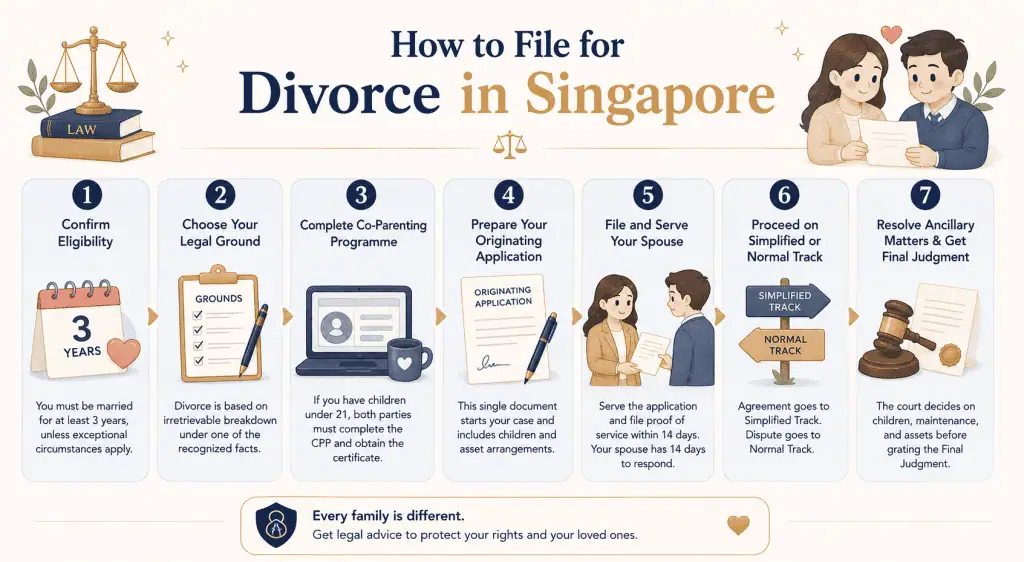
Since the Family Justice Rules 2024 took effect on 15 October 2024, the process runs on either a Simplified Track or a Normal Track, and the separate Writ, Statement of Claim, and Statement of Particulars have been reduced into a single Originating Application.
Step 1: Confirm You Are Eligible to File
Under section 94(1) of the Women’s Charter, you generally cannot file for divorce until three years have passed since your marriage date. An earlier filing is only allowed under section 94(2), where the applicant has suffered exceptional hardship or the other spouse has engaged in exceptional depravity, and even then the Court weighs the interests of any children before granting leave.
You must also confirm the Court has jurisdiction over your marriage, which for civil marriages means the case belongs in the Family Justice Courts rather than the Syariah Court.
Step 2: Choose the Legal Ground for Your Divorce
The only legal ground for divorce in Singapore is that the marriage has broken down irretrievably, and this must be established through one of the recognised facts under section 95(3) of Women’s Charter:
- Adultery
- Unreasonable behaviour
- Desertion for a continuous period of at least two years
- Separation for three years, with the other party’s consent
- Separation for four years, without consent required
- Divorce by Mutual Agreement (DMA), newly added fact on 1 July 2024, this fact does not require a minimum separation period but requires both parties to agree the marriage has broken down and to state the reasons.
The fact you choose must match what you can support with evidence, since your Originating Application will be built around it.
Step 3: Complete the Mandatory Co-Parenting Programme, if You Have Children Under 21
If you and your spouse have at least one child under 21, you must each complete the Mandatory Co-Parenting Programme (CPP) under section 94A of the Women’s Charter before you can file.
This involves an e-learning module and a private consultation session run by the Ministry of Social and Family Development, and it results in a Certificate of Completion that must be filed together with your Originating Application.
Step 4: Prepare Your Originating Application
The Originating Application is the single document that now starts your case, replacing what used to be several separate filings. It sets out the fact you are relying on, your proposed arrangements for any children, and your position on dividing matrimonial assets, so it needs to be complete and internally consistent before you file it with the Family Justice Courts.
Step 5: File and Serve the Originating Application on Your Spouse
Once filed, you must serve the Originating Application on your spouse and file an Affidavit of Service within 14 days. Your spouse then has 14 days from being served to file a Notice to Contest, stating whether they agree with the divorce and whether they agree with the proposed ancillary matters. If your spouse cannot be located or refuses to accept the papers, you can apply to the court for substituted service or to dispense with service altogether.
Step 6: Proceed on the Simplified or Normal Track
If both parties agree the marriage has broken down, the case proceeds on the Simplified Track, which is generally faster and may not require either party to attend a hearing in person.
If your spouse disputes the divorce itself, the case moves to the Normal Track, which deals with the divorce first and then the ancillary matters as a second stage, and typically takes more than 10 months or even 2 years or more if hotly contested. .
Step 7: Resolve Ancillary Matters and Obtain the Final Judgment
Once the divorce itself is resolved, the court addresses ancillary matters, including care and control of children, access arrangements, child and spousal maintenance, and division of matrimonial assets. The court first grants an Interim Judgment, and the marriage is only fully dissolved once these ancillary matters are settled and the Final Judgment is granted.
Also Read: Does Divorce Revoke a Will in Singapore? Guide to Updating Your Estate Plan
Jurisdiction Requirements for Foreigners and Expats
Foreigners can file for divorce in Singapore, but only if the court has jurisdiction under section 93 of the Women’s Charter.
This requires that either you or your spouse is domiciled in Singapore at the time of filing, or has been habitually resident in Singapore for a continuous period of at least three years immediately before filing.
If one is a Singapore citizen, this in itself is sufficient to prove Singapore domicile.
Holding a work pass or permanent residence in Singapore on its own does not automatically satisfy this test, the court looks at the actual living situation, so if you are unsure whether you qualify, look into this criteria before ending up with rejected court papers after putting in all the effort.
Divorce Process for Muslim Marriages Through the Syariah Court
If your marriage was solemnised under Muslim law, the Syariah Court Singapore handles the case under AMLA, not the Family Justice Courts, and the process differs from the civil filing steps above.
Parents with a child under 21 are generally required to attend counselling through the Syariah Court’s Marriage Counselling Programme before the matter can proceed, which is designed to encourage settlement and narrow disputes over children, maintenance, and assets where the marriage cannot be saved.
If you are uncertain whether your marriage falls under civil or Muslim law, confirm this first, using the wrong process can waste time and add unnecessary cost.
Documents You Need to File for Divorce
Because the Originating Application now consolidates several previously separate documents, it helps to have your supporting materials organised before you start.
Common documents include:
- Marriage certificate
- Identity documents for both parties
- Children’s birth certificates, if applicable
- Certificate of Completion for the Mandatory Co-Parenting Programme, if you have children under 21
If you are filing on your own, take extra care to keep names, dates, and addresses consistent across every document, minor inconsistencies are common causes of delay.
Filing for Divorce Without a Lawyer
Yes, you can file for divorce in Singapore without a lawyer, sometimes called a “DIY” divorce. It may be suitable where the issues are straightforward, there are no major asset disputes, and both parties are cooperative on the Simplified Track.
That said, filing on your own means you are responsible for choosing the correct fact, preparing the Originating Application without guidance and submitting the court papers properly. By choosing a DIY divorce, you may unwittingly deprive yourself of the benefit of receiving important legal advice before entering into an irrevocable and binding court order with your spouse. Once the order of court is issued by the court, the ancillary matters within the order of court can impact your life long after the divorce is concluded.
If there are children, division of property, or contested facts involved, obtaining professional legal advice from a divorce lawyer can help you avoid costly mistakes that are difficult or impossible to undo once the order of court has been granted.
Also Read: Divorce Mediation in Singapore: Guide & Process
How Long Does It Take to Get a Divorce in Singapore
On the Simplified Track, an uncontested case can often be completed within a few weeks to a few months, particularly if the ancillary matters are also agreed. On the Normal Track, where the divorce itself is disputed, the process can take more than 10 months, and can run longer with mediations, contested hearings, affidavits to be filed by both parties, discovery applications regarding assets and more legal documents to be prepared, filed and served to the other party.
Get Help Filing for Divorce with Ng Pui Khim
Filing for divorce in Singapore involves more than submitting one form, and the rules changed significantly in 2024, so relying on outdated information can cost you time or lead to a filing that has to be corrected.
You may need to appoint a divorce lawyer to consider whether filing your divorce under the Simplified Track or Normal track is suitable for your situation.
If you are not a Singapore resident and do not have a SingPass, it is often easier to appoint a divorce lawyer to take care of the divorce papers.
If you need assistance to figure out how to draft the Originating Application and ancillary matters such as how to handle the sale proceeds upon sale of the HDB or private property getting the details right from the outset makes the rest of the process considerably smoother.
Ng Pui Khim, has over 20 years of experience personally handling divorce matters in Singapore, including contested and uncontested cases, division of matrimonial assets, and child-related arrangements. To discuss your situation, please contact us here!
Frequently Asked Questions
How long does the divorce process take in Singapore?
An uncontested case on the Simplified Track can often be completed within a few weeks to a few months, while a contested case on the Normal Track usually takes more than 10 months due to hearings, service issues, and disputed ancillary matters.
Can foreigners file for divorce in Singapore?
Yes, if the Family Justice Courts have jurisdiction under section 93 of the Women’s Charter, meaning either spouse is domiciled in Singapore at filing, or has been habitually resident in Singapore for at least three continuous years before filing.
Do I need to attend the Mandatory Co-Parenting Programme before filing?
If you have at least one child under 21, both you and your spouse must generally complete the programme and obtain a Certificate of Completion before filing, unless a specific exemption applies.
What happens if my spouse refuses to accept the divorce papers?
Your spouse does not need to agree for the case to begin, but the Originating Application must still be properly served. If they refuse to accept it or cannot be located, you can apply to the court for substituted service or to dispense with service. For such a situation, it would be better to appoint a divorce lawyer to help you with that.
Can I file for divorce before being married for three years?
Only in limited circumstances, under section 94(2) of the Women’s Charter, where you can show exceptional hardship suffered by you or exceptional depravity by your spouse.
What is the difference between the Simplified and Normal Track?
The Simplified Track applies where both parties agree the marriage has broken down and is generally faster. The Normal Track applies where the divorce itself is disputed and proceeds through a slower, two-stage process that can take more than 10 months to conclude.

Ng Pui Khim is a senior lawyer with over 20 years of private practice experience focusing on divorces (family and matrimonial law), real estate (conveyancing practice), wills and succession law.
All rights reserved. Any information of a legal nature in this website is given in good faith and has been derived from resources believed to be reliable and accurate. The author of the information contained herein this website does not give any warranty or accept any responsibility arising in any way, including by reason of negligence for any errors or omissions herein. Readers should seek independent legal advice