

Infidelity is a common cause of divorce in Singapore. Yet, many neither understand nor are realistic in their expectations when they seek a divorce on grounds of adultery.
Here are 9 pointers to consider before filing based on adultery for divorce proceedings.
In practice, the person that is alleging adultery is the plaintiff; and the person that is being alleged of the act is known as the defendant, and will be mentioned accordingly in this article for clearer understanding.
9 Facts Adultery and Divorce in Singapore
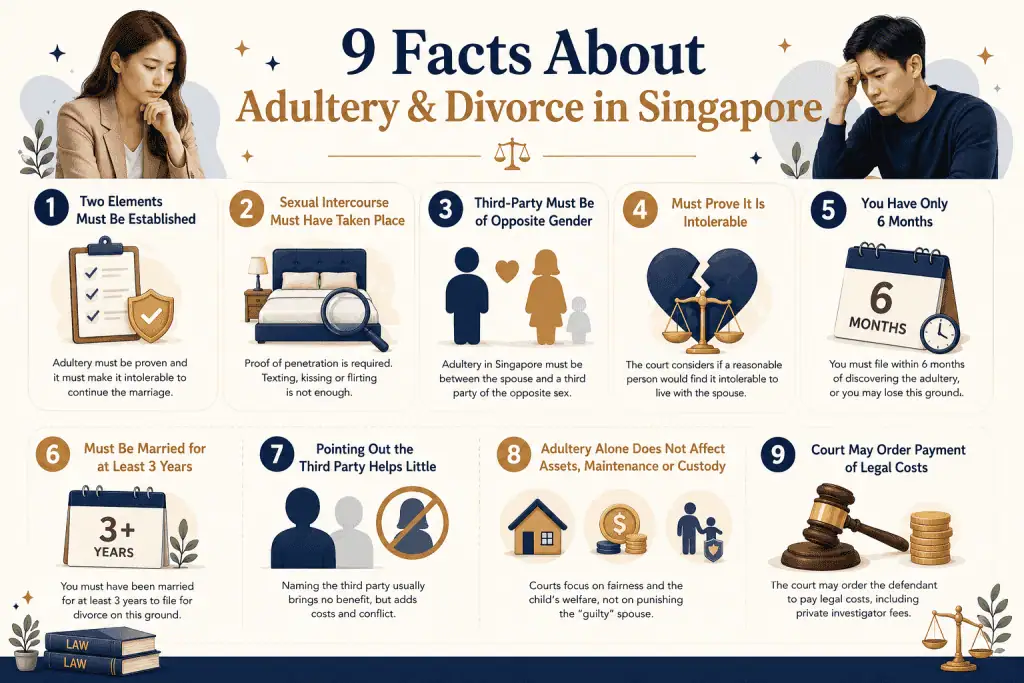
#1: Two Elements Must Be Established in Court
To file for divorce on grounds of adultery, the plaintiff must prove both of the following:
i) The defendant has committed adultery; and ii) The adultery has made it intolerable for the plaintiff to continue living with the defendant.
Both elements must be satisfied — proving adultery alone is not enough.
#2: Sexual Intercourse Must Have Taken Place
In practice, sexual intercourse (penetration) must have taken place between the defendant and a third party. It is therefore insufficient when you provide proof of your spouse communicating intimately through text messages and emails, or other intimate activities such as hand-holding or kissing, with the alleged third party.
Proving adultery is often rather difficult as the courts in Singapore have adopted such a high standard of proof. The plaintiff may need to hire a Private Investigator (PI), and fees for hiring a PI can be high.
Evidence gathered by the PI may not always guarantee a successful divorce based on adultery. If the evidence obtained is not sufficient, a better solution may be to engage an experienced divorce lawyer to help identify an alternative fact to support the divorce instead, for example, using the fact of unreasonable behavior.
#3: Third-Party Has to Be of The Opposite Gender
In Singapore, adultery can only be committed between the defendant and a third party of the opposite sex. Thus, if your spouse has engaged in an intimate relationship with another party of the same gender, it is advised that you consider other grounds for divorce.
#4: You Must Prove It Is Intolerable to Continue Living With Your Spouse
The plaintiff will have to prove that living with the defendant has been intolerable since adultery has been committed.
The courts will consider whether a reasonable person in the position of the plaintiff would find it intolerable to live with the defendant. Circumstances and personalities of both parties will also be assessed. However, establishing this element for divorce is not as demanding as that of providing proof of adultery.
#5: You Have Only 6 Months to File for Divorce
When confronted in the face of evidence that a spouse is cheating, most individuals would first make efforts to save the marriage before considering divorce as an ultimatum.
Should you be in this position, note that you will not be allowed to divorce your spouse based on adultery, if you continue to live with your spouse for six months and longer upon finding out about the adulterous relationship.
Furthermore, it may also be argued that you have acknowledged the actions, and forgiven the grievance caused by your spouse’s infidelity, and therefore have found it tolerable to continue living with him/her.
Thus, it is advised that a plaintiff commence divorce proceedings as soon as he/she has confirmed the suspicions of the spouse being unfaithful to the marriage if he/she wishes for it to be based on the grounds of adultery.
Also Read: How Matrimonial Assets Are Divided in a Singapore Divorce
#6: Must Have Been Married for at Least 3 Years
A plaintiff can only commence divorce proceedings if he/she has been married for three years or more.
This would mean that even if the plaintiff has knowledge that his/her partner is involved in an adulterous relationship a few months into the marriage, he/she will be unable to file for divorce on the grounds of adultery.
It is only in very exceptional circumstances that the court will grant divorces for cases involving marriages that are less than three years in duration.
If you want to file a divorce within 3 years of your marriage, you should engage an experienced divorce lawyer to obtain advice as to what these exceptions are and whether your marriage falls into this category.
#7: Pointing Out the Third Party Serves no Tangible Benefit
The plaintiff may decide to identify the third party in court. However, naming or shaming the third party does not lead to the plaintiff being given a better settlement at the divorce suit.
In fact, the plaintiff who files a divorce based on adultery typically spends more legal fees on the divorce as compared to filing a divorce based on separation or unreasonable behavior.
#8: Adultery in Itself Does not Affect Maintenance, Division of Matrimonial Assets nor Custody of Children
A common misconception is that the “guilty” spouse will be penalised in financial and custody matters. This is not automatically the case.
The court does not automatically penalise an adulterous defendant when deciding on:
- Division of matrimonial assets
- Spousal or child maintenance
- Custody of children
However, if the defendant is proven to be a serial adulterer or has demonstrated a lifestyle that is grossly immoral, this may influence the court’s decision on child custody. Every case is assessed individually, and the court’s paramount concern in custody matters is always the welfare of the child.
#9: Paying Party for Divorce Proceedings
When adultery has been established, the court may order that the defendant pays for the divorce proceedings to the plaintiff.
The defendant may also be ordered to reimburse the plaintiff for the private investigator’s fees if the plaintiff had engaged one to provide the proof of adultery. The actual amount ordered is left entirely to the court’s discretion.
Adultery vs. Unreasonable Behaviour: Which Path Is Right for You?
If you are struggling to gather sufficient proof of adultery, or if your spouse’s affair involved a same-sex partner, unreasonable behaviour is often the more practical legal route. It is less costly, requires no PI evidence, and covers a wide range of conduct that makes cohabitation intolerable.
Consult an experienced divorce lawyer to assess which ground best fits your situation before filing.
| Key Difference | Adultery | Unreasonable Behaviour |
|---|---|---|
| Proof required | Sexual intercourse (penetration) | Pattern of behaviour making cohabitation intolerable |
| PI typically needed? | Often yes | Usually no |
| Cost | Higher (PI fees + legal) | Lower |
| Time | Longer | Shorter |
| Same-sex affairs? | Not applicable | Applicable |
Common Pitfalls to Avoid When Filing for Adultery Divorce in Singapore
These are the mistakes that people most commonly make when filing for divorce on grounds of adultery:
- Waiting too long
Many people discover the affair, attempt reconciliation, and only seek legal advice after the 6-month window has already passed — losing the right to file on adultery grounds entirely. - Relying on the wrong evidence
Screenshots of WhatsApp messages, hotel check-in photos, or proof of overnight stays are often insufficient on their own. Penetration must be established to meet the legal threshold. - Assuming adultery means a better settlement
The court’s division of assets is based on each party’s contributions to the marriage — not on who caused the divorce or who was “at fault.” - Naming the third party unnecessarily
Identifying the co-respondent adds legal cost and emotional stress with no tangible benefit to the plaintiff’s case or settlement outcome. - Not considering alternatives early enough
Unreasonable behaviour is often a quicker and less expensive route — and is equally valid as a legal ground for divorce in Singapore.
Also Read: 8 Signs of an Unhappy Marriage: Legal Advice for Divorce in Singapore
Are you seeking a divorce because of adultery?
Filing for divorce based on the reason for adultery can be time-consuming, stressful and costly. An experienced Singapore divorce lawyer can advise you accordingly for the best outcome, and guide you through the divorce procedure.
If you need advice on divorcing based on adultery, feel free to contact Ng Pui Khim’s office for a consultation.
FAQs about Adultery
Is adultery illegal in Singapore?
Adultery is not a crime in Singapore. Neither the third party nor the Defendant would be punished with a jail sentence or be fined.
Do I still have to pay alimony if my spouse cheated?
Yes, potentially. Adultery alone does not disqualify a spouse from receiving maintenance in Singapore. The court determines alimony based on financial needs, earning capacity, length of marriage, and each party’s contributions — not on who caused the breakdown of the marriage.
If you are concerned about maintenance obligations in an adultery divorce, consult a divorce lawyer to understand how the court is likely to assess your specific situation.
Can you sue for adultery in singapores?
No. Singapore law does not provide a cause of action to sue a third party for adultery. Naming the co-respondent in divorce proceedings does not result in any financial compensation or penalty against them.
Images from Unsplash and Freepik.

Ng Pui Khim is a senior lawyer with over 20 years of private practice experience focusing on divorces (family and matrimonial law), real estate (conveyancing practice), wills and succession law.
All rights reserved. Any information of a legal nature in this website is given in good faith and has been derived from resources believed to be reliable and accurate. The author of the information contained herein this website does not give any warranty or accept any responsibility arising in any way, including by reason of negligence for any errors or omissions herein. Readers should seek independent legal advice