

Marriage difficulties do not always lead immediately to divorce. For many couples in Singapore, separation is a necessary first step, a period of living apart that allows both parties to reflect, regroup, and make considered decisions about the future of their marriage.
Whether you are considering a private Deed of Separation, a court-ordered judicial separation, or simply need to understand how living apart affects your legal rights, knowing where you stand early can make a significant difference.
This article explains the key forms of legal separation in Singapore, what each one involves, and why getting timely advice matters.
What is Legal Separation?
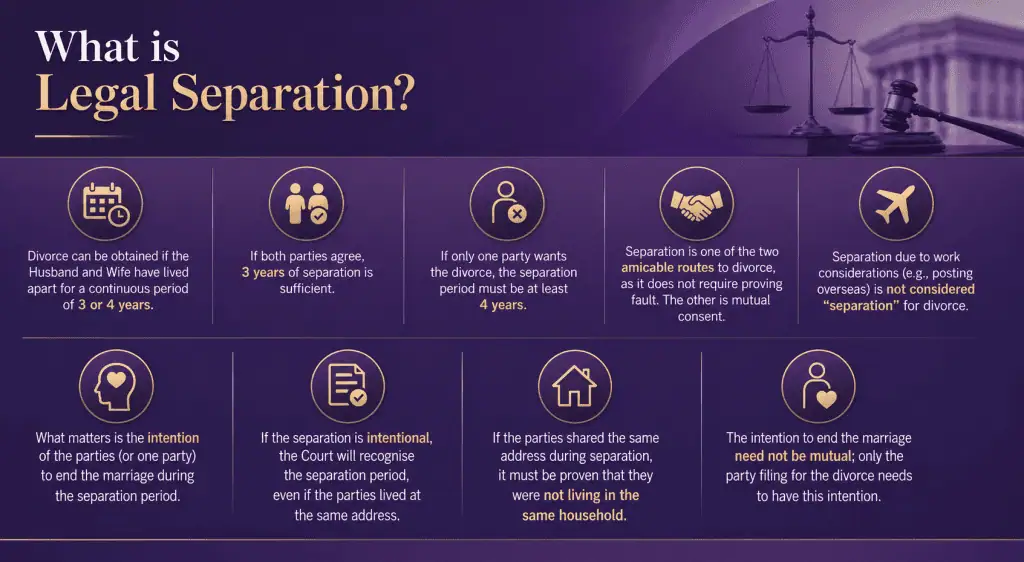
One way to obtain a divorce to end a marriage in Singapore, is to prove that the Husband and the Wife have lived apart from each other for a continuous period of either 3 years or 4 years.
Separation as Grounds for Divorce
If both parties agree to the divorce, the period of three years is enough. However, if only one party wants the divorce, the separation period needs to be a continuous period of at least four years.
Getting a divorce by citing the reason of separation is one of the two amicable routes to divorce, as there is no requirement to prove fault of the other party. The next amicable route is to divorce by mutual consent of both parties.
The Role of Intention in Legal Separation
To prove separation under divorce laws of Singapore, a mere act of physically living apart is not enough. If the separation of the parties is due to work considerations – for example if the Husband needs to live overseas due to being posted to an overseas country by his employer, the period in which the Husband and Wife is separated is not considered “separation” for purposes of obtaining a divorce.
So, what constitutes separation? What is important is the presence of intention of the parties (or one party) to end their marriage during the separation period.
Living Apart: The Physical and Legal Requirements
If it can be proved that the separation is intentional, the Court will recognise the separation period, even if the parties had been living at the same address.
For those cases in which the parties shared the same home address during separation, there is an additional requirement to prove that the parties must not be living in the same household.
The intention to end the marriage during the separation period need not be a mutual intention, only the party filing for the divorce needs to have this intention.
Also Read: Mandatory Co-Parenting Programme
Do you need to sign a document to prove Separation?
To achieve Separation for purposes of divorce laws, it can be done formally or informally.
In Singapore, the formal way of proving a Separation would be for the Husband and Wife to sign a Deed of Separation or a Separation Agreement.
The informal way would be for the Husband and Wife to live separate and apart from each other without signing any documents.
It is obviously easier for the party filing the divorce to prove mental intention of the parties, if a Deed of Separation had been signed by the parties prior to their separation.
To achieve Separation for purposes of divorce laws, it can be done formally or informally.
In Singapore, the formal way of proving a Separation would be for the Husband and Wife to sign a Deed of Separation or a Separation Agreement.
The informal way would be for the Husband and Wife to live separate and apart from each other without signing any documents.
It is obviously easier for the party filing the divorce to prove mental intention of the parties, if a Deed of Separation had been signed by the parties prior to their separation.
What You Need to File for Divorce Based on Separation
To file a divorce using the fact of separation, the application must include the following information:
- Date the separation started
- Duration of the separation
- Intention of the parties or party to end the marriage with the separation
- Addresses of the parties during the separation
- In cases of the parties living in the same address, citing of facts to prove that the parties were living in separate households under the same roof.
Grounds for Divorce: Irretrievable Breakdown of Marriage
Divorce is granted by the Court once the applicant for the divorce proves that the marriage has irretrievably broken down – this is the only ground of divorce.
The irretrievable breakdown of marriage is proven by any one of the six situations:
- Adultery of Respondent;
- Unreasonable behaviour of Respondent;
- Desertion exceeding 2 years by Respondent;
- Separation of parties of at least 3 years (with consent of Respondent to divorce);
- Separation of parties of at least 4 years; OR
- Divorce by mutual consent of both parties.
What about Judicial Separation?
Either the Husband or the Wife may file for judicial separation instead of divorce.
This application is not a common occurrence. The party who files for judicial separation usually chooses this route for personal reasons, i.e. religion, that he/she does not wish to be divorced but wants to obtain legal remedies available to him or her under ancillary reliefs to be granted by the Court under the Women’s Charter.
There is no requirement to prove that the marriage has irretrievably broken down, but once the Court grants the judicial separation order, there is no obligation for the party to continue to live with his/her spouse anymore. It is important to point out that the judicial separation only separates a couple, it does not terminate the marriage. Therefore, parties who have been judicially separated cannot legally remarry as they are still considered married.
Also Read: Interim Judgment Explained: Key Step in Singapore Divorce Proceedings
Legal remedies in Singapore
If you and your spouse are currently living separate and apart, you may consider the following legal remedies to ensure clarity of legal positions and reduce ambiguities.
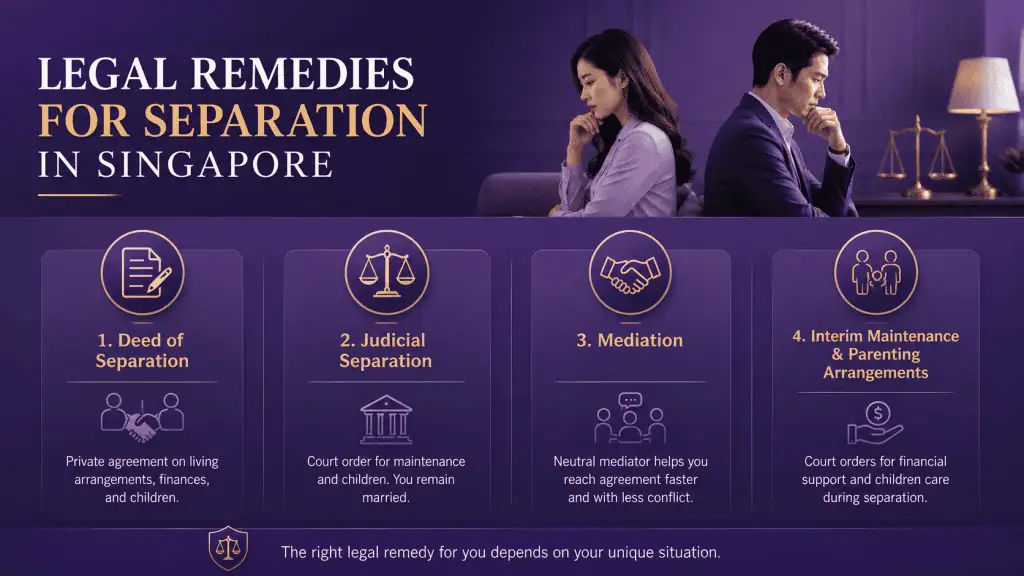
1. Deed of Separation 📄
A Deed of Separation is a private contract by mutual agreement that records living arrangements, finances, maintenance, and care of children. It works well when both parties can negotiate reasonably. It can preserve dignity and reduce conflict. It is also useful evidence if you later file for divorce based on separation under the Women’s Charter, Section 95(3).
2. Judicial Separation ⚖️
Judicial separation is a court order under the Women’s Charter, Section 101. You remain married, but the court can make orders on maintenance and children. This route suits cases involving serious disputes or where a formal court framework is needed. You cannot remarry while judicially separated.
3. Mediation 🤝
You may wish to consider obtaining professional help by getting a trained Meditator to facilitate a separation deed or pre-divorce settlement agreement to set out agreed parenting schedules, living arrangements, and financial support. It is less adversarial and usually faster and cheaper than a contested hearing. Mediation is well suited if you both want structure and closure without fighting out in court.
4. Interim Maintenance and Parenting Arrangements 💡
If financial support or children care arrangements cannot be agreed upon despite best efforts and discussions, you may apply for spouse or child maintenance orders during the separation at the Family Justice Courts.
The right legal remedy for you depends on the specific situation you are in.
Why early legal advice matters
People often wait, hoping tensions ease or because they are unsure where to start. Timing matters for a few reasons:
- Dates and evidence matter. Keep a clear record of when separation began, who pays which bills, and parenting arrangements.
- Legal timelines exist. You generally cannot file for divorce within 3 years of marriage under the Women’s Charter, Section 94, so planning is important.
- Early solutions cost less. A fair Deed of Separation or mediated plan is usually cheaper and less stressful than a contested court fight.
Early advice brings peace of mind and can prevent bigger problems.
How Pui Khim can help
Legal separation is common, and it can be managed with care. Pui Khim provides clear advice, practical strategies, and steady guidance on deeds of separation, judicial separation, and parenting plans.
You can expect domain expertise in family law, transparent fees, and an approachable style. If you need structure and stability while you decide the next step, get in touch with us for a legal consultation.
Lets contact us, here!
FAQs About Legal Separation
What is the difference between legal separation and divorce in Singapore?
Legal separation lets you live apart with clear terms while remaining married. Divorce ends the marriage. With judicial separation under the Women’s Charter, Section 101, you cannot remarry. Some couples use separation first, then later file for divorce based on separation under Section 95(3)(d)-(e).
Do we need a lawyer for a Deed of Separation?
It is not legally required but strongly recommended. A Deed of Separation affects financial matters, housing, and children, and it may affect how divorce orders would be issued ultimately. A lawyer ensures the terms are clear, workable, and fair, and that you understand your rights under Singapore family law.
Can we be “separated” while living in the same home?
Yes. Separation under one roof is possible if you live separate lives, for example separate bedrooms, no conjugal relations, no sharing of meals together as a couple, no domestic support (you do not cook, wash or clean for each other), Keep records so there is evidence of the separation to support divorce claim in Singapore courts.
How long must we be separated before divorce?
If relying on separation as the fact for divorce, it is generally 3 years with the other spouse’s consent or 4 years without consent, under the Women’s Charter, Section 95(3)(d)-(e). Other facts, such as unreasonable behaviour, may allow earlier filing depending on circumstances.
What if we cannot agree on money matters or child arrangements during separation?
Mediation can help you settle parenting schedules and support. If that fails, you can seek interim maintenance for a spouse or child under the Women’s Charter, for example Section 69, and parenting orders at the Family Justice Courts. Early advice keeps matters proportionate and focused.

The PKNG Editorial Team researches and maintains general Singapore legal information for iLawyer. Its work follows the site editorial policy and uses authoritative sources where available.
All rights reserved. Any information of a legal nature in this website is given in good faith and has been derived from resources believed to be reliable and accurate. The author of the information contained herein this website does not give any warranty or accept any responsibility arising in any way, including by reason of negligence for any errors or omissions herein. Readers should seek independent legal advice