

If you are reading this, you may already be asking yourself: “I don’t want to be married anymore — what happens now?” Deciding to end a marriage is one of the most stressful experiences a person can face in Singapore. Beyond the emotional toll, the legal complexities of asset division, HDB flat ownership, child custody, and CPF nominations can feel overwhelming.
To help you navigate this transition, our senior divorce lawyer, Ng Pui Khim will shares 10 critical “secrets” that most people only discover when it is already too late.
10 Things You Wish Knew Before Filing for Divorce
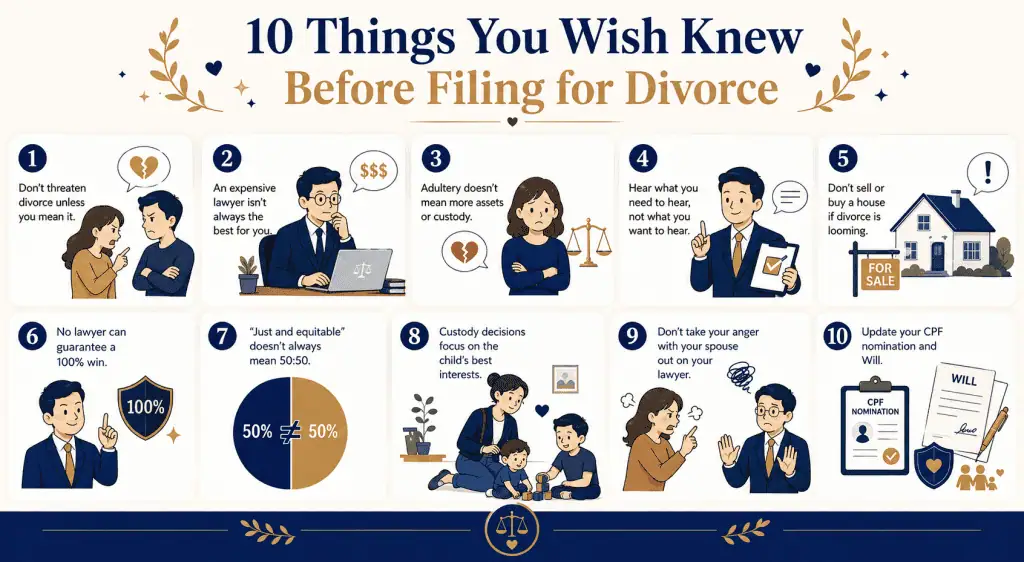
1. Don’t threaten your spouse with a divorce unless you mean it.
If you think that using the word “divorce” might knock some sense into your husband/wife’s head, please think again. Often, divorce clients tell their lawyers that the main reason for filing a divorce is because their spouses have been constantly threatening them with divorce.
Are you prepared to face the prospect of a divorce if your spouse unexpectedly agrees to the threat? There should be other more constructive ways of telling your spouse to improve on his/her behavior other than issuing the “divorce” threat.
2. An expensive lawyer does not necessarily mean the best lawyer for you.
A well-known lawyer that charges you an arm and a leg for a divorce may not be the best lawyer for you. Usually the legal fees you are charged with goes to paying the rentals for the expensive office unit, salaries of the team of junior lawyers and perhaps the chauffeur-driven expensive car.
Often, the less expensive divorce lawyers may be more experienced in actual court litigation, as compared to the famous lawyers who spend more time talking to newspaper reporters to generate publicity for the firm.
3. You don’t get awarded with more assets or custody of child, just because your spouse committed adultery.
Many people assume that the spouse who cheats during marriage will get “punished” with a smaller share of the assets or with losing custody of the children. This is a false assumption. The law does not mete out such punishments.
It is best to consult an experienced divorce lawyer to find out the criteria the Court will take into account when deciding on the division of assets and custody dispute.
4. Trust the lawyer that tells you what you need to hear and not what you like to hear.
You go to your divorce lawyer for professional legal advice, not to get mental therapy. A good lawyer will give you a fair assessment of your case based on your merits of your case. If you only want to hire the lawyer that tells you what you like to hear, then you may end up the ultimate loser of an expensive divorce law suit.
5. Do not sell or buy a house if a divorce is looming.
If you intend to obtain a divorce, and there is no binding agreement drawn up as to how to split the profits from the sale of your house, do think twice. Usually, the net proceeds of sale will be in joint names. If there is no clear agreement on how the monies will be split, you might end up arguing at the bank after the sale is completed.
If you intend to get a divorce, consider carefully before buying a HDB flat or private housing. You will be subject to penalties if you sell the flat or house too soon after your purchase.
For a HDB flat, there is a currently a minimum occupation period of 5 years before a sale can be arranged. For private housing, you need to hold it for 3 years or more, if you want to avoid paying sellers stamp duty. Bank loan commitment fees and renovation expenses may add up to a hefty sum too.
Also Read: Adultery & Divorce in Singapore: 9 Key Facts You Must Know
6. A divorce lawyer that guarantees a 100% win is probably blowing smoke at you.
Every case is unique and stands on its own merits. The legal reasoning of a precedent case may not apply due to different facts of your situation.
Even if the facts look similar to you, there is no way a lawyer can predict the outcome of your case, simply because no two judges share the exact same view. There is always a risk that the judge in charge of your case departs from the perceived conventional legal position. Don’t forget, win or lose, the lawyer still earns his fees.
7. Do not presume that a “just and equitable” division means 50:50.
Upon divorce, the Court divides the matrimonial assets in a just and equitable manner. It is not always 50:50. If the division of matrimonial assets is always equal, there will be no need for law suits over distribution of matrimonial assets in the courts! The term “just and equitable” basically means fair division, which need not always be equal.
8. Why are more mothers losing custody battles to the fathers?
As a result of more women gaining gender equality in the workplaces, there is an increase in the number of working mothers that land up high up in the career ladder. Success usually comes with a price. The working mother that spends a lot of time at work often spends less time with the children at home.
It is no longer rare to find that a child spends more time with the father or the grandparents, than with the working mother. We are also seeing fathers that opt to be stay-at-home fathers so that the working mothers can continue to bring home the high earnings.
Many men in the IT-related industries are now working from home-offices and invariably spend more time at home with the children. The roles of fathers and mothers have changed dramatically in the last two decades. The primary caregiver is no longer presumed to be the mother. The tide has begun to turn against women in custody battles.
9. Do not redirect your anger with your spouse, to your own lawyer.
In the midst of a hotly contested and acrimonious divorce battle, you might just give in to your heated up emotions and start treating your lawyer as the dartboard.
Are you crazy? Your lawyer is your ally, your comrade and your wise adviser in the divorce battle. Your lawyer needs your valuable input and cooperation to help you win. You should be working hand-in-hand with your comrade, instead of giving him a punch in the face.
10. Remember to do a fresh CPF nomination form and review your Will
If you previously named your spouse as your CPF nominee and the beneficiary in your Will, you need to be aware that any subsequent divorce does not automatically revoke a CPF nomination or your Will. Meaning, your hard-earned CPF monies and assets might just end up in the hands of your hated ex-spouse if you should die without doing a fresh nomination or doing a fresh Will.
If you have made up your mind to part ways with your spouse, go ahead and change your CPF nominee and review the beneficiaries of your Will now. Life is never predictable. Ensure that your loved ones will be taken care of if death comes unexpectedly.
Also Read: Divorce Procedure in Singapore: Step-by-Step Process, Timeline and Requirements
Are You Ready to File for Divorce?
Before taking any legal steps, it is important to ensure you are genuinely prepared — emotionally, legally, and financially. Use this checklist to assess your readiness before beginning the divorce process in Singapore.
Divorce Readiness Checklist
✅ Married for at least 3 years
Required under the Women’s Charter, subject to limited exceptions.
✅ Can identify at least one fact proving irretrievable breakdown
Examples include adultery, unreasonable behaviour, desertion, or prolonged separation.
✅ Have a general understanding of matrimonial assets
Including CPF balances, HDB or private property, joint accounts, and investments.
✅ Have considered arrangements for any children
Including schooling, living arrangements, care arrangements, and maintenance.
✅ Have reviewed CPF nominations and your Will
To ensure they continue to reflect your current intentions.
✅ Have obtained legal advice before making major financial decisions
Professional guidance can help you avoid costly mistakes during the divorce process.
If you can confidently tick most of the items above, you may be in a stronger position to begin the divorce process. If not, seeking legal advice early can help you better understand your options and prepare for the road ahead.
How a Singapore Divorce Lawyer Protects Your Interests
Navigating a divorce in Singapore involves far more than filling in court forms. A qualified divorce lawyer provides critical guidance at every stage — from assessing whether your grounds for divorce are sound, to negotiating a fair division of matrimonial assets, to representing you in contested custody hearings.
The 10 secrets above represent the key mistakes and misconceptions that can significantly undermine your position. Having legal counsel who understands the realities of Singapore Family Court — and who gives you honest, practical advice — is not a luxury. It is a necessity.
Ng Pui Khim is a senior lawyer with over 20 years of experience in Singapore family and matrimonial law — providing frank, practical advice whether you are at the early stage of considering a divorce or already in the midst of a contested hearing. Book consult now!
Frequently Asked Questions
How long does a divorce take in Singapore?
An uncontested divorce in Singapore typically takes 4 to 6 months from filing to the Final Judgment. A contested divorce — where the parties dispute assets, custody, or maintenance — can take anywhere from 1 to 3 years or longer depending on complexity.
What are the grounds for divorce in Singapore?
Under the Women’s Charter, there is only one legal ground for divorce in Singapore: the irretrievable breakdown of marriage. This must be established through one of five facts: (1) adultery, (2) unreasonable behaviour, (3) desertion of at least 2 years, (4) 3-year separation with the respondent’s consent, or (5) 4-year separation without consent.
Can I keep the HDB flat after a divorce?
Possibly. Eligible parties may apply to take over the flat under sole ownership, provided HDB eligibility conditions are met (e.g., citizenship, income ceiling for certain flat types). The court will also consider the flat as part of the overall division of matrimonial assets. An HDB divorce specialist can advise on your options.
Does adultery affect how assets are split in Singapore?
No. Singapore courts do not penalise a cheating spouse by awarding less in asset division. The court focuses on each party’s contributions to the marriage and the welfare of any children.
What is the difference between contested and uncontested divorce?
In an uncontested divorce, both parties agree on all ancillary matters: asset division, maintenance, and child custody. This is faster, less expensive, and less stressful. In a contested divorce, the parties disagree on one or more issues, requiring the court to adjudicate — which significantly increases cost, time, and emotional strain.

Ng Pui Khim is a senior lawyer with over 20 years of private practice experience focusing on divorces (family and matrimonial law), real estate (conveyancing practice), wills and succession law.
All rights reserved. Any information of a legal nature in this website is given in good faith and has been derived from resources believed to be reliable and accurate. The author of the information contained herein this website does not give any warranty or accept any responsibility arising in any way, including by reason of negligence for any errors or omissions herein. Readers should seek independent legal advice