
Table of Contents
- What is Annulment of Marriage?
- Annulment vs Divorce in Singapore
- What are the grounds for annulment in Singapore?
- When an annulment application may not succeed
- Contested vs Uncontested Annulment
- 5 Step Annulment of Marriage Process in Singapore
- How does annulment affect your HDB flat?
- Required documents checklist for Annulment Marriage
- Annulment costs and legal fees in Singapore
- Speak to a family lawyer about annulment in Singapore
- Frequently asked questions about Annulment of Marriage in Singapore
The end of a marriage is rarely simple — emotionally or legally. But if your marriage was never truly valid in the eyes of the law, or if specific circumstances surrounding the marriage qualify under Singapore’s Women’s Charter, an annulment marriage may offer a path forward that divorce cannot.
Unlike divorce, an annulment does not merely end a marriage, it declares that the marriage either never legally existed, or is set aside as though it did not. The result is that your marital status returns to “Single,” not “Divorced.” For many people, this distinction carries real personal, cultural, and legal significance.
Singapore law draws a careful line between marriages that are void (invalid from the start) and those that are voidable (legally valid, but capable of being annulled at a party’s request). Understanding which side of that line your situation falls on is the first and most important step.
This guide explains the legal grounds for annulment in Singapore, how the process works, what happens to your HDB flat, and what to expect at each stage, so you can move forward with clarity.
What is Annulment of Marriage?
Annulment of marriage is a legal procedure in Singapore that cancels a marriage between two people. It is different from divorce, as it declares the marriage void from the start. This means that the marriage never existed and both parties are free to marry again.
Annulment vs Divorce in Singapore
A divorce ends a legally valid marriage. An annulment asks the court to declare that the marriage should be treated as invalid under the law. The legal basis, filing requirements, and practical implications are therefore different.
Many people are unsure which path applies to their situation. The table below outlines the key differences:
| Key Differences | Annulment | Divorce |
|---|---|---|
| Resulting marital status | Single | Divorced |
| Minimum marriage duration | No minimum | 3 years (except exceptional circumstances) |
| Legal effect | Marriage declared invalid | Valid marriage legally ended |
| HDB flat impact | Must generally be surrendered | May be transferred or sold |
| Grounds required | Specific void/voidable grounds | Irretrievable breakdown |
The most significant difference is the status outcome. If being recorded as “Single” rather than “Divorced” matters to you, whether for personal, cultural, or religious reasons, annulment may be worth exploring.
Also Read: Divorce Mediation in Singapore: Guide & Process
What are the grounds for annulment in Singapore?
Singapore law recognises two categories of invalid marriages: void marriages and voidable marriages.
1. Void marriages
A void marriage was never legally valid from the outset. No court order is strictly required to undo it, but obtaining a formal judgement of nullity is strongly advisable to establish your legal status clearly. Common grounds include:
- Non-fulfilment of formal requirements — for example, the marriage was not solemnized according to law, or the ceremony did not comply with the requirements of the Women’s Charter.
- Non-fulfilment of substantive requirements — for example, one party was already married at the time of the ceremony (bigamy), or the parties are within the prohibited degrees of relationship under Singapore law.
2. Voidable marriages
A voidable marriage is legally valid unless and until one party successfully applies to have it annulled by the Court. The grounds under Section 106 of the Women’s Charter are:
- Non-consummation due to incapacity
The marriage has not been consummated because either party is physically incapable of doing so. No time limit applies to filing on this ground. - Non-consummation due to wilful refusal
The marriage has not been consummated because the respondent wilfully refused to do so. No time limit applies. - Lack of valid consent
Either party did not validly consent to the marriage — whether due to duress, mistake, unsoundness of mind, or any other reason that negated genuine consent. - Mental disorder
Either party, though capable of giving consent, was suffering (whether continuously or intermittently) from a mental disorder of a nature or degree that made them unfit for marriage. - Venereal disease
At the time of the marriage, the respondent was suffering from a venereal disease in a communicable form. - Prior pregnancy by another person
At the time of the marriage, the wife was pregnant by someone other than the husband.
Important time limit: For the last three grounds — mental disorder, venereal disease, and prior pregnancy, the application for nullity must be filed within 3 years of the date of marriage.
When an annulment application may not succeed
Even where a voidable ground exists, the Court may decline to grant nullity if the respondent can show that the applicant — knowing they had the right to seek annulment — conducted themselves in a way that led the respondent to reasonably believe they would not pursue it.
In practical terms: if you continued living as a married couple for a significant period after becoming aware of the ground, the Court may find it unjust to grant the annulment. This is why early legal advice is essential.
Contested vs Uncontested Annulment
Uncontested annulment
where the respondent does not dispute the claim — is significantly faster and less costly. The Court will typically grant an interim judgement, with the final judgement following approximately 3 months later. Total timeline: around 4 to 6 months.
Contested annulment
where the respondent disputes the grounds or the facts — requires a full hearing with evidence. Timelines vary considerably, and applicants should expect the process to take longer than 6 months, depending on the complexity of the dispute.
5 Step Annulment of Marriage Process in Singapore
Whether your matter is contested or uncontested, the annulment process follows the same general path through the Family Justice Courts.
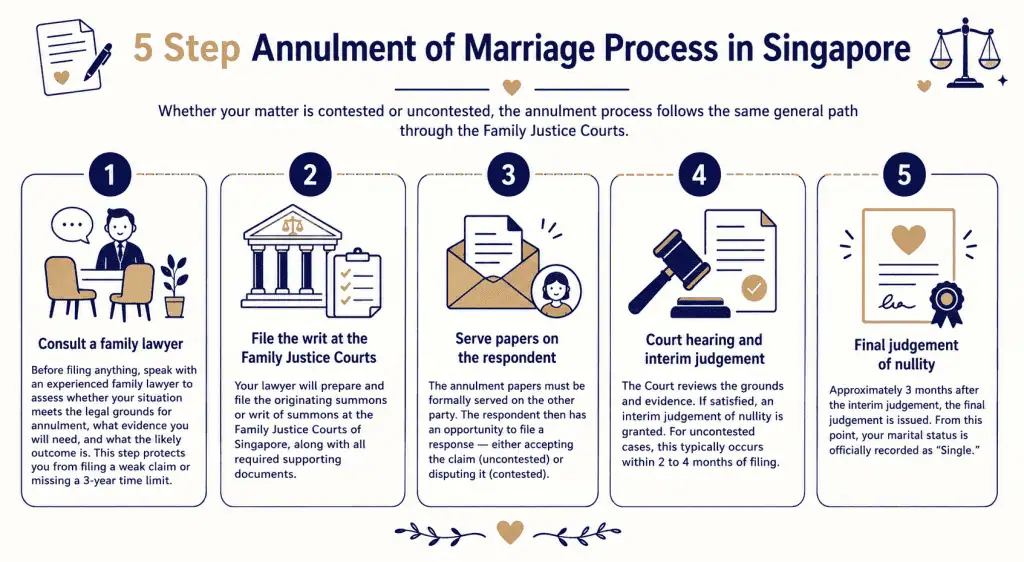
1. Consult a family lawyer
Before filing anything, speak with an experienced family lawyer to assess whether your situation meets the legal grounds for annulment, what evidence you will need, and what the likely outcome is. This step protects you from filing a weak claim or missing a 3-year time limit.
2. File the writ at the Family Justice Courts
Your lawyer will prepare and file the originating summons or writ of summons at the Family Justice Courts of Singapore, along with all required supporting documents.
3. Serve papers on the respondent
The annulment papers must be formally served on the other party. The respondent then has an opportunity to file a response — either accepting the claim (uncontested) or disputing it (contested).
4. Court hearing and interim judgement
The Court reviews the grounds and evidence. If satisfied, an interim judgement of nullity is granted. For uncontested cases, this typically occurs within 2 to 4 months of filing.
5. Final judgement of nullity
Approximately 3 months after the interim judgement, the final judgement is issued. From this point, your marital status is officially recorded as “Single.”
Also Read: Procedure of Divorce in Singapore
How does annulment affect your HDB flat?
This is one of the most practically important questions for couples who jointly own an HDB flat, and the answer differs from divorce in a significant way.
Where parties purchased an HDB flat based on their marital relationship, and that marriage is subsequently declared null and void, HDB generally requires both parties to surrender the flat. This is a key distinction from divorce, where a flat may be transferred to one party or sold with proceeds divided.
Retention of the flat in one party’s sole name after nullity is possible but subject to HDB’s approval and eligibility conditions. You should not assume retention will be permitted — this must be confirmed with HDB and should factor into your decision-making before filing.
For full details on the HDB process, see our guide on surrendering an HDB flat after divorce. If children are involved, our child custody resources cover how their welfare affects ancillary orders.
Required documents checklist for Annulment Marriage
To commence an annulment application, you will generally need:
- Original marriage certificate
- Identity documents (NRIC / passport) for both parties
- Particulars of any children of the marriage
- Details of jointly owned assets (including HDB flat, if applicable)
- Supporting evidence of the ground relied upon (e.g. medical reports, correspondence, statutory declarations)
Your lawyer will advise on any additional documents specific to your grounds.
Annulment costs and legal fees in Singapore
There is no single standard fee. Costs depend on whether the matter is uncontested, whether there are disputes over children or assets, and how much legal work is required. To avoid overcommitting, it is safer to explain costs as ranges rather than fixed promises.
| Case type | Indicative position | Why the fee changes |
| Straightforward uncontested matter | Usually lower / may fit a fixed-fee model | Less drafting, fewer disputes, fewer hearings |
| Contested matter | Usually significantly higher | More affidavits, evidence review, preparation, and hearing work |
If the matter is straightforward and uncontested, legal fees are often lower and may fall within a fixed-fee range. If the case is contested or involves disputes over children, maintenance, or property, costs usually increase because more affidavits, hearings, and preparation are required.
Speak to a family lawyer about annulment in Singapore
Annulment proceedings involve precise legal grounds, strict time limits, and consequences for your housing and family arrangements that are easy to misunderstand without expert guidance. Getting the right advice early can be the difference between a straightforward process and a prolonged contested hearing.
At Pui Khim, We handle both void and voidable marriage cases, including complex matters involving non-consummation, lack of consent, and cases approaching the 3-year filing deadline. Clear, honest advice from the first consultation. We assess your grounds upfront so you understand your realistic prospects before committing to any legal action — no surprises.
From drafting the writ to representing you at the Family Justice Courts, our team manages every stage so you can focus on what comes next. If you are considering an annulment or are unsure whether your situation qualifies, we invite you to speak with our team. Contact us, here!
For further reference, visit the Family Justice Courts of Singapore or read the Women’s Charter on Singapore Statutes Online.
Frequently asked questions about Annulment of Marriage in Singapore
How long does an annulment take in Singapore?
For uncontested cases, the process typically takes 4 to 6 months from filing to the final judgement of nullity. Contested cases take considerably longer depending on the number of hearings and the complexity of the dispute.
Can I keep my HDB flat after an annulment?
Not automatically. HDB generally requires surrender of a jointly purchased flat when a marriage is annulled. Retention in one party’s sole name is possible but requires HDB’s approval. Always seek legal advice before assuming retention is an option.
Do I need my spouse’s consent for an annulment?
No. You may file for nullity without the other party’s consent. However, if the respondent contests the application, the matter proceeds to a full contested hearing, which takes longer and involves greater cost.
What are valid reasons for annulment?
Valid reasons for annulment typically include fraud, lack of consent, mental incapacity, bigamy (when one spouse was already married), or other circumstances that make the marriage legally invalid. The specific grounds vary depending on the laws of the jurisdiction where the annulment is sought.
What’s the longest you can be married to get an annulment?
The maximum length of time you can be married and still obtain an annulment depends on the legal grounds and the laws of the relevant jurisdiction. Some cases have strict time limits, while others may allow applications years after the marriage. It is best to seek legal advice as soon as possible if you believe you may qualify for an annulment.

Ng Pui Khim is a senior lawyer with over 20 years of private practice experience focusing on divorces (family and matrimonial law), real estate (conveyancing practice), wills and succession law.
All rights reserved. Any information of a legal nature in this website is given in good faith and has been derived from resources believed to be reliable and accurate. The author of the information contained herein this website does not give any warranty or accept any responsibility arising in any way, including by reason of negligence for any errors or omissions herein. Readers should seek independent legal advice